

about the maker
This is the story behind the work:
For decades, my practice has moved between fine art, craft, travel, exploration, working, solitude, and long periods of sustained making.
The Tribute Tarot grew from that same discipline — not as a departure from my art, but as one of its clearest forms.


first encounter
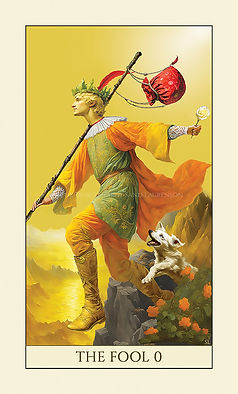
At fourteen, I found a book on tarot in the local library. I was not looking for prophecy, or instruction, or any grand system of belief. What caught me first was the image: Figures standing inside their small painted worlds, each one carrying a mood, a gesture, a weather of its own.
The cards seemed to speak before they explained themselves. A figure turned away, a hand was raised, water moved, a tower burned, a woman sat between pillars. I did not yet understand the structure behind them, but I understood that images could hold more than they said.
Two years later, I bought my own deck. I remember the physical fact of it: the slip of the cards, the smell of ink and paper, the strange authority of seventy-eight small rectangles gathered together. It was like finding a language I already half-recognised.

when the tower falls
There are times when the life already built does not simply change, but comes apart. Mine did. It happened suddenly, though not without history. Some part of me had known for a long time that the structure could not hold.
What followed was not freedom in any easy sense. It was fear, force, possibility, and consequence all at once. The old shape of things had gone, but no new one had yet appeared. I needed somewhere firm to stand, and art became that ground.
I was not remade overnight, and I have no interest in turning that period into a neat story of survival. It was more complicated than that. But it changed the direction of my life and my work. Art became the place where feeling, memory, instinct, and pressure could begin to take form.
the education
I entered art education later than most, after I had already lived, worked, parented, and carried responsibility for many years. I was not a blank page waiting to be formed by college. I had a life behind me, and that made the experience more complicated.
I began with a foundation in art, then completed a BA(Hons), and in 2001 received a scholarship for three years of postgraduate study in Fine Art at the Royal Academy in London. It was a privilege, but not a simple one. The education I received was largely conceptual: talk, theory, critique, argument, position, and the performance of certainty.
I learned a great deal there, though not always what was being taught. Much of the practical work had to be learned elsewhere, by doing it. Art school taught me more sharply how art is discussed, defended, dismissed, and framed; how class, confidence, language, and access shape what is seen and what is overlooked.
That knowledge stayed with me. It made me wary of fashion, suspicious of easy authority, and more committed to work that has to answer both to thought and to the eye. The Tribute Tarot comes from that position: not anti-intellectual, not nostalgic, but rooted in the belief that meaning must eventually answer to the image, the hand, and the finished thing.

what i kept doing
After the Royal Academy, I kept making. Exhibitions, drawings, commissions, art technician, teaching, workshops, gallery work, studio work — and long stretches when none of it was visible and none of it paid. Some work entered the world; much of it remained private. But the making continued.
Over time, the work became less separate from life and more like the structure running through it. There were studios, temporary rooms, borrowed spaces, kitchen tables, late nights, practical interruptions, and the ordinary business of keeping going. I drew, erased, built, repaired, and began again.
There is nothing glamorous in that process. It is repetition, failure, adjustment, and the slow calibration of eye, hand, and judgement. But it carries its own kind of freedom: a release from waiting to be approved, understood, invited, or saved.
That long continuation matters. The Tribute Tarot did not come from nowhere, and it was not made in a single burst of inspiration. It came from years of working with images, materials, symbols, stories, and the stubborn fact that making, however interrupted, had remained the one thing I kept doing.
a deck born in stillness
Then the world stopped moving. During the first year of COVID, in a top-floor flat on the South Coast of England, I found myself looking out over empty water with two strange gifts I had rarely been able to hold for long: time and silence.
For years, the idea of making a tarot deck had remained somewhere in the background. It was an old promise, made to myself long before I had the skill, space, or nerve to attempt it properly. The right moment never seemed to arrive. Then, abruptly, there was no movement, no ordinary noise, and nowhere else to go.
The days began to be measured less by clocks than by line, colour, adjustment, and return. Isolation brought its own clarity. The quiet was not empty; it became a working space. Symbols that had lived in memory for decades began to surface again, not as nostalgia, but as material waiting to be handled.
The Tribute Tarot grew from that stillness. Not quickly, and not as a single grand plan, but card by card, image by image, through research, drawing, revision, and long attention. The old figures returned with their weather intact: thresholds, warnings, mirrors, ordeals, comforts, and the stubborn demand to be looked at again.

the work begins
There were no deadlines, no audience, and no certainty that the work would become anything beyond itself. That mattered. The deck began without performance: only process, image, revision, and the need to keep returning to the cards until something in them held.
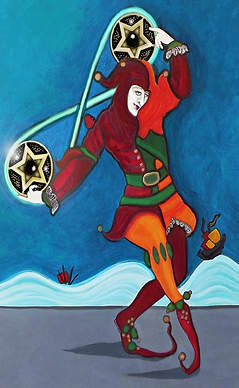
I tested materials, redrew, re-layered, corrected, and began again. Each image became a negotiation between homage and invention, between the authority of the old deck and the pressure of my own visual language. I was not trying to modernise the tarot, or to decorate it, but to find the narrow place where fidelity and independence could meet.
The work demanded restraint. Too much invention, and the cards lost their root; too much obedience, and they became imitation. The task was to listen closely to the original structure while allowing each image to arrive in its own weather: darker, more detailed, more psychologically charged, but still recognisably part of the same symbolic inheritance.
Card by card, the language began to settle. Figures, colours, thresholds, gestures, landscapes, shadows, and small symbolic details found their place. What emerged was not a reinvention of tarot, but a conversation with it — a deck made through attention, correction, and the long search for balance.

what remains
After decades of working, I no longer think of art as a refuge. It is more exacting than that. It is a way of staying in relation to the world: through attention, resistance, curiosity, doubt, and the repeated act of making something where there was nothing before.
There is no final arrival in that process. No summit, no clean conclusion, no point at which the work is finished with you. There is only the return: to the image, the hand, the material, the thought, the mistake, the correction, and the next thing asking to be made.
I have lived simply, moved when I had to, stayed when there was no choice, worked when the work was visible and when it was not. The continuity has not always been graceful, but it has been real. A life can be built from making and remaking, even when the ground keeps changing.
I am aware of the fortune in that. To have begun, to have continued, and to have lived long enough to see the work gather form is no small thing. Purpose, for me, is found there: in the trace left by each image, each card, each word, and each refusal to disappear.


the art of movement
Leaving and returning have both been ways of continuing. I have made art in temporary rooms, borrowed spaces, boats, rooftops, beaches, backstreets, islands and cities. Travel was rarely romantic for long.
It could be beautiful, difficult, frightening, funny and exhausting, often in the same day. What it gave me was not decorative inspiration, but a harder education in looking.
For the foreseeable future, I am back in the UK. I value the stability of being in one place, even if the country around me does not feel especially settled. After years of movement, I am allowing a life to gather around the work rather than loosening it again before it has properly formed.
The thread remains the same: old works revisited, new works begun, images altered, repaired and returned to.
One reason I made The Tribute Tarot was that it might travel further than I do — not as a monument, but as work made by hand, passing into other hands and carrying forward the quiet proof that the work continued.
What comes next is not fixed.
The Tribute Tarot is part of a wider body of work that continues through drawing, painting, writing, revision, and return.
I continue the larger practice from which this project grew.
More of my wider artwork can be found at: