

old friends - old foes
Enduring patterns of the human story
“We don’t invent archetypes.
We inherit them.” — C. G. Jung
the shape of the archetype
Archetypes are not inventions of the mind but inheritances of it. They live beneath reason — patterns that shape imagination, emotion, and instinct long before language names them. We meet them in myth, religion, politics, and family; they are the invisible scripts from which the human play is endlessly rewritten.
They are not merely symbols but forces, drawing events and people into recurring forms — creation, betrayal, sacrifice, renewal. The psyche moves through them as planets through orbit. When recognised, they become guides; when ignored, they rule unseen.Jung called them “images in the collective unconscious,” but they might more plainly be called the memory of being human. Every era discovers them anew, mistaking rediscovery for invention.
Archetypes endure because they answer the same human questions under different conditions. They shape how we recognise authority, desire, danger, belonging, and transgression long before we reason about them. Each archetype carries an inner tension — freedom and risk in the Fool, union and division in the Lovers, withdrawal and wisdom in the Hermit.

These are not fixed roles but recurring pressures within the psyche, activated whenever circumstance calls them forth. We meet them not as abstractions, but as lived dilemmas: when to speak or remain silent, when to commit or refuse, when to stand apart or step forward.
What changes across time is not the archetype itself, but the costume it wears. Where myth once placed these figures among gods and monsters, modern life disperses them through institutions, media, and personal identity. The Fool may now appear as the disruptor of systems, the Hermit as withdrawal from noise rather than society, the Magician as both creator and manipulator of meaning.
The tarot is one of their languages — seventy-eight mirrors of our shared story, shifting costume yet constant in essence. Each card, each myth, each moral question is a fragment of this vast inheritance: the shared memory that keeps us tethered to meaning even as culture dissolves and reforms.
The archetype survives by adapting its surface while preserving its inner structure. To recognise this shape beneath appearances is not nostalgia — it is discernment: the ability to see pattern rather than novelty, inheritance rather than invention.
the collective mirror
If the Shadow shows what we refuse to see, the archetype reveals what we repeat. It is the blueprint of both virtue and vice. The same heroes and villains, mothers and martyrs, return across centuries, testing how we handle the power they represent. They are old friends and old foes because they are never truly gone — only renamed.
To meet an archetype is to face an inner pattern that has turned outward. The tyrant on the stage, the saint in the square, the trickster in the feed — each is an image drawn from the same moral well. We recognise them instinctively because they live in us.
Archetypes don’t moralise; they reflect. They show the scale of our capacity, the reach of our error. They are the theatre of conscience, reminding us that history is not linear but cyclical — that progress without reflection merely repeats the ancient play in brighter lights.
When we call something timeless, we are really naming the persistence of pattern. The task is not to escape these forms but to see them clearly, to act within them rather than be acted upon.


the human theatre
Every life plays out as a cast of characters — hero and fool, lover and judge, creator and destroyer. We step between these roles daily, often without knowing which mask we wear.
Archetypes are not otherworldly beings but psychological functions: the ways we make sense of conflict, purpose, and belonging.
In childhood we begin as The Fool, open to experience. In youth we call upon The Magician’s will, The Lovers’ risk, The Chariot’s drive. Adulthood brings The Hermit’s solitude, The Tower’s fall, and — if we are lucky — Temperance.
The pattern repeats across generations, each life a retelling of the same ancient script.
This isn’t fate but opportunity. The archetype offers form, not sentence. To recognise it is to act consciously within the myth rather than unconsciously enact it.
The tragedy is not that we play roles; it’s that we forget we are actors. To live with awareness is to step off the stage for a moment, see the costume, and choose which part still fits.

archetypes in motion
When archetypes move unconsciously, they rule through repetition. When seen, they offer choice. The Fool can become The Magician; the Lover can evolve into The Hermit. The theatre of psyche is not punishment but rehearsal — each act a chance to remember that recognition itself is the first form of redemption.
The archetypes evolve as culture does, changing dress but not design. The hero no longer wears armour; he wears ambition. The priest becomes therapist, the oracle becomes influencer, the tyrant becomes brand. The mythic theatre persists, replayed in the light of modern spectacle.
What was once enacted in temple or battlefield now unfolds in screen and story. Technology multiplies the masks, yet the moral weight remains. The archetype adapts to survive our inventions: the Trickster finds a new voice in viral culture, the Devourer feeds on distraction, the Magician manipulates algorithm instead of element.
These figures remind us that progress doesn’t abolish pattern — it accelerates it. Each invention revives an older impulse in sharper form. The wheel of myth still turns, only faster, its centre harder to hold.
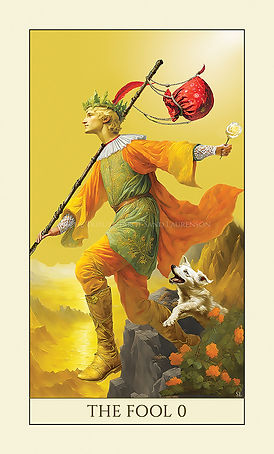
example of the archetype
— the fool 0
Across centuries, the Fool has appeared in many guises — comic, tragic, divine. In medieval courts, the jester was both entertainer and conscience, licensed to speak truth to power under the mask of folly.
The Fool is the archetype of renewal — the blank page, the unwritten life, the step into possibility. He carries no doctrine, only trust. Yet beneath the innocence lies paradox: the Fool is both the most foolish and the most divine, the only one who moves freely between worlds.
Psychologically, the Fool is the beginning of individuation — the moment awareness takes its first step into experience. He is the soul before role, the potential that precedes pattern. Every journey through the tarot — and through life — begins and ends with him.
In the modern age, his courage becomes our question: can innocence survive information? Can openness exist without naivety? The Fool answers by walking — neither resisting nor retreating, but trusting that meaning is made in motion.

fools we recognise
In Shakespeare, figures like Feste and Lear’s Fool stand outside the drama’s hierarchy, seeing with moral clarity what their masters cannot. Theirs is the Fool’s privilege — to reveal contradiction without accusation, to expose pride through wit.
Earlier myths carry the same pattern. The Celtic trickster, the Greek satyr, and the wandering Parzival all move through ignorance toward insight. Dionysus, the god of ecstatic inversion, embodies the same paradox: madness as revelation, chaos as renewal.
Modern culture still replays this archetype, though the costumes have changed. Chaplin’s Tramp, Forrest Gump, and Saint-Exupéry’s Little Prince continue the lineage: outsiders whose simplicity unsettles the rational world around them.
Each reveals what civilisation forgets in its cleverness — that vision often comes through humility, and that detachment from convention can restore perspective.

conclusion
Archetypes are old friends because they remind us who we are; old foes because they remind us how easily we forget. They are neither moral nor immoral, but they demand a moral response — awareness, restraint, and the courage to see ourselves in their reflection.
The tarot gives these patterns form: a language of images through which we can think ethically without preaching. To read them well is to practise discernment — the quiet work of separating symbol from superstition, story from self.
The archetype is not a relic of the past but the grammar of the present. It speaks through every choice, every conflict, every act of creation. The more consciously we recognise its voice, the freer we become to answer it wisely.
What endures is not only the image but the pattern it reveals. These figures — hermit, fool, lover — live on because we do. To meet them is to remember the old stories still speak in our own voice.