here & now
“A time is coming when men will go mad,
and when they see someone who is not mad, they will attack him, saying,
'You are mad; you are not like us.”
― St. Antony the Great

the shape of the present
This section turns the cards toward the weather we live in now — not as escape but as mirror. We are fluent in information but starved for meaning; swift in reaction but slow in thought. The modern world doesn’t abolish the old archetypes — it repackages them as lifestyle, content, or brand.
The ancient symbols still speak, but the voices are scattered across too many frequencies. Tarot once reflected the cosmos as a single story — human life nested within pattern and consequence. Now we inhabit an age of disconnection: speed without direction, exposure without intimacy, progress without purpose. The task is not to mourn what’s lost but to read where those fractures show. The archetypes have not died; they’ve adapted, sometimes into parody.
Every age invents its own illusions. Ours are built from light — the glow of screens, the endless scroll of affirmation. But this luminosity conceals a darkness of comprehension. We see more than any generation before us, yet understand less. The digital flood offers attention without awareness, visibility without vision. These are not new failings, only modern disguises of older wounds.
What the Tribute Tarot offers is pause — a way to hold the moment still long enough to notice what repeats. The cards are not moral sermons but diagnostic tools: they trace the recurring shapes of human error and endurance. The same patterns that once governed myth now sketch the circuits of modern psychology.
the dark night of the soul
These pages look at how those patterns of meaning — pain, isolation, abundance, folly — still play out in subtler forms: the anxiety of noise, the poverty of attention, the fatigue of endless choice. The cards don’t condemn it. They hold their mirror steady so that what is diffuse might take shape again.
The human mind, wired for rhythm and pause, now spins at the speed of the feed. There is no longer a difference between being haunted and being over-notified.
The old dream of “knowing everything” has metastasised into an obligation to react to everything. What once lived in private conscience now parades as public performance — outrage, confession, fatigue, all flattened into spectacle. The body is exhausted, but the mind mistakes exhaustion for engagement.
We live under a new insomnia: the endless waking state of those who cannot afford to stop watching. The screen becomes a mirror that doesn’t close. It breeds an empathy stretched too thin to care deeply, and a loneliness too loud to hear itself.
The first act of resistance is stillness: to retreat from the theatre long enough to remember how to think. The nightmare has no power when met with awareness. Reflection — honest, unbroadcast, unmarketed — is how the mind relearns sleep.
Binding the card: The IX of Swords shows mind awake against its will — and asks for the courage to turn from glare to grace.

we are together alone
Connection has never been easier — or lonelier. We have built networks so vast that we’ve forgotten how to inhabit a single room. We mistake proximity for intimacy, reaction for relationship.
This is not only emotional poverty; it is moral and civic. A world that has outsourced compassion to systems and slogans forgets the face-to-face. When every transaction is mediated through performance, even kindness risks becoming content.
Solitude and loneliness are not the same. Solitude restores; loneliness corrodes. Yet the two are constantly confused, as if being alone must mean being deficient. Many have lost the art of speaking face to face — of hearing hesitation, tone, and truth in a living voice.
Our conversations are edited before they begin, shaped by fear of misstep and the need for approval. Speech without presence becomes a kind of moral anaemia: talk that circulates but carries no life.
The remedy isn’t communication through content, it’s presence. Being with, not for — means standing beside another - the quiet skill of staying present without turning away: — the ability to care without reward, to hold another’s gaze without turning away.
lost signal
Disconnection in the Age of Connection
We speak more, but say less. Every exchange is translated through machine syntax — filtered, corrected, optimised for consumption. Meaning survives the process, but barely. We’ve become adept at transmission yet incapable of true conversation.
We trust the machine’s voice over our friend’s. It’s quicker, cleaner, unambiguous — but also hollow. It offers data in place of dialogue, and we accept it because it feels safer than confrontation. We call this progress, but it is a trade: language stripped of nuance in exchange for control.
The more we connect, the less we understand. Ludwig Wittgenstein once noted, “If lions could speak, we would not understand them.” We have reached that point with ourselves. The technology speaks our words, but we no longer recognise the difference between human comprehension and simulation.
What happens to a civilisation that can communicate instantly but not always truthfully? When translation becomes transformation — when the word becomes code, and code becomes authority — the cost is not only language but intimacy itself.

example of modern times
the magician i
In earlier ages, The Magician stood between the elements — a conduit between heaven and earth, his wand raised to summon meaning into form. He embodies the energy of air: quick, mercurial, charged with intellect and movement. Yet when that current turns inward, the clarity of mind becomes the theatre of ego. The trickster side of the Magician emerges — half-alchemist, half-conjurer — dazzling the eye to disguise the emptiness of the act.
In the present tense, that gesture has shifted. Power still moves through symbol, but now through light, code, and persuasion. His table of tools has become a desk of devices; the circle of invocation, a signal loop. The archetype survives — but the medium has changed its ethics.
Yet even in this corrupted form, the Magician’s principle remains: the will to connect, to translate thought into action, to make meaning material. His shadow teaches discernment — that knowing how to make is not the same as knowing what should be made. To act with integrity in an age of illusion is the hardest alchemy of all.
closing reflection
Ours is an age ruled by these magi of appearance. Influence replaces understanding; charisma eclipses competence. The “black magicians” are not robed in mystery but lit by ring lights — politicians, pundits, prophets of the feed, conjuring belief through repetition rather than truth.
Here and Now is about reading the weather of the world and gathering the fragments scattered by speed — the insomnia of attention, the poverty of sincerity, the digitalised soul. This is where the tarot’s old architecture meets modern weather, where the same archetypes speak in altered tongues.
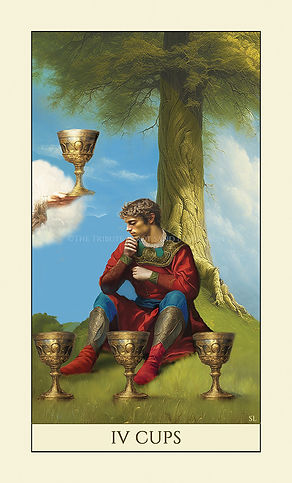
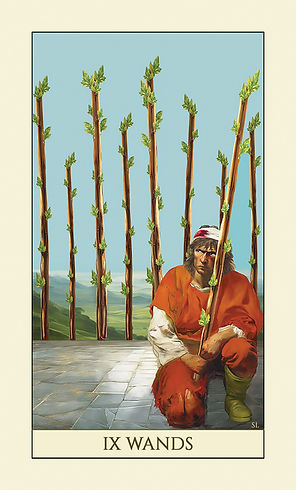
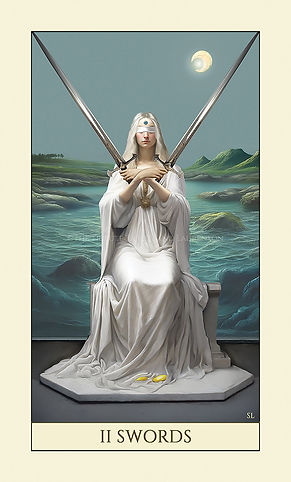
Each section on this page listens to that change: the IX of Swords tracing the fatigue of constant awareness, the IV of Cups depicting abundance turned anaemic, the II of Swords holding silence against the algorithmic din.
To help understand where these fractured patterns come from — the gods, myths, and ancestral shapes behind them — continue into The Archetypes. To confront the distortions they cast upon us now, return to The Shadow.