

honouring pamela
Acknowledgement without sentimentalising.
Smith as image-maker not decorative footnote.


honouring pamela colman smith
a fact-based portrait - summary
Birth and Family Background
Corinne Pamela Colman Smith—known as “Pam” to family and friends—was born on 16 February 1878 at 28 Belgrave Road, Pimlico, London. Her father, Charles Edward Smith, was an American merchant from Brooklyn (grandson of Brooklyn mayor Cyrus P. Smith). Her mother, Corinne Colman, also hailed from a prominent Brooklyn family of English descent. Both lines were firmly rooted in white, Anglo-American society.
Early Years: England, Jamaica, and New York
Shortly after Pam’s birth, her father’s work took the family to Kingston, Jamaica. There she absorbed local folklore—later publishing Annancy Stories (1899) and Chim-Chim (1905)—but these years reflect her residence and literary interest, not her ancestry. By 1893, following her mother’s death, Pam returned to Brooklyn and enrolled at the Pratt Institute. After her father’s passing in 1899, she settled in London to pursue her art.
Artistic Lineage and Influences
Pamela’s maternal Colman family were long-time Swedenborgians (followers of mystic Emanuel Swedenborg) and included writers and Hudson River School painters. Her great-granduncle ran one of New York’s earliest art galleries. This rich cultural heritage helped shape her visual imagination and literary interests.
Stage Persona and Folklore
In London, Smith cultivated a “Pixie” persona—donning Creole costumes, performing Jamaican folktales, and editing her journal The Green Sheaf. While she wore Afro-Jamaican dress and dialect for stage presentations, this was an artistic performance rather than evidence of mixed-race heritage. Contemporary records—birth certificates, censuses, family correspondence—consistently identify her as white.
Tarot and the Rider–Waite Deck
In 1909, A. E. Waite commissioned Smith to illustrate a new 78-card tarot deck. Her Art-Nouveau–inspired designs for both Major and Minor Arcana transformed tarot symbolism forever. Despite her signature monogram on each card, she received little credit or financial reward at the time and since.
Later Life and Legacy
After a successful 1907 exhibition at Alfred Stieglitz’s Gallery 291, Smith grew disillusioned, converted to Catholicism in 1911, and ultimately retired to Bude, Cornwall. She died in 1951 in financial hardship, her grave unmarked until recent renewed interest in her work.
Why the Mixed-Race Myth?
Pamela’s childhood in Jamaica, her folklore publications, and stage performances fueled rumors of mixed ancestry. In fact, every reliable genealogical and archival source confirms her Anglo-American parentage. The persistence of the myth reflects both her dramatic persona and modern desires to diversify historical narratives—but it remains unsupported by the historical record.
Pamela Colman Smith: Artist First
Throughout her life, Smith was celebrated by peers—from W. B. Yeats to Bram Stoker—and today her artwork is rightly hailed as the definitive visual language of tarot. By grounding her story in documented fact, we honour both her creative genius and her true heritage. While contemporary discussions sometimes emphasise an artist’s race or sexuality, it’s essential to remember that Pamela Colman Smith’s enduring significance lies above all in her work.
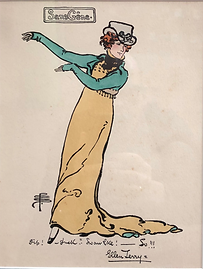
All images are by Pamela Colman Smith.
artistry Before identity
Vision and Craft
Smith’s genius was in translating mystical concepts into clear, evocative imagery. Her mastery of line, composition and colour made the Rider–Waite deck accessible to generations of readers. These technical and creative achievements stand on their own merits—regardless of who she was or whom she loved.
Female Perspective
As a woman working in the early 20th-century art world, Smith broke important ground. Her success at Alfred Stieglitz’s 291 gallery and her collaborations with Yeats, Terry and Stoker reflect her talent and determination in a male-dominated field.
separating from fiction
Race
Conclusive genealogical records show Smith was of Anglo-American parentage. Her childhood in Jamaica informed her folklore collections, but does not equate to mixed-race ancestry. Presenting her as “black” misrepresents both her true background and her authentic achievements.
Sexuality
Smith’s close relationships—most notably with her housemate Nora Lake—have led to speculation, but no concrete evidence confirms a lesbian identity. Whether she was gay or not, her personal life remains secondary to her art.

why identity myths persist
Desire for Representation
In striving to find role models for under-represented groups, some narratives have stretched beyond the historical record. While some maybe well-intentioned, such myths risk overshadowing Smith’s real contributions.
Theatrical Persona
Smith’s adoption of costumes and folklore performance cultivated an exotic, “other” persona. Over time, this theatricality has been mistaken for personal heritage.

art as universal language
Universal Language
Tarot is a symbolic system that speaks to the human experience—joy and sorrow, freedom and bondage—across cultures and eras. Smith’s images endure because they tap into shared archetypes, not because of her race or private life.
Honouring the Work
By focusing on Smith’s creativity, technique and imaginative vision, we preserve the integrity of her legacy. Her role as the defining “voice” of modern tarot is best honoured by celebrating the art itself.

Colman Smith’s achievements as an illustrator, storyteller and designer stand on their own merits.
Grounded in documented fact—birth records, exhibition histories and archival correspondence—we acknowledge her true heritage while celebrating her technical mastery and visionary imagery.
In the end, Smith’s tarot remains a testament to creativity unbounded by identity. Let us honour her by engaging with her work in all its depth, free from myth or modern agendas.
lineage and foundation
The Tribute Tarot holds closely to Pamela Colman Smith’s original deck. Most figures remain in place. The gestures, proportions, symbols — all adhere to her compositions, some, such as The Devil XV may be slightly re-interpreted. It's these subtle changes that can bring deeper clarity and meaning. What has changed significantly is how clearly those elements are seen.
The focus of this deck is not reinvention, but refinement: enhancing line, tone, and compositional depth to allow the original meaning to come forward with greater clarity.
Much of the symbolic material in Smith’s cards has long been flattened or obscured — by poor reproductions, oversimplified redrawing, or stylistic dilution.
This deck works to recover that detail: not by adding completely new imagery, but by adding or re-emphasising what was already there. The Christian references, the traces of Grail legend, the echoes of Egyptian, Indian, and medieval sources — these existed in her work.
The structure remains faithful, small changes have been made: a realignment of a hand, a shift in balance, a clarified expression. All changes were made in service of symbolic coherence and narrative precision. You can read more about those refinements in the Changes Within the Deck section below.
This is not a reinterpretation. It is a restatement — done with care, visual discipline, and a long view. The story remains unchanged. The archetypes still speak. This version simply allows them to be seen more clearly.


changes within the deck
While the composition of each card remains symbolically faithful to Pamela Colman Smith’s intent, the Tribute Tarot restores balance and realism through subtle shifts in tone, gesture, setting, and proportion. The aim was never to modernise, but to recover structure and truth of expression.
For example - in the VII of Cups, Smith’s figure stands before a collection of spectral visions. They shimmer — half real, half dream — as if temptation were staged upon a cloud. In my Tribute Tarot, that same moment unfolds inside a chamber of desires: The illusions remain, but the setting exposes them — the mind confronted by its own constructions.
This approach extends throughout the deck. The III of Cups becomes less ceremonial, more human; the IX of Swords gains quiet surrender rather than despair. Faces and hands are more deliberate, the light more directional, and the colour tempered to carry subtle depths. These refinements are not interpretive gestures but restorative ones — the careful redrawing of meaning through proportion, realism, and restraint.
The result is a deck that fundamentally holds to the original form while reasserting its moral centre — clarity over display, meaning over style.

deeper dive
Pamela Colman Smith’s place in the history of illustration and tarot is secure. Her images reshaped the visual language of tarot in ways that continue to influence readers and artists more than a century later. Grounded in documented fact—birth records, exhibition histories, and archival correspondence—we can recognise both her true heritage and the extraordinary skill that informed her work.
In the end, Smith’s achievement rests not in speculation about identity, but in the clarity of her artistic vision. She created a symbolic language capable of speaking across cultures and generations. By approaching her work with attention to craft, imagination, and symbolism, we honour the enduring power of the images themselves.
Art ultimately moves beyond the particulars of biography. While the circumstances of an artist’s life may inform their work, the lasting strength of a painting or illustration lies in its ability to evoke shared human experience. Smith’s tarot imagery continues to resonate because it draws upon archetypal themes—hope and loss, transformation and renewal—that belong to the collective imagination.
To recognise this is not to diminish the artist, but to restore focus to the work itself. Pamela Colman Smith’s legacy is the luminous body of images she left behind. When we engage with them thoughtfully and attentively, the conversation she began continues.
want to know more about pamela?
Below is a curated list of reliable, in-depth sources—both print and online—covering Pamela Colman Smith’s life, work, and legacy. These will deepen your understanding of her true heritage, her art outside the Rider–Waite deck, and her place in early-20th-century art and occult culture.
1. Dawn R. Robinson, Pamela Colman Smith: Tarot Artist (Fonthill Media, 2020)
A richly illustrated monograph and catalogue raisonné that draws on newly uncovered letters, diaries and gallery records. Robinson carefully traces Smith’s biography—including her Pratt Institute years—and provides high-quality reproductions of both tarot and non-tarot works.
2. The Pamela Colman Smith Foundation (pamcolmansmith.org)
The official home for archival documents, letters, sketchbooks and commissioned essays by tarot scholars. Maintained by custodians of Smith’s estate, it offers primary-source materials and exhibition histories.
Contacts: archives@pratt.edu | +1-718-636-3500
Collections: Student directory photographs (1893–1895), “Tickets of Leave” yearbooks, and early application portfolios.
Archivists can provide digital scans of studio portraits and early drawings, illuminating Smith’s formative training.
4. Beinecke Rare Book & Manuscript Library, Yale University
Online Catalog:
Search for “Pamela Colman Smith” to locate correspondence, sketchbooks and exhibition catalogues.
Contacts: beinecke.library@yale.edu
Yale holds Smith’s personal letters and some unpublished illustrative work, invaluable for biographical fact-checking.
5. Stuart R. Kaplan, The Encyclopedia of Tarot Volume III (U.S. Games Systems, 1999)
Kaplan’s multi-volume study remains a cornerstone of tarot scholarship. Volume III includes a detailed chapter on the Rider–Waite–Smith deck, with background on Smith’s collaboration with A. E. Waite and comparisons to earlier tablier decks.
6. ThoughtCo: “Pamela Colman Smith: The Artist Behind the Tarot”
An accessible, well-sourced overview of Smith’s biography, artistic training and tarot work. Includes citations to census records and family-history details confirming her Anglo-American parentage.
7. American Renaissance Tarot Blog: “Pamela Colman Smith: American”
A meticulously researched post by tarot historian Micki Pellerano, debunking mixed-race myths and tracing Smith’s Brooklyn and London connections.
8. Marguerite Murphy, “Pamela Colman Smith and the Early Golden Dawn Tarot”, EsotericaJournal, Vol. 12 (2021)
A peer-reviewed article analysing Smith’s symbolic vocabulary in light of Hermetic Order rituals, with careful attention to her Swedenborgian background and performance persona.
9. Tarot Thrones Blog: “The Real Story of Pamela Colman Smith”
An illustrated web essay examining family trees, newspaper notices and gallery archives, offering step-by-step genealogical proof of her Anglo-American lineage.
10. “At the Dawn of a New Age” Exhibition Catalogue, Whitney Museum of American Art (2024)
Features essays by curator Barbara Haskell on Smith’s pre-tarot watercolours—such as The Wave (1903) and The Blue Cat (1907)—and contextualises her within early American Modernism.