

artistic influences

Not "inspiration board," but visual ancestry:
Blake, Goya, theatre, symbolic image, sacred art, printed image, costume, gesture, composition.


BLAKE, DORÉ, AND THE VISUAL INHERITANCE
Before my years at the Royal Academy of London I felt an instinctive kinship with artists who refused to separate craftsmanship from conviction. Both Blake and Gustave Doré stood for an ideal in which art was not decorative illustration, but a structure for moral pressure: a way of giving thought, feeling, fear, faith, and doubt visible form. Their works are not simply images, but visual arguments — forms in which drama, architecture, gesture, and light carry the force of conviction. It was within that lineage that I found the logic for my own re-imagining of Pamela Colman Smith’s medieval-inspired tarot: one built not on novelty, but on renewal through fidelity.
Every artist works within a chain of inheritance. For me, influence has never been a matter of borrowing, but of recognition — the moment one finds one’s own restlessness reflected in another’s struggle. Blake’s spiritual defiance, his refusal to separate the sacred from the sensual, mirrored my own resistance to the cool detachment of conceptual orthodoxy. Doré’s architectural gravitas — his cathedrals of shadow and stone — offered a counterbalance: the intellect shaped through discipline and the patience of light.
The Christian iconography both artists drew upon was never doctrine to me, but visual language: a charged system of structure, suffering, judgement, radiance, fall, and return. Their art, though separated by time, spoke the same dialect of faith and doubt: Doré’s penitent grandeur echoing Blake’s visionary blaze. In that tension — between illumination and structure, revelation and restraint — my own deck took shape.

WILLIAM BLAKE: VISION AND RESISTANCE
William Blake (1757–1827) trained at the Royal Academy of London from 1780 to 1784, studying the classical techniques that underpinned European art. Disenchanted by the Academy’s strictures—its emphasis on rational replication over spiritual insight—he departed early, choosing instead to forge a solitary path as poet-engraver and prophet.
His Christian faith lay at the heart of this rebellion: he perceived the Church’s institutional dogma as a constraint on true vision, yet he remained deeply invested in Scripture’s symbolic richness.
Blake’s illuminated books—Europe a Prophecy, Milton’s Paradise Lost and Jerusalem—recast biblical narratives through personal mythologies, using fluid, calligraphic lines and stark chiaroscuro to evoke the soul’s struggle between reason (Urizen) and creative fervour (Orc)

William Blake’s influence weaves seamlessly through the deck, evident in the interplay of figurative and symbolic elements. Like Blake, I sought emotional resonance through potent visual metaphors.
Blake’s symbolic intensity encouraged me to trust image, gesture, and atmosphere to carry psychological and intellectual weight, without reducing everything to explanation. His ability to capture profound emotional intensity inspired me to imbue my figures with palpable humanity.
I echo Blake’s emphasis on expressive gesture and emotional intensity: faces rendered with fine, arching brows; limbs poised between tension and release. Each figure carries emotional and symbolic weight—hand raised in benediction, a subtle halo of light around the head—reminding readers of the Tarot’s roots in Christian iconography and the medieval tradition of spiritual allegory

gustave doré: architect of divine drama
Gustave Doré was born on 6 January 1832 in Strasbourg, then part of France’s Alsace region. He lived in an era of industrial upheaval and renewed interest in medievalism. His engravings for The Divine Comedy, Paradise Lost, and Don Quixote brought baroque grandeur to mass audiences, blending meticulous line-work with dramatic contrasts of light and shadow.
Doré’s Catholic imagination gave his work a vast moral architecture: deep blacks, glimmering highlights, monumental scale, and scenes where judgement, terror, mercy, and awe occupy the same space.
In The Tribute Tarot, Doré’s influence appears in the architectural backdrops — vaulted arches, crumbling battlements — and in the sculptural modelling of each form. Shadows fall like carved relief, giving scenes a cathedral-like solemnity. I wanted to evoke that same sense of charged space: a card is not merely a picture, but a constructed world where architecture, atmosphere, symbol, and feeling gather force.
The interplay of light and human shadow connects Doré’s visual drama with Smith’s medieval atmosphere — and with my own wish to let inherited symbolism speak in a contemporary key.

THE SHARED GRAVITY
Doré’s monumental architecture and Blake’s visionary intensity became part of the spine of The Tribute Tarot. Their shared gravity shaped my approach to image as balance: Blake bringing fire, pressure, and imaginative force; Doré bringing structure, scale, shadow, and solemnity.
In my cards, Doré’s sense of weight grounds Blake’s volatility, while Blake’s fervour keeps Doré’s architecture from becoming inert. One reminds the hand of proportion; the other reminds the image of purpose. That tension became part of the discipline of the deck: to work within measure without emptying the image of meaning.
Both artists worked as though image-making carried moral consequence. They did not treat art as decoration, but as a way of giving thought, fear, faith, doubt, and longing visible form. I found that ethic indispensable while building this deck.
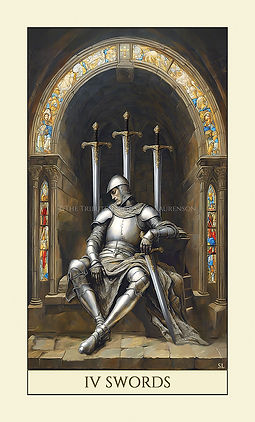
Influence alone remains inert without translation. My intention was never to mimic their language, but to let their grammar of drama, structure, light, shadow, and symbolic pressure find a contemporary inflection — while remaining in clear homage to Pamela Colman Smith.
The resulting images are not copies, but correspondences: Blake’s intensity lending heat to Doré’s structure; Doré’s gravity giving weight to Blake’s flame. The Tribute Tarot stands in that space — a conversation across centuries, held inside the discipline of image, architecture, gesture, and form.
The deck is also only one part of a larger body of work. Beneath it lies a wider practice — painting, sculpture, drawing, and conceptual experiments developed over many years — what I call The Well Beneath, the deeper ground from which this project emerged.