
archetype & tradition
“Justice is based on values. And those change every generation.”
Eiichiro Oda
Justice is the archetype of measure: the attempt to weigh action against consequence and to bind power to principle. Unlike the Emperor, who asserts authority, or the Hierophant, who codifies belief, Justice stands between them as correction. She does not rule by command or faith, but by reckoning. Her concern is not comfort or mercy, but truth rendered legible.
Across myth, Justice appears as Ma’at weighing the heart against the feather; as Dike, reporting human transgression back to Olympus; as Astraea, abandoning the world when law collapses into violence. In each guise, Justice is not invented by rulers but recognised by them — a calibration between order and excess that even kings cannot finally escape.
Placed at XI, Justice functions as a hinge in the Major Arcana. Power has been gathered; will has been tested. Now comes accountability. Justice does not ask what was intended, but what was done — and what followed. She promises no absolution. She promises proportion.
Historically, every civilisation has attempted to give Justice form: Hammurabi’s code, Roman jurisprudence, Magna Carta, modern charters of rights. That these systems must be continually revised is not failure but proof of the archetype’s demand. Justice is never settled. It must be re-asserted, generation after generation, against corruption, sentiment, and force.

setting the scene
“Justice will not be served until those who are unaffected are as outraged as those who are.”
Benjamin Franklin
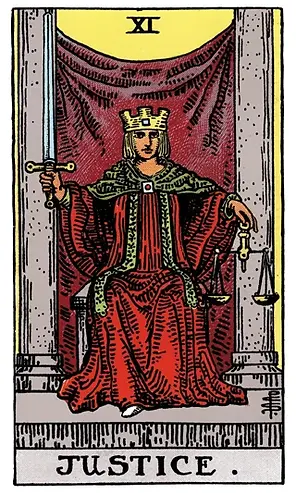
In my card, Justice sits frontal and immovable upon a squared stone plinth. Two columns frame her throne, suggesting the threshold of process: entry requires exposure. Behind her falls a violet and crimson drape, heavy with folds, concealing passion so that deliberation may be clear. Steps rise toward her dais: ascent is permitted, but not casual — those who approach must climb toward scrutiny.
The light of the scene is a clear gold, not dawn nor dusk, but the steady illumination under which evidence cannot hide. She does not avert her gaze, nor lower it, but looks straight ahead with composure unsoftened. Everything in the stage-setting makes the point: this is not a throne of charisma, but of measure.
Even the architecture is symbolic: the squared plinth speaks of truth that cannot be rounded off, the columns echo the gateways of Solomon’s temple. The whole is theatre, but a theatre of proportion.
Note that the sword extends beyond the frame of the card, a motif that recurs often throughout my deck. That it is double-edged reminds us that judgement always cuts both ways: the one who judges is also measured. The sword’s extension beyond the card’s frame insists that justice does not remain contained within ritual or courtroom. Its consequences spill into the world, long after the verdict is spoken.
esoteric correspondences
“I have never made but one prayer to God, a very short one:
Oh Lord, make my enemies ridiculous. And God granted it." Voltaire
Astrologically, Justice corresponds to Libra, sign of balance, ruled by Venus. This is not sentimental harmony but active equilibrium — restraining brutality, proportion tempering excess. Venus here does not indulge; she moderates.
In Hebrew mysticism, Justice aligns with Lamed, the goad or staff: correction rather than punishment, motion toward alignment. On the Tree of Life, the path bridges Severity and Beauty — justice yoked to the heart, not divorced from it. Alchemically, Justice echoes the careful adjustment between dissolution and coagulation. Too much heat destroys; too little leaves matter inert. Justice is the measure that allows transformation without collapse.
Her instruments are exact. The sword is heavy and vertical: reason cutting cleanly through distortion. The scales are horizontal: reciprocity, cause and effect, self weighed against other. Together they form a cross of judgment — an emblem older than Christianity, symbolising the tension between transcendence and relation. Justice is therefore not only courtroom but cosmology: the law of measure woven into existence itself.
COSTUME & MOTIFS
““I should like to be able to love my country and still love justice.”
Albert Camus
Justice is clothed in deliberate restraint. The deep red of her robe signals action, consequence, and blood rightly acknowledged — not hidden, not sentimentalised. This is not the red of passion but of responsibility: what has been done cannot be undone. The green that edges and tempers it speaks to life, renewal, and continuity, insisting that justice is not annihilation but correction. Together these colours hold tension rather than harmony — judgment held against the ongoing need for human survival.
Her crown is spare, unadorned, almost austere. Authority here is not theatrical. There is no flourish, no excess ornament, nothing to distract from function. Justice does not persuade; she measures. The absence of decoration rejects charisma as a source of legitimacy. Power is justified only insofar as it is proportionate. The crown weighs lightly because it is not inflated by ego.
The scales are suspended, not fixed — a critical detail. Balance is not a static condition but an ongoing act of calibration. They require attention, adjustment, vigilance. The sword, upright and unsheathed, cuts vertically through distortion. It does not threaten outwardly; it clarifies inwardly.

archetype & psychology
“Life is never fair, and perhaps it is a good thing for most of us that it is not.”
Oscar Wilde
Psychologically, Justice is the function of truth-telling. She arises when rationalisation cracks, when self-deception cannot sustain itself, when the psyche insists on proportion. She is the inner witness that can hold both sides at once — empathy for the person, clarity about the act.
She appears as the breakthrough moment: when denial collapses, when the excuses end, when the account must be faced. She is painful but liberating — the psyche regaining its balance.
In individuation she demands congruence: the outer life must match the inner oath. She represents the moment we accept responsibility not out of shame but out of integrity. She also warns of her shadow: the temptation to moral omniscience, the refusal to recognise bias, the psyche’s hunger for verdict without nuance. Justice is thus the archetype of clarity — but also the test of whether clarity will be endured.
justice xi
the measure and the sword
"Never pray for justice, because you might get some." - Margaret Atwood
upright Meaning
“We are not to simply bandage the wounds of victims beneath the wheels of injustice, we are to drive a spoke into the wheel itself.”
Dietrich Bonhoeffer
Upright, Justice signals process done in daylight. It points to transparency, fairness, decisions rooted in evidence. In relationships it demands reciprocity, contracts honoured, boundaries respected.
In work it may indicate audits, rulings, or agreements that clarify what has been obscured. Spiritually it is the invitation to live congruently — to allow truth into action.
The presence of Justice often announces that excuses will not hold. It favours truth-telling even when costly, outcomes that may be stern but proportionate.
Upright, she is the card of disclosure: the time when accounts are balanced and the record must stand.
It may also appear when an individual is asked to stand as arbiter: the role of mediator, adjudicator, or witness. The upright card affirms that this is possible when impartiality is held.

reversed meaning
“To be wealthy and honored in an unjust society is a disgrace.”
Confucius
Reversed, Justice warns of crooked balances. It may show bias disguised as fairness, or judgment warped by fear. Personally, it may be self-justification: the refusal to see one’s role, the projection of guilt onto others.
In relationships it can appear as double standards — one rule for the self, another for the partner. In institutions it signals corrupted processes: courts influenced by ideology, tribunals staging verdicts for political theatre.
Reversed also speaks to the psychology of denial: the avoidance of responsibility by drowning in excuses or moral fog. At its worst it is paralysis — endless weighing with no decision, hiding behind procedure to avoid clarity. Yet even inverted, Justice demands acknowledgement. It insists that distortion be recognised before proportion can return.
Reversal can also signal the misuse of compassion: mercy that becomes indulgence, forgiveness offered before truth is admitted. The card warns that love without clarity is as unjust as law without mercy.
here and now
“There is no crueller tyranny than that which is perpetuated under the shield of law.” Montesquieu
In the present moment, Justice confronts us not with abstract ethics but with personal complicity. Where have rules replaced thought? Where has correctness supplanted truth? The card asks whether our judgements are alive or merely inherited—whether we are weighing, or simply repeating.
In an age saturated with systems, policies, and frameworks, it is easy to mistake alignment with procedure for moral clarity. Justice here insists on something harder: active discernment. It demands the courage to stand between extremes without retreating into slogans or absolutes.
Psychologically, this is the moment of reckoning with one’s own internal court. The inner judge may be harsh, inflexible, or spectacularly unjust—sentencing parts of the self without appeal. Justice asks whether that judge is fit to rule. Are the standards humane? Is evidence actually examined, or merely assumed? In the here and now, the work of Justice is often unglamorous and solitary: revising a verdict, reopening a case, admitting error. Balance is not achieved once, but continuously renegotiated.
Ethically, Justice now is about restraint as much as action. Knowing when not to strike. Knowing when enforcement causes more harm than mercy would. This is not sentimentality; it is proportionality. Historically, grounded justice has always understood this tension. Roman law, biblical judgement, medieval equity—all wrestled with the same problem: how to uphold order without becoming monstrous. The card reminds us that justice without humanity becomes tyranny, but humanity without structure dissolves into favouritism. The work is to hold both.
Finally, Justice in the present demands personal cost. To judge truthfully is to risk isolation. To refuse false balance is to invite accusation. To act justly may mean losing status, approval, or safety. This is why Justice is seated and still: not because it is passive, but because it endures. The here and now is not about grand verdicts but daily ones—spoken and unspoken—where the sword is held back or brought down with full awareness of its consequence.


shadow
“In keeping silent about evil, in burying it so deep within us that no sign of it appears on the surface, we are implanting it, and it will rise up a thousand fold in the future. Aleksandr I. Solzhenitsyn
Justice’s shadow is not chaos but rigidity: the moment when law hardens into idol and conscience is outsourced to procedure. Here the scales no longer weigh truth but compliance, and the sword ceases to discriminate, cutting simply because it can.
Mythically, this is the perversion of Ma’at and Dike alike—the cosmic order maintained not by balance but by terror of imbalance. The judge becomes priest, the statute becomes scripture, and moral responsibility is displaced upward until no one is accountable. “I was only applying the rule” is the phrase that hollows justice from within, leaving a shell that looks righteous and functions efficiently while quietly destroying the very thing it claims to protect.
Psychologically, this shadow manifests as projection disguised as virtue. What the individual cannot bear to judge within is punished without. Shame, resentment, and unresolved guilt are sublimated into moral certainty, often with exquisite cruelty. The sword here is sharp not because it is precise, but because it is unexamined. In Jungian terms, the shadow is split off and then encountered in the accused, the transgressor, the scapegoat. Punishment becomes purification; severity masquerades as strength. This is justice without mercy, but also without self-knowledge—an executioner wearing the mask of balance.
Historically, this is the justice of show trials, legal purges, and exemplary punishments staged to reassure a frightened populace that order still exists. Law becomes theatre, and truth is sacrificed to optics. The guilty may walk free if their conviction would destabilise the system, while the innocent may be destroyed to preserve it. In this shadow, justice is no longer a measure of truth but a performance of power. The scales are fixed; the outcome predetermined. What remains is not justice but legitimacy anxiety—an institution endlessly proving itself by destroying those who cannot defend themselves.
At its darkest, Justice inverted becomes vengeance with paperwork. The sword is wielded not to cut through falsehood but to silence it. Compassion is dismissed as weakness; nuance as threat. And yet this shadow is seductive, because it promises relief from ambiguity. It offers the comfort of certainty in a world that refuses to be simple. The price is conscience. Once paid, it is rarely recovered.
conclusion
Justice is not comfort but calibration. Her sword cuts illusion; her scales demand proportion.
When she appears, the call is simple: face the truth and accept the cost.