
archetype & tradition
“Be still when you have nothing to say; when genuine passion moves you,
say what you’ve got to say — and say it hot.” D. H. Lawrence
Strength is the archetype of inner sovereignty. Unlike the Emperor’s external authority or the Chariot’s triumphant advance, this card speaks of a power quieter yet no less formidable: mastery of the self. It belongs to a long tradition of virtues in Christian and classical thought, where fortitude was counted as one of the cardinal virtues, not because it crushed but because it endured.
In Greek myth it evokes Heracles’ trials, not his brute force alone, but his capacity to suffer, to endure, and to hold fast. In alchemical thought, Strength represents the taming of the prima materia — the raw impulses and hungers of the flesh — into something radiant and integrated. Where the Magician proclaimed “I can,” Strength whispers “I can endure.” Where Justice demands balance imposed from without, Strength embodies balance chosen from within.
Yet the archetype carries a paradox. Strength is not repression, for denial breeds eruption. Nor is it indulgence, for instinct left unchecked devours its keeper. The true path lies between: the lion as companion, not enemy; instinct as ally, not master. The tradition therefore reminds us that civilisation itself rests on the capacity to stand before the wild without flinching, and to tame it without chains.

setting the scene
“Nothing is so strong as gentleness, and nothing so gentle as real strength.”
St. Francis de Sales
In my card, the woman is not a warrior, nor priestess, but a figure of poise. Her gaze is lowered, her head bowed in concentration — not in defeat but in gentleness. She does not force the lion; her hand rests lightly, almost tenderly, upon his head, and he responds not with rebellion but with trust. His eyes lift upward, his face caught between ferocity and supplication, as if recognising that her strength is not one he can resist, because it comes without threat.
The sky is saturated yellow, solar and insistent, suggesting vitality and illumination. Yet unlike the blazing banners of the Chariot, here the light is steady, diffused, carrying no triumph but a steadying presence. Around them, roses bloom in a profusion of red: emblems of passion sublimated, desire not denied but transfigured.
The contrast between her composure and the lion’s potential violence creates the tension of the card. It is the silence before the roar, the calm that proves itself stronger than the storm.
esoteric correspondences
“Let everything happen to you: beauty and terror.
Just keep going. No feeling is final.” - Rilke
Astrologically, Strength corresponds to Leo, sign of solar vitality, courage, and instinct. The lion embodies raw eros and hunger, but also nobility and protection. Its number is Eight, the lemniscate: infinity, balance, the eternal dance of control and release.
Strength is placed on the Tree of Life along the path between Chesed (Mercy) and Geburah (Severity), reminding us that true power is born not of dominance but of proportion — the discipline to know when to act and when to hold. The infinity sign above her head links her to the Magician: both draw on the eternal, yet here the gesture is softer, the energy inward.
The lion symbolises raw libido, hunger, and anger — but also courage and solar force. In esoteric texts the lion is often doubled: the red lion of passion, the green lion of nature, each requiring integration. The woman crowned with roses embodies Venusian energy — love as higher law — reminding us that will without compassion becomes cruelty, and compassion without will becomes weakness.
Her white gown signifies purity of intent; the rose embroidered at her breast is not decoration but a living emblem of the heart’s capacity to flower when disciplined by patience. The mountain peaks in the distance suggest aspiration, trials still to be endured, while the meadow foreground offers a paradoxical calm: Strength does not roar, it abides.

COSTUME & MOTIFS
“The tigers of wrath are wiser than the horses of instruction.” William Blake
Every detail in her costume is purposeful. The flowing gown is embroidered not for ornament but for meaning: the rose at her chest anchors her to themes of the heart, compassion, and the red threads of life itself. The floral patterns running down her gown suggest nature not repressed but woven into her being.
Unlike the armour of the Emperor or the plated chariot, her raiment is soft, vulnerable — and that is the point. Strength here is not protected but exposed, and yet she does not falter.
The lion’s mane flares like fire, a corona of instinct, his body both majestic and dangerous. He is no domesticated pet but the archetype of nature’s fury, willingly leaning into her touch. Above, the lemniscate hovers, not as flourish but as crown — the mark of unending potential.
In Christian symbolism, the rose crown she wears links to martyrdom, love, and sacrifice, yet reinterpreted here it is a crown of reconciliation: strength through tenderness, will through grace.

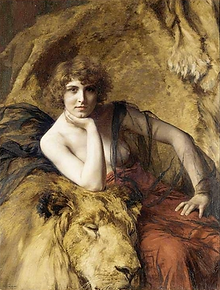
archetype & psychology
“In the depth of winter, I finally learned that within me there lay an invincible summer.”
― Albert Camus
Psychologically, Strength is the card of integration. Jung wrote that to individuate is not to slay the animal within but to acknowledge it, to seat it at the table.
The lion is that animal: libido, rage, desire, the impulses often repressed or denied. To repress them is to invite them to break out in destructive ways; to indulge them without restraint is to be consumed. Strength shows the third way: the conscious holding of tension until something greater emerges.
It is the card of survivors: those who endure what cannot be changed and yet do not lose their humanity. In trauma work it appears as the capacity to sit with the overwhelming and still remain present. In relationships it speaks of a gentleness that outlasts force.
In culture it stands as the antithesis to spectacle: the quiet, unfashionable virtue of patience, restraint, and dignity. This is why Strength has always been countercultural — because its victories are invisible, its triumphs internal.
The danger, however, lies in false integration: mistaking suppression for serenity. The psyche that silences anger calls it virtue, but the repressed lion waits, teeth bared, in the unconscious. True strength is not repression but fearless relation.
upright Meaning
“The soft overcomes the hard; the gentle overcomes the rigid.” Lao Tzu
Upright, Strength affirms courage, compassion, and mastery over instinct. It is not conquest of others but self-command. It signals the capacity to face trials not with denial but with resolve, to endure suffering without being deformed by it.
In practical terms it may appear when someone is asked to hold steady in crisis, to respond not with panic but with poise. It often points to situations where persuasion is stronger than force — where listening tames anger, where patience outlasts fury.
In creative work it signals the power of a light touch, the ability to stay with the process long enough for meaning to emerge.
In personal development it reminds us that growth is slow, that strength is often invisible until tested.

reversed meaning
“The attempt to silence passion is itself a form of passion.” — Oscar Wilde
Reversed, Strength warns of fragility masquerading as control. It can signal repression that turns to neurosis, or indulgence that becomes addiction.
The lion may break free and rage unchecked, or the woman may collapse, unable to sustain her poise. It may appear when fear is projected as hostility, or when will collapses into passivity.
In relationships, it can suggest coercion — the attempt to dominate another under the guise of care.
In politics, it may be the brittle authoritarianism that insists on obedience while trembling within.
Inwardly, it signals the cost of unresolved conflict: either the lion tears free, or it dies of starvation within, leaving the psyche barren.
here and now
“To see what is right and not do it is lack of courage.” Confucius
In the present world, Strength asks what it means to endure when societies themselves fray. Endurance has become survival against invasion; Strength is claimed in the name of conquest, its lion unleashed upon neighbours. In parts of the world, strength is the daily struggle against poverty and exploitation. Around the world, restraint and rage circle endlessly in cycles of retaliation. Everywhere, the lion paces.
At the same time, we live in an age of spectacle. Virtue is signalled loudly while cities burn quietly in the background — protests staged for cameras while wars rage ignored, speeches made of compassion while policy turns cold. Strength’s lesson is almost entirely absent: endurance without integrity, patience without purpose, resilience reduced to performance.
Here and now, the card challenges us: are we taming the lion, or simply caging it? Are we enduring with dignity, or numbing ourselves into submission? In a world of fractured attention and empty signalling, true strength may be the rarest virtue of all.
The zeitgeist is precisely this contradiction: a society that praises strength but punishes those who dare to show their teeth. We are told to endure the unbearable as if endurance itself were enough. But Strength, rightly understood, demands more: that we act with authenticity, that we refuse to let patience become complicity, and that we channel our endurance into integrity rather than performance.
The hard question is this: what happens when endurance finally breaks? What happens when people, silenced for too long, refuse the role of the calm lion and roar instead? History suggests the answer is always the same: collapse, revolt, upheaval. The danger of our time is not that people are too angry, but that their anger is repressed into silence until it erupts without direction.
The balm — if there is one — is in rediscovering Strength’s true essence: calm not as compliance, but as courage; endurance not as silence, but as resolve.


shadow
“Beware that, when fighting monsters, you yourself do not become a monster.” — Nietzsche
The shadow of Strength is endurance twisted into submission. What begins as inner sovereignty becomes a weapon in the hands of those who demand silence. Across history, those in power have urged the powerless to “bear their burden” and “keep their place.” This is no true strength but exploitation, cloaked in virtue.
Women told to remain quiet under abuse, civilians expected to withstand oppression, soldiers commanded to die for causes not their own — the lion is muzzled not by compassion, but by force disguised as morality.
The lion here is libido, rage, and instinct — forces repressed too long that eventually break out in destructive ways. Repress passion, and it festers into violence. Indulge it without restraint, and it consumes. The shadow of Strength is precisely this distortion: patience demanded as obedience, resilience hollowed out into passivity, a mask of calm placed over barely contained despair.
In the Thoth Tarot, this card is called Lust. This too is the lion’s shadow. Lust is the intoxication with appetite — sexual, political, economic. It is the surrender to craving without discernment, the worship of desire for its own sake. In its grip, the lion is no longer companion but devourer.
We see this lust in the exploitation of children, in the commodification of bodies, in the endless search for new sensations to dull an inner emptiness. We see it in leaders who mistake conquest for glory, in corporations that devour resources without thought of tomorrow, in cultures where greed and consumption are normalised as ambition.
This darker naming reminds us that the shadow of Strength is not only silence forced upon the powerless but also appetite left unchecked by conscience. It is lust elevated to principle, rage sanctified as courage, desire mistaken for destiny. It is as old as myth and as current as today’s headlines — the lion not guided, but unleashed.
conclusion
Strength is not conquest, but composure. It is the virtue of gentleness stronger than any sword, the quiet endurance that reshapes fate itself. She reminds us that the lion within is neither enemy nor master, but companion — provided we dare to face it.
strength viii
the taming of mastery
"In the midst of movement and chaos, keep stillness inside of you."
Lao Tzu