archetype & tradition
“Second star on the right, straight on 'til morning.” Peter Pan J.M Barry
The archetype of the Star is hope, but not the easy hope of wish or rescue. It is the quiet, sustaining force that often emerges only after collapse, when illusions have burned away and nothing remains to cling to but life itself. Following the Tower’s violent unmaking, the Star appears not as triumph, but as continuation — the psyche’s refusal to end.
In mythic terms, stars have always served as guides rather than destinations. They do not intervene; they orient. Sailors, shepherds, and wanderers looked upward not for comfort but for direction. The Star belongs to this lineage: a fixed point amid uncertainty, distant yet reliable. It does not promise arrival, only bearing.
Psychologically, the Star does not deny the wound from the tower; it appears because the wound has been acknowledged. It is not illusion, but a minimal truth — enough to keep moving. At its deepest level, the Star represents renewal without erasure. Nothing is undone. The past is not redeemed. Yet something essential survives. This archetype insists that life contains a quiet intelligence, one that resumes even after devastation. Hope here is not optimism, but fidelity to existence itself. What distinguishes the Star from illusion is that it appears after catastrophe. It does not promise that suffering was unnecessary; it promises that suffering was not meaningless.
So in a sense, the Star is not optimism but moral stamina: the ability to remain aligned with meaning when proof is absent. It is hope stripped of fantasy and reduced to function. The archetype insists that truth alone is insufficient. After truth has destroyed illusion, something must remain that allows the psyche to live with what it now knows. The Star is that remainder.

setting the scene
“You can cut all the flowers but you cannot keep Spring from coming.” Pablo Neruda
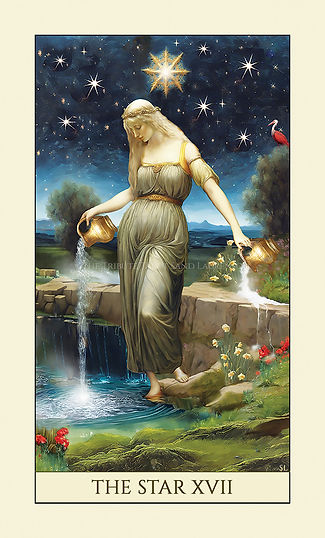
The Star unfolds beneath a vast, unclouded night. The sky is deep indigo, expansive and lucid, scattered with seven smaller stars and crowned by a central eight-pointed brilliance. The light does not pierce the darkness — it inhabits it. The heavens feel ordered, spacious, continuous.
The landscape is open and unfortified. Low hills recede softly into the distance. There are no walls, no structures, no human boundaries. The horizon line remains calm and level, suggesting equilibrium rather than upheaval.
At the centre of the terrain lies a clear pool edged with stone. Water spills gently over a ledge into its basin, forming a quiet cascade. The surface reflects starlight without distortion. Nothing is turbulent. The movement is cyclical, not catastrophic.
To one side, trees rise in shadowed stillness. A red ibis stands poised against the dark foliage, alert but unthreatened. Wildflowers bloom naturally at the water’s edge — white and red among grasses and moss. They grow from the soil, not arranged upon it.
The scene is neither aftermath nor spectacle. It is a restored atmosphere. The sky remains unbroken. The earth remains receptive. The world breathes again.
esoteric correspondences
“The world is not a wish-granting factory.” John Green, The Fault in Our Stars
Aquarius, as the Star’s astrological ground, introduces a paradox that mirrors the card’s psychological tension. Though an air sign, Aquarius is depicted as a water-bearer — a reminder that insight alone is barren unless it is poured into life. This reinforces the Star’s message: clarity without nourishment leads to sterility; vision must circulate to remain alive.
Saturn’s influence introduces endurance, patience, and time — hope that survives not through enthusiasm, but through discipline. Uranus contributes rupture and renewal, ensuring that the hope offered is not conservative or regressive. Together they form a hope that can withstand disappointment without calcifying into bitterness.
In alchemical terms, distillation follows fire not to undo it, but to recover what survives burning. The psyche, having been reduced, is now refined. Drop by drop, meaning returns — not as certainty, but as coherence. The Star does not rebuild the Tower; it salvages what was never meant to fall.
The eight-pointed star reasserts cosmic order, but not dominance. It does not rule the heavens; it stabilises them. The surrounding seven stars suggest companionship rather than hierarchy — guidance dispersed rather than concentrated. The Star teaches that orientation does not require authority, only constancy.

the star xvii
the unbroken sky
“The night is large and full of light.” — Rainer Maria Rilke
COSTUME & MOTIFS
“We are all in the gutter, but some of us are looking at the stars.” Oscar Wilde
In my Tribute Tarot, the woman in the Star card is clothed rather than exposed. Her grey-green garment falls in weighty, classical folds, gathered at the waist with quiet simplicity. This alters the tone profoundly. She is not vulnerable through nakedness; she is dignified through presence.
She stands upright rather than kneeling. One foot rests within the water, the other upon stone — balanced, deliberate. This is not supplication but participation. She does not beg for illumination; she cooperates with it.
She holds two golden vessels. From one, water returns to the pool. From the other, it flows onto the earth. The gesture is measured and steady. The act is not dramatic; it is continuous. The double pouring affirms circulation — restoration that moves between interior and exterior life.
Above her, the eight-pointed star burns brighter than its companions. The surrounding seven do not compete; they accompany. The emphasis is not on miracle but orientation. These stars are bearings, not wishes.
The ibis anchors the image in mythic continuity. Associated with Thoth — keeper of knowledge — it introduces memory into hope. The flowers at her feet, red and white, do not deny loss; they suggest renewal that includes remembrance.
Every motif reinforces constancy. Hope here is not spectacle. It is disciplined light.


archetype & psychology
“Hoping for the best, prepared for the worst, and unsurprised by anything in between.” Maya Angelou
Psychologically, the Star is the archetype of hope after despair. It appears when the psyche has endured collapse and is ready to begin again — not with grand gestures, but with steady realignment. It is the moment of breathing after crisis, of seeing beyond the wreckage.
But hope is fragile. It is the most necessary of archetypes, but also the most dangerous. It lives beside despair, so close that they almost touch. Alexandre Dumas, in The Count of Monte Cristo, called it “all human wisdom contained in two words — Wait and hope.” To hope is to endure waiting, often unbearable, and yet at times, it is the only thing that sustains.
Hope can be narcotic, a drug that numbs; but it can also be discipline, a light maintained when everything else has gone out. Herman Melville wrote: “Hope is the struggle of the soul, breaking loose from what is perishable, and attesting her eternity.” Hope insists that the psyche is larger than its collapse.
In Jungian terms, the Star is reintegration after shadow. It is the psyche refusing despair, choosing to orient itself toward light even when the night seems endless. Its discipline is the refusal to stop pouring, to keep balance, to continue even when silence is the only answer.
UPRIGHT
“Do not spoil what you have by desiring what you have not; remember that what you now have was once among the things you only hoped for.”
Epicurus
The Star signals renewal, inspiration, clarity. It often appears after collapse, heralding recovery, guidance, direction. It is a promise that though devastation has been real, healing is possible.
The upright Star guides as much as it heals. It is not only restoration of strength, but orientation: a light to follow, a path to navigate by. Like the North Star, it offers direction in darkness. Like Bethlehem’s star, it heralds new beginnings.
In readings, the upright Star can signify healing from illness, reconciliation, the return of faith, the rekindling of creativity. It can also mark inspiration: the sudden sense of being guided, of seeing where to walk.
The Star’s hope is not naive. It is fragile, disciplined, hard-won. Upright, it demands constancy, not spectacle — to follow its light steadily, not to expect it to dazzle.

REVERSED
“But I know, somehow, that only when it is dark enough can you see the stars.”
Martin Luther King, Jr.
Reversed, the Star does not remove light; it obscures relationship to it. The sky remains intact, yet orientation falters. The individual may know healing is possible, yet resist trust in its return. It can indicate spiritual fatigue — not dramatic despair, but quiet depletion. One pours and pours, yet feels unrefilled. Hope becomes effort rather than sustenance.
Another distortion appears as brittle optimism: declarations of healing without the vulnerability of healing. Light performed rather than embodied. In this form, the card cautions against bypassing grief. Water must be replenished before it can nourish.
The reversed Star can also signal estrangement from guidance itself. Insight is present, yet doubted. One sees the sky but questions its relevance. Cynicism begins to harden around disappointment.
To recognise the absence of hope is already to look toward it. The sky remains unbroken. Orientation can return when humility does.
here and now
“You don’t forget the face of the person who was your last hope.”
Suzanne Collins, The Hunger Games
In our time, hope is thin. Generations have been betrayed by governments promising prosperity and justice, only to deliver austerity, scandal, or division. Institutions rise and fall, leaving people more disillusioned each cycle. What was once trust has become suspicion, and what was once expectation has curdled into cynicism.
The same betrayal repeats at the personal scale. Families fracture, marriages collapse, friendships corrode. People who were once trusted to shelter and protect instead wound and abandon. Hope, once placed in the closest bonds, becomes a source of bitterness when those bonds are broken. Nothing poisons more deeply than betrayed expectation.
Meanwhile, society cheapens the very word “star.” Actors and celebrities are paraded as “personalities” and “stars,” hollow lights projected into the void of culture. The archetypal power of the star — the beacon to guide, the emblem of constancy — is reduced to branding, spectacle, and gossip. False hope is sold in cinemas, magazines, and feeds, distracting from the absence of the real.
The result is a crisis of hope: not only because life is difficult, but because the very structures that should nourish it instead prey upon it. Leaders betray, institutions corrode, even intimate ties fail. What remains is weariness, a suspicion that no resolution is possible.
And yet, the Star endures as symbol because even in betrayal, we turn upward. The night sky remains vast, the stars still burn. True hope is not the slogans of politicians or the glamour of celebrities. It is the discipline of endurance, the quiet act of continuing, the refusal to let betrayal be the last word.


shadow
“The miserable have no other medicine but only hope.”
Shakespeare, Measure for Measure
The shadow of the Star lies in the very thing that makes it beautiful. Hope, which can sustain through despair, also deceives. It can numb, infantilise, or blind. Archetypally, its danger is that it hovers too close to despair, promising light but leading into delusion.
One distortion is hope betrayed. To invest in light too fervently is to risk devastation when it fails. When hope is crushed, despair is sharper than if hope had never been held at all.
Another distortion is narcotic hope. The Star becomes fantasy, dream without action. It lulls the psyche into believing things will improve “someday,” while nothing changes. This is not resilience but paralysis — a refusal to grieve, a refusal to act, an endless waiting that corrodes the soul.
A third is false hope as exploitation. Institutions, governments, friends, families, hold out promises of betterment while delivering misery, using hope as a leash. Archetypally, this is the betrayal of light by those entrusted with it — rulers who promise but do not deliver, guardians who abandon. Hope is twisted into a weapon.
And finally, there is the shadow of proximity to despair. Hope cannot exist without it, and when the two are too close, despair devours. Viktor Frankl, surviving the camps, wrote: “The prisoner who had lost his faith in the future — his future was doomed. With his loss of belief in the future, he also lost his spiritual hold.” The shadow of the Star is the razor’s edge: when hope collapses, nothing remains.
The archetype reminds us: hope is necessary, but it must be honest. If it is false, premature, or naive, it becomes more dangerous than despair itself.
conclusion
The Star XVII is fragile and luminous. It is hope after despair, guidance after collapse, renewal after ruin.
It is not naive innocence, but resilience.