archetype and tradition
“Dancers are the athletes of God.” ― Albert Einstein
The World is the final threshold of the Major Arcana, where the Fool’s first step has reached its destination — not an ending, but a state of wholeness that makes the next beginning possible. Archetypally, it represents integration after ordeal: opposites reconciled, experience metabolised, the Self no longer fragmented. This is not triumph but arrival — the moment when nothing essential is excluded.
What began in innocence returns as wisdom; what was once scattered is now gathered. The World does not conquer its elements but contains them. Unlike earlier cards that force change through rupture or trial, this one reveals a quieter mastery — the capacity to hold complexity without collapse.
The image of the dancer within the wreath appears across cultures and epochs: in sacred circles, mandalas, ritual dances, and the ouroboros devouring its own tail. It expresses eternity not as stasis, but as rhythm — the continuity of motion within containment. Endings and beginnings are not opposites here, but phases of the same current.
In this sense, The World completes the arc without sealing it shut. Fulfilment is not finality. What has been integrated can now be lived — and eventually surrendered — without fear of disintegration. The archetype affirms that meaning is not found by escaping the world, but by standing fully within it.
What distinguishes The World from mere success or resolution is that it carries no promise of exemption. The archetype does not imply escape from suffering, error, or effort, but a reconciliation with their necessity. The dancer stands not above the world but within it, affirming that wholeness is achieved not by transcendence alone, but by consent to life as it is.
the world xxi
the dance of completion
“Dance, when you're broken open. Dance, if you've torn the bandage off. Dance in the middle of the fighting. Dance in your blood. Dance when you're perfectly free.” ― Rumi
esoteric correspondences
“To see a World in a Grain of Sand
And a Heaven in a Wild Flower,
Hold Infinity in the palm of your hand
And Eternity in an hour.”
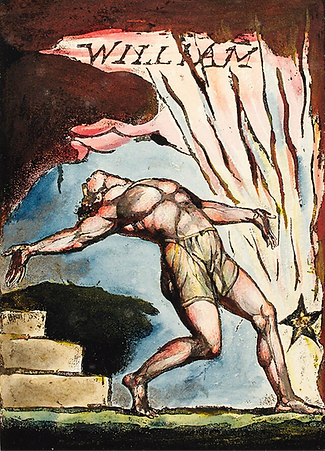
William Blake, Auguries of Innocence
Esoterically, The World marks the moment when structure and freedom cease to oppose one another. Astrologically, it is associated with Saturn — the planet of limit, boundary, and time — yet here Saturn is no longer punitive. What once constrained now contains. The wreath does not imprison the dancer; it gives her a field within which movement becomes meaningful.
On the Kabbalistic Tree of Life, The World corresponds to Malkuth, the Kingdom — not as a fallen realm, but as spirit fully realised in matter. This is the point at which the descent is complete: nothing further to escape, nothing higher to climb. What has been fragmented across the journey is gathered into lived presence.
Alchemically, The World belongs to rubedo, the reddening — the final stage of the opus. This is not purity regained but substance transformed. What survives is not innocence, but coherence. The two batons the dancer holds echo the Magician’s wand, now doubled and balanced: will divided becomes will integrated. Fire and water, motion and stillness, ascent and descent are no longer in contention. The work has been endured long enough to stabilise.
Completion folds back into creation. The spiral does not end; it renews. The World therefore refuses finality. It affirms that every arrival carries the seed of another beginning, but now undertaken with memory, responsibility, and earned presence. What repeats does so at a higher octave — not innocent, but awake.


setting the scene
“Those who were seen dancing were thought to be insane by those who could not hear the music." Friedrich Nietzsche
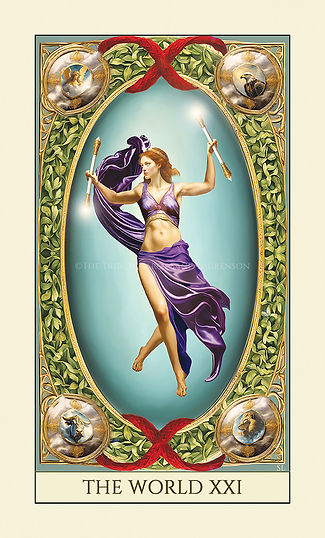
The scene is enclosed, yet open. At the centre, the dancer moves within an oval wreath that both frames and defines her space. This boundary is not rigid or architectural; it is organic, living, composed of leaves and tied with red ribbons. The enclosure does not confine — it holds. Motion occurs because the space is defined, not in spite of it.
The dancer’s body is turned slightly off-centre, caught mid-step rather than posed. One leg lifts behind her, the other grounds her forward. This asymmetry matters. Completion here is not stasis, but balance maintained through movement. She does not face the viewer directly, nor does she retreat. Her posture suggests ease earned through repetition, not display. This is not performance for an audience, but movement sustained for its own sake.
In each hand she holds a baton. They echo the Magician’s wand, now doubled and levelled. Where once will was directed outward, now it is distributed evenly. The batons do not command the elements; they keep time. The dancer’s authority is rhythmic rather than forceful — she conducts herself rather than the world around her.
At the four corners of the image sit the living creatures: human, lion, bull, and eagle. They do not intrude upon the central space. They witness rather than participate. Their placement suggests that the dancer’s movement is held in a larger order — observed, stabilised, and contextualised. The scene implies relation rather than isolation: wholeness is recognised, not self-declared.
There is no dramatic background, no storm, no abyss. The emphasis is deliberate. After the upheavals of the preceding cards, the absence of spectacle becomes meaningful. Nothing is breaking. Nothing is rising or falling. The World closes the sequence with quiet insistence: integration does not announce itself. It simply continues.
COSTUME & MOTIFS
“Let us read, and let us dance; these two amusements will never do any harm to the world.” Voltaire
The most dominant motif in this card is the oval enclosure itself. Unlike the rigid circle of completion, the ovoid shape carries generative tension. It suggests the egg rather than the seal — an enclosed form that holds potential rather than finality. The cosmic egg appears across mythologies as the birthplace of order: Orphic, Hindu, Egyptian. In the card, the dancer is not trapped within this shape but emerging through it, signalling completion that is alive, not static.
The laurel wreath reinforces this paradox. Traditionally a symbol of victory, honour, and endurance, it carries historical weight without triumphalism. Laurels crown effort that has been sustained, not conquest achieved by force. Here, the wreath does not sit upon the dancer’s head; it surrounds her entirely. Victory is not personal glory but the environment that now supports movement. Achievement becomes context rather than identity.
Threaded through the wreath are red ribbons, tied into looping forms that read unmistakably as lemniscates — the infinity symbol. This detail is crucial. Eternity here is not abstract or celestial; it is embedded, tactile, bound into matter. The red colour binds eternity to blood, life, and consequence. Time is not escaped; it is woven. Continuity is not theoretical; it is lived.
The background blue has an unmistakably amniotic quality. It reads as sky, water, and interior space simultaneously — neither fully external nor internal. It reinforces the egg-like reading of the card: a space where something has been fully formed and is ready to be lived outwardly. The dancer stands not against the world, but within its sustaining field.
The dancer’s veil and partial covering avoid spectacle. She is neither naked nor armoured. The body is present but not sexualised, visible but not exposed. This restraint matters. The World does not equate completion with exhibition. The self is integrated enough not to need concealment, yet dignified enough not to require display.


archetype & psychology
“Everything in the universe has a rhythm, everything dances. ” ― Maya Angelou
Psychologically, The World represents integration achieved without collapse of complexity. This is not the relief of problems solved, but the steadiness that comes when inner contradictions no longer tear the psyche apart. What once pulled in opposing directions now coexists. Desire, discipline, instinct, and reflection are held in proportion. The psyche no longer seeks resolution through excess or denial; it sustains balance through participation.
Unlike earlier stages of the journey, The World does not announce transformation as an event. There is no rupture, no catharsis, no sudden enlightenment. Integration here is quiet and often anticlimactic. It is recognised less by feeling than by function: life works. Choices align with values. Energy circulates without constant obstruction. The self no longer fragments under pressure because it is no longer divided against itself.
This archetype also marks the end of compulsive becoming. Much psychological suffering arises from the belief that one must always be improving, healing, transcending, or correcting. The World interrupts this narrative. It does not deny growth, but it ends growth driven by deficiency. The psyche rests not because it is finished, but because it is no longer at war with its own history.
Importantly, The World does not dissolve individuality into harmony. Integration does not mean conformity or peace at any cost. Conflict still exists, but it is no longer existential. Tension becomes navigable rather than destabilising. The self can enter difficulty without losing coherence. This is maturity, not serenity.
At its deepest level, The World reflects the psychological capacity to remain present without fragmentation. Nothing essential needs to be excluded to maintain identity. The self is no longer constructed defensively. This is why the card feels complete without being final: it describes a way of inhabiting life rather than a state beyond it. The journey does not end — but it no longer needs to prove itself through struggle.
UPRIGHT
“You must have chaos within you to give birth to a dancing star.”
Friedrich Nietzsche
Upright, The World signifies completion that has been earned rather than granted. A long cycle reaches coherence, not because everything has gone well, but because what has gone wrong has been absorbed, understood, and carried forward without fragmentation. This is the sense of having arrived inside one’s life rather than at its conclusion.
In practical terms, this card points to fulfilment that is stable. Projects come to rest because they are finished, not abandoned. Relationships settle into their true form — not idealised, but workable, real, and honest. There is a feeling of rightness that does not depend on excitement. Things fit because they have been tested.
Psychologically, The World upright reflects self-containment. The individual no longer looks outward for constant validation or inward for perpetual correction. Identity stabilises. Energy circulates rather than leaks. There is space for pleasure without guilt and responsibility without resentment. This is not happiness as mood, but as alignment.
Importantly, The World upright also carries visibility. What has been integrated can now be lived openly. There is no need to hide process, uncertainty, or history. The self stands whole enough to be seen without fear of collapse. This often coincides with a sense of recognition — not applause, but acknowledgement that one’s place in the wider pattern is secure.
At its best, this card affirms participation in life as it is. Not escape, not transcendence, not retreat — but engagement without inner resistance. The cycle closes cleanly, making space for the next one to begin without residue.

REVERSED
“Out beyond ideas of wrongdoing and rightdoing there is a field.
I'll meet you there.
When the soul lies down in that grass
the world is too full to talk about.” ― Rumi
Reversed, The World suggests an interruption of completion. Something essential remains unresolved, not through lack of effort, but through reluctance to relinquish an old identity. The cycle is technically finished, yet psychologically unfinished. The dancer hesitates at the edge of the wreath, unwilling to step fully into the space she has earned.
This often manifests as restlessness after success. Goals are achieved, but satisfaction does not arrive. The psyche immediately looks for the next task, the next struggle, the next improvement. Completion feels unsafe because it removes the familiar tension of striving. In this state, growth becomes compulsive rather than meaningful.
Reversed, the card can also indicate fragmentation returning under pressure. Elements that were once integrated begin to separate again — work and values diverge, instinct and intention lose alignment. This is not collapse, but slippage. The warning here is subtle: without conscious inhabitation, coherence erodes.
In relationships or life structures, The World reversed may point to a reluctance to fully arrive. Commitments are delayed, endings avoided, transitions stretched out indefinitely. The sense of being “almost there” becomes a permanent condition. Movement continues, but without the grounding that gives it purpose.
At its core, the reversal asks a difficult question: what would you lose if you allowed this cycle to be complete? Often, it is not opportunity but identity. The World reversed invites the courage to accept fulfilment — and to trust that life does not end when struggle does.

shadow
“Dance first. Think later. It's the natural order.” ― Samuel Beckett
The shadow of The World is not failure, but false completion. It appears when wholeness is declared prematurely — when integration is performed rather than lived. In this shadow, the wreath becomes a display case rather than a containing form. The dancer continues to move, but the movement is hollow, repeating gestures that once carried meaning but no longer do. Completion is claimed to avoid further reckoning.
One distortion of this shadow is complacency. The belief arises that the work is finished, that insight exempts one from further responsibility. Contradictions are glossed over in the name of harmony; unresolved tensions are reframed as acceptance. What is lost here is honesty. The psyche prefers the appearance of wholeness to the discipline required to sustain it. Growth halts not because it has concluded, but because it has been declared unnecessary.
Another expression of the shadow is stagnation masked as peace. Life becomes orderly, functional, even comfortable — yet subtly airless. Without the friction of becoming, vitality drains away. The dancer stands still inside the wreath, mistaking enclosure for containment. This is the danger of completion without renewal: the self begins to preserve itself rather than participate. Wholeness calcifies into identity.
There is also a darker mirror in which completion becomes exclusion. The integrated self looks outward and judges fragmentation harshly. Those still struggling are viewed as inferior, unenlightened, or immature. The World’s shadow here becomes moral closure — the refusal to re-enter uncertainty once it has been survived. Compassion contracts. Integration turns into superiority.
At its deepest level, the shadow of The World is fear of beginning again. The cycle has closed, but another waits. To remain within the wreath forever is to deny time its movement. Eternity becomes paralysis. The card warns that wholeness must remain permeable to change, or it will decay. Completion that cannot be surrendered is no longer integration — it is refusal.
The World’s shadow reminds us that nothing alive is ever finally finished. Wholeness is not a state to be possessed, but a condition that must be continuously inhabited. When that effort is abandoned, the dance ends — even if the music continues.
here and now
“I am a part of all that I have met.” ― Alfred Tennyson
Many people reach points of apparent completion — careers stabilise, identities solidify, narratives settle — only to discover that fulfilment does not automatically follow. The World in the here and now exposes the modern discomfort with arrival. We are trained to strive, optimise, and overcome, but rarely taught how to inhabit what has been achieved. Completion feels suspicious, even threatening, because it removes the momentum that once defined us.
Psychologically, this manifests as restlessness disguised as ambition. Even when life functions well, there is a compulsion to keep moving, improving, rebranding, or correcting. The World appears when the question shifts from “What am I becoming?” to “Can I remain?” Many struggle not with failure, but with staying present once struggle ends. The absence of crisis reveals anxieties that productivity once concealed.
At the level of the individual life, The World often coincides with a quiet but profound recognition: this is it. Not resignation, but reality. The life you are living — with its constraints, relationships, responsibilities, and pleasures — is the arena, not a rehearsal. This recognition can be deeply unsettling. It removes fantasies of escape and deferral. Meaning must now be made within what exists.
As the final card, The World does not close the book — it returns it to the reader. The cycle is complete, but life continues. What has been integrated must now be lived, tested, and eventually released. The journey does not restart in innocence, but in awareness. And that awareness carries a final, uncompromising truth: wholeness is not something you reach — it is something you are responsible for sustaining.
conclusion
The World XXI closes the Major Arcana with a vision of rhythm.
The Fool’s first step and the dancer’s final step are the same — one innocent, one wise, both necessary.