
archetype and tradition
"Do not wait for the last judgment. It comes every day.” Albert Camus
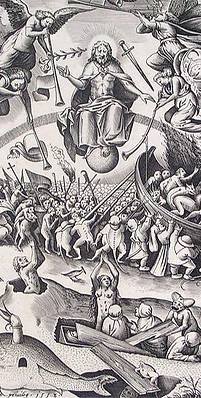
Judgement stands at the penultimate threshold of the Major Arcana — not as destruction, and not as conclusion, but as awakening. It is the moment when concealment ends and what has been buried rises into recognition. This card does not ask for obedience, nor does it offer absolution by default. It asks for honesty. It is not purity that is demanded here, but wholeness — the willingness to be seen intact, with wounds and contradictions included.
The archetype itself long predates Christianity. The Egyptians weighed the heart against the feather of Ma’at; the Greeks imagined Hermes guiding souls onward; the Norse awaited the blast of the Gjallarhorn at Ragnarök. Across cultures, the same structure appears: a moment when fragments must be gathered, when the soul is summoned, when nothing can remain hidden. Judgement is not invention but inheritance — a pattern humanity has always recognised, even when it fears it.
At its core, Judgement holds the tension between the holy and the human. It is divine in its archetypal voice — the trumpet that calls beyond time — yet it is lived in entirely human terms: in the choices we make, the truths we face, the reckonings we postpone or accept. The card reminds us that while religions may frame judgement as a celestial decree, it also unfolds in every honest confrontation with conscience. It is both cosmic and personal: the vast scale of eternity set against the absolute weight of a single life.
Judgement does not comfort. It clarifies. It does not punish; it exposes. And once exposure has occurred, there is no return to sleep. This is why the card sits where it does — after the Sun’s illumination, before the World’s completion. Nothing can be integrated until it has first been named.
esoteric correspondences
"There are just some kind of men who're so busy worrying about the next world they've never learned to live in this one, and you can look down the street and see the results.”
Harper Lee, To Kill a Mockingbird
Astrologically, Judgement resonates with Pluto, the planet of ruthless transformation. Pluto strips away pretence and leaves only essence. Under its influence, nothing decorative survives. This is not gentle change but irrevocable passage — the death of false continuity. In Judgement, Pluto does not destroy for punishment’s sake; it exposes what was never viable. The old structure collapses because it can no longer carry truth. What rises afterward may be scarred, but it is real.
Alchemically, Judgement belongs to coagulatio — the fixing of what was volatile, the forming of a body from scattered fragments. It follows dissolution and distillation, the long work of breaking down illusion, habit, and false identity. This is the phoenix moment, but without romance: the fire has already burned. What remains is not innocence restored, but substance earned. Judgement asks whether the work has truly been done, or merely spoken about.
On the Tree of Life, Judgement is associated with the Hebrew letter Shin — flame, tooth, spirit. Shin is fire that both purifies and devours. It burns away what cannot survive truth, yet it also risks consuming what is fragile. This is the dual peril of awakening: acceptance can refine, but it can also harden. Judgement asks not only what must be burned, but what must be protected while the fire passes through.
Esoterically, Judgement is therefore not about the afterlife but about thresholds. It marks the instant when the soul must decide whether to rise into coherence or sink back into fragmentation. It is not fate imposed from above, but consequence revealed from within.

judgement xx
the reckoning
“Sooner or later we all sit down to a banquet of consequences.” — Robert Louis Stevenson
setting the scene
“Reserving judgements is a matter of infinite hope.”
― F. Scott Fitzgerald, The Great Gatsby
In my Tribute Tarot, Judgement unfolds not as catastrophe but as arrival. The angel fills the sky, wings aflame, trumpet raised — yet his expression is not wrathful. This is not a god of punishment but of summons. The sound he releases is not command but resonance: a call that cannot be unheard, not because it is loud, but because it is true.
Below him, the figures do not claw their way from graves in panic. They are already upright. Already oriented. The water that surrounds them no longer reads as a threat but as residue — the aftermath of passage rather than its beginning. This is not drowning but having crossed. The flood has done its work. What remains is reckoning.
Crucially, the adult figures in the foreground are mirrored across the axis of the card. They do not reach only upward; they reach toward each other. Their raised arms are not gestures of surrender but recognition. This Judgement is not solitary. Awakening here is relational. One person’s rising calls forth another’s. Truth moves laterally as well as vertically — between human beings, not only from heaven to earth.
The children are the only naked figures, and this nakedness is not exposure but innocence. They do not need to be stripped of disguise because none has yet been formed. Their emergence is uncomplicated, untouched by shame or defence. In contrast, the adults are clothed, marked by experience, bearing the memory of concealment. Their awakening carries weight because it follows a life lived.
The coffins float like thresholds rather than tombs — vessels that carried something across water and are now no longer needed. This is not resurrection from death alone, but restoration to relation. The scene captures the moment just after concealment collapses, when truth has arrived but before judgment hardens into verdict. It is the instant where nothing can be hidden — yet nothing is condemned.
Judgement, as shown here, is not about being seen by God alone. It is about being seen by one another — without disguise, without performance, without the stories that once protected us. The trumpet does not end the world. It ends pretending.
COSTUME & MOTIFS
“The difference in judgement between you and me originates from different rules derived from past experience.”
Hajime Isayama
Clothing in Judgement is not decoration but evidence. The figures are neither fully clothed nor fully stripped; they are caught mid-threshold, still holding fragments of covering that no longer function. These remnants matter. They signal that awakening is not instantaneous purification but a process in which former protections lose their purpose. What once concealed now only lingers, inert, incapable of restoring the old order.
The semi-nudity is therefore crucial. This is not innocence reclaimed — that belongs only to the children — but exposure arrived at through necessity. The adults are not purified; they are undeniable. Their bodies carry history, experience, consequence. The coverings fall not because virtue demands it, but because concealment can no longer be sustained. Judgement strips by truth, not by force.
The coffins function less as graves than as vessels. Their design echoes containment rather than burial — carved, deliberate, almost ark-like. They float because they have already done their work. These are not places of death but of transport: structures that carried the self through dissolution and are now obsolete.
Above, the trumpet is rendered with restraint. It is not oversized, not violent, not theatrical. Its power lies in inevitability. The banner, marked with the red cross, carries the most volatile symbolism in the card. Historically, it signals ordeal, sacrifice, and moral reckoning. It is neither triumphant nor accusatory.


archetype & psychology
“All books are judged by their covers until they are read.”
Maryrose Wood, The Mysterious Howling
Judgement is the archetype of recognition. It is not the psyche’s longing for comfort, absolution, or reassurance, but for truth — to be seen whole, with contradictions intact. This is the moment when denial collapses under its own weight. What has been buried does not return as accusation, but as fact. Judgement does not ask whether one is ready; it arrives when readiness is no longer relevant.
Psychologically, this card marks the culmination of individuation. Persona fractures. The shadow has already been encountered, the child acknowledged, the projections exhausted. What rises now is not innocence regained, but integrity restored. The figures do not emerge purified; they emerge coherent. This is the psyche recognising itself without the buffer of narrative, excuse, or self-deception.
Crucially, Judgement is not self-criticism. That belongs to the superego, not the archetype. Here, judgement is not condemnation but orientation — the capacity to distinguish what is true from what is tolerated, what is essential from what has merely persisted. The mirrored figures reinforce this psychological truth. Awakening is never purely solitary. We recognise ourselves through others — not by comparison, but by resonance. What rises in one psyche calls forth the same reckoning in another.
At its most difficult, Judgement confronts the fear of exposure. To be seen without disguise threatens identity itself. Many prefer ambiguity to clarity because ambiguity preserves possibility. Judgement ends possibility in order to restore direction. Once seen, something cannot be unseen. Once named, something cannot be rationalised back into shadow.
Ultimately, Judgement is the psyche’s refusal to remain half-awake. It is not a spiritual awakening but a psychological one — the moment when the self accepts the cost of consciousness. What rises from the coffin is not reborn innocence, but accountable presence. The soul stands, not to be forgiven, but to be known.
UPRIGHT
“Your judgement judges you and defines you”
Jean Paul Sartre
Upright, Judgement signals awakening through necessity rather than choice. In personal terms, this card marks a reckoning with truth — spoken or internal. A confession may be made, a realisation accepted, a silence broken. Judgement upright does not punish; it liberates by ending pretense. The weight lifted is not guilt, but the labour of concealment. Relief comes not from forgiveness, but from honesty.
This may involve acknowledging harm done, responsibility avoided, or potential neglected. It is not an emotional catharsis but a sober alignment — the self stepping into reality without disguise.
In relationships, Judgement upright brings truth to the surface. Conversations long postponed become unavoidable. Forgiveness may be offered or sought, but only where recognition precedes reconciliation. This is not reconciliation through forgetting, but through naming. What survives this moment is real.
In work or creative life, Judgement upright marks vocation rather than ambition. It is the discovery of what one must do rather than what one wishes to appear to be doing. The call feels less like inspiration and more like obligation — not imposed from outside, but rising from within.

REVERSED
“Youth is quick in feeling but weak in judgement.”
Homer
Reversed, Judgement speaks of resistance. Judgement reversed signals fear of exposure. The self clings to familiar narratives, even when they no longer hold. Shame, guilt, or self-judgement may masquerade as humility, while genuine reckoning is deferred.
In relationships, Judgement reversed often manifests as silence, stagnation, or unresolved rupture. Truth is withheld, conversations circle but never land. There may be an unspoken agreement not to awaken what would require change. The relationship remains suspended — neither alive nor ended.
In work or vocation, Judgement reversed suggests ignoring one’s real calling in favour of safety, image, or inertia. The cost is not failure but numbness. Energy drains because effort is spent maintaining misalignment. Burnout here is not overwork, but self-betrayal.
There is also a deeper danger: the belief that judgement itself is cruel, and that refusal to judge equals compassion. In this distortion, discernment is abandoned, and repetition sets in. Without judgement, nothing is resolved; patterns recur under different names.
here and now
“At the Day of Judgement we shall not be asked what we have read
but what we have done.”
― Thomas A Kempis
In the present moment, Judgement appears less as a singular event than as a slow accumulation. We live in an age skilled at postponement — deferral of responsibility, outsourcing of conscience, dilution of accountability through systems, language, and noise. Decisions are made incrementally, often anonymously, until consequence arrives seemingly from nowhere. Judgement, here and now, is the shock of realising that nothing has vanished — it has merely been stored.
Psychologically, this shows up as exhaustion rather than fear. Many reach Judgement not because they seek truth, but because maintaining misalignment has become unbearable. The labour of self-editing, rationalising, and sustaining contradictions drains vitality. People speak of burnout, anxiety, or loss of meaning, but beneath these symptoms lies a simpler condition: living against what one knows. Judgement is the moment when that dissonance demands resolution.
In contemporary relationships, Judgement manifests as the end of ambiguity. Patterns long tolerated — emotional evasiveness, unequal responsibility, unspoken resentment — reach a point of visibility. This is not always dramatic. Often it arrives quietly, as the recognition that something can no longer continue as it is. Conversations become unavoidable not because emotions are heightened, but because clarity has finally caught up.
At a societal level, Judgement emerges where trust erodes. Institutions that rely on legitimacy rather than force eventually face exposure when language and lived experience diverge too far. People sense inconsistency long before they can articulate it. When articulation arrives, it often feels abrupt, even shocking — not because truth is new, but because acknowledgement has been delayed. Judgement here is not revolution; it is recognition breaking silence.
Importantly, Judgement in the modern world is not about punishment. It is about consequence without spectacle. The fantasy of absolution — that errors can be erased by rebranding, apology, or distraction — falters. What remains is responsibility: to respond honestly to what has been revealed. This is uncomfortable precisely because it cannot be delegated.
Here & now, Judgement asks for maturity rather than purity. It does not demand perfection, only coherence. It insists that lives be lived in alignment with what is known, not what is convenient. The trumpet sounds not from heaven, but from within ordinary experience — in moments of realisation that cannot be undone.
Judgement today is not the end of the world. It is the end of pretending that consequences do not exist.


shadow
“Judgement is a mirror in which we see our own reflection.”
— François de La Rochefoucauld
The shadow of Judgement is not condemnation, but avoidance. It appears when the psyche refuses recognition while still sensing its approach. The trumpet is heard, but its meaning is distorted: truth becomes threat, exposure becomes persecution. In this state, judgement is experienced as something done to the self rather than something arising within it. The result is deflection — blame projected outward, responsibility displaced, conscience dulled.
At its most corrosive, this shadow manifests as moral evasion disguised as tolerance. Discernment is rejected in the name of compassion; accountability is reframed as cruelty. The psyche convinces itself that to judge at all is violent, forgetting that refusal to judge leaves destructive patterns intact. In this inversion, repetition replaces reckoning, and harm persists under the cover of non-interference.
Another distortion emerges as self-condemnation. Instead of recognition, the psyche collapses into punishment. The trumpet becomes an accusation; awakening turns into shame. Here, judgement hardens into identity — I am my failure, I am my past. This is not accountability but fixation. The self remains trapped in the coffin, not because truth is denied, but because it is weaponised against growth.
There is also a collective shadow to Judgement: the pleasure of judging others as a substitute for self-reckoning. Public condemnation, spectacle, and righteous exposure offer a false sense of purification. By placing judgement entirely outside the self, the psyche avoids its own awakening. This is judgement without conscience — a performance of morality rather than an encounter with truth.
At its deepest level, the shadow of Judgement is the refusal to rise. The coffin opens, but familiarity exerts its pull. The known misery feels safer than the unknown responsibility of consciousness. To remain asleep is not ignorance; it is a choice. Judgement’s dark mirror shows us this without comfort: that awakening is resisted not because it is impossible, but because it demands everything illusion once provided.
Judgement warns that truth delayed does not soften. What is not faced returns with greater weight. The shadow does not silence the trumpet — it only postpones the moment when its call must finally be answered.
conclusion
Judgement is not about comfort but about clarity. It is the moment when the soul is summoned, when the fragments rise, when the flood sweeps away pretence. It is terrifying because it cannot be faked
— and liberating because once the call is answered, disguise is no longer needed.