the chariot vii
will and mastery
"He who conquers himself is the mightiest warrior" - Confucius

archetype & tradition
“The strong man is strongest when alone.” — Friedrich Schiller
The Chariot is the archetype of directed power. Where The Lovers expose the weight of choice, the Chariot enacts it. This is not contemplation but mobilisation — the moment when decision hardens into momentum. The Charioteer does not ask whether the road is just; he moves. Victory here is not moral, only effective. The danger is not hesitation, but the belief that motion itself confers legitimacy.
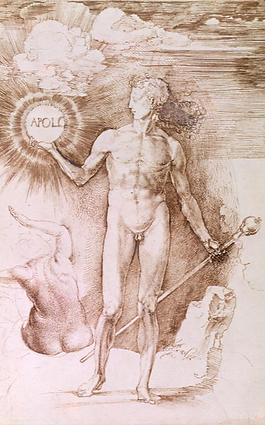
In myth, this figure also appears wherever power outruns wisdom. Apollo drives the sun in perfect rhythm, yet Phaethon, inheriting the same vehicle, burns the world through excess confidence. Alexander crosses continents believing destiny travels with him; Caesar parades triumphs knowing the same crowd may soon demand his fall. Medieval allegory understood this well: the ruler’s chariot is splendid, but Fortune’s wheel waits nearby. Triumph is always temporary, and the faster the motion, the steeper the descent when balance fails.
Psychologically, the Chariot represents ego organised into command. This is the psyche learning to impose coherence — to marshal instinct, desire, and fear into forward motion. Jung warns that such consolidation risks inflation: power mistaken for integration, mastery confused with maturity. The Chariot therefore asks a severe question: is will aligned with conscience, or merely unchecked momentum dressed as purpose?

setting the scene
“To be at the helm is not to rush — it is to wait until all parts are ready.”
— John Donne, adapted
The Charioteer does not approach his city in triumph; he has already left it. Behind him lie walls, towers, and the ordered life of civilisation — security abandoned for conquest, expansion, or exile. Before him stretches open country, ripe with possibility, uncertain in outcome.
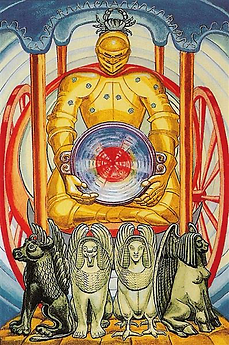
He stands upright, unmoving, hands not on reins. Control is internal, not mechanical. The sphinxes wait, statuesque, disciplined into silence. Nothing restrains them but his will. This stillness is not peace — it is containment, the held breath before force is released.
Above him, the canopy transforms the chariot into a moving throne. The crown he wears is ornate, heavy, and unmistakably public. It signifies honour, but also burden. Authority is not a reward here; it is a weight assumed.
Around the base, grass pushes up against the wheels — life indifferent to ambition. Even at the height of command, the earth prepares to reclaim what passes over it.
esoteric correspondences
“As above, so below: control the inner, and the outer will follow.” — Hermetic axiom
Astrologically, the Chariot corresponds to Cancer — not sentimentality, but defence. This is the sign of armour, enclosure, and territorial instinct. Cancer protects what it claims, but often confuses possession with care. Ruled by the Moon, its cycles bring fluctuation and projection: certainty today, doubt tomorrow, emotion steering judgement while believing itself rational. The Chariot advances under this unstable light.
In Kabbalah, the card aligns with Cheth, the fence — structure, boundary, vehicle. A fence protects, but it also excludes. It defines inside and outside, authority and threat. The Chariot’s strength lies in containment, yet that same containment becomes rigidity when no longer questioned. The vehicle that carries power forward also narrows vision, enforcing direction at the cost of reflection.
The opposing sphinxes embody divided forces — not harmony achieved, but tension sustained. They do not pull; they are held. The Chariot moves only so long as contradiction remains suppressed rather than resolved. At its front rests the winged solar disk, symbol of sanctioned authority and victorious sight, yet beneath it the yoni–lingam reminds us that conquest rests upon generative forces it often denies. Power here is not pure — it is borrowed, embodied, and fragile.

COSTUME & MOTIFS
“The greatest victory is that which requires no battle.” — Sun Tzu
The Charioteer wears full armour, wrought in gold and steel. It is ceremonial rather than battle-worn — unsmudged, untested, immaculate. This is the armour of preparation, not survival. His chest bears lunar crescents, waxing and waning across polished metal, reminders that power, like the Moon, is never constant.
A broad belt anchors his stance, binding lower instincts beneath disciplined posture. Blue garments trimmed in gold echo the heavens above, suggesting divine sanction — or at least the claim of it. His crown rises sharply, red and gold, asserting dominance and visibility. Yet his expression is remote, unreadable. His gaze is front but sight turns inward, fixed on intention rather than outcome.
At his feet, the sphinxes — one dark, one pale — are muscular and calm. They do not struggle. They wait. Their stillness is ominous: forces subdued, not reconciled. Between them rests the winged sun over the yoni–lingam, an ancient sign of sacred union buried beneath the machinery of conquest. The Chariot advances not through domination, but through enforced alignment — and enforcement always exacts a price.

archetype & psychology
Psychologically, the Chariot marks the stage where the ego asserts command over competing drives. It is individuation in motion — identity no longer forming, but acting. Yet this movement is precarious. The Chariot governs trajectory, not territory. Unlike the Emperor, who rules by structure, the Charioteer governs by momentum.
This archetype embodies discipline, ambition, and focus, but also the temptation of certainty. When will is mistaken for wisdom, progress becomes compulsion. Jungian analysis frames this as inflation: the ego believing itself sovereign rather than provisional. The Chariot does not integrate opposing forces; it subordinates them.
The lesson is severe. Unless inner divisions are acknowledged, victory remains unstable. Power held together by vigilance alone will eventually fracture. The Chariot promises direction, not safety. It teaches that mastery must be renewed constantly — or collapse will do the work instead.
upright Meaning
“If you live long enough, you'll see that every victory turns into a defeat.”
― Simone de Beauvoir
Upright, the Chariot signals triumph through focus and stamina. It marks the moment where opposing forces are held together, directed, and carried forward with confidence.
In relationships, it can show bonds strengthened by overcoming obstacles, commitment tempered by struggle, or attraction channelled toward enduring union.
In work, it indicates progress through perseverance, goals carried to completion by sheer discipline. Spiritually, it represents integration: shadow and light united into one motion, inner contradictions mastered into wholeness.
Upright, the Chariot reminds us that true victory is never accident but the fruit of relentless direction. At its best, it is courage with conscience, strength with restraint.
reversed meaning
““There is only one kind of shock worse than the totally unexpected: the expected for which one has refused to prepare.”
― Mary Renault, The Charioteer
Reversed, the Chariot warns of loss of control, collapse of direction, or arrogance mistaken for mastery. The sphinxes pull apart, momentum dissolves, triumph becomes fragmentation.
In relationships, it may show domination where love should be, or passivity where leadership is required. In work, it suggests wasted energy, projects abandoned, or hollow victories pursued at ruinous cost.
Spiritually, it speaks to divided will, unresolved contradictions undermining forward progress.
Yet even reversal instructs. The overturned chariot reveals the truth: ego alone cannot sustain triumph. Only by integrating inner opposites can outer life hold steady. Failure, humbling as it is, may be the very thing that makes genuine mastery possible.
here and now
“History does not repeat itself, but it often rhymes.” — Mark Twain
In our present moment, The Chariot’s shadow is visible everywhere. Leaders rise who drive forward without reins: strongmen politics, ideological crusades, technological acceleration pursued without pause. AI systems, and surveillance empires can be read as modern chariots — dazzling in speed, but threatening to outrun responsibility.
The modern world is saturated with Chariots in motion. Leaders proclaim climate salvation, yet emissions climb. Global summits set targets, but penalties fall on smaller nations and ordinary citizens, while the true elephants — China and India — charge on, multiplying emissions unchecked. Is this mastery, or hypocrisy gilded with banners?
Islamic fundamentalism remains a present force, destabilising societies abroad and sowing fear in Western streets. Politicians fear to name it, yet attacks, parallel laws, and intimidation prove its advance. The Chariot here is ideology in armour, advancing under often enforced silence from the majority.
Meanwhile, our own economies devour themselves in the cult of productivity. AI advances without restraint, surveillance expands, and ordinary people are driven like sphinxes to exhaustion. Burnout becomes the hidden epidemic of progress.
But the deeper question cuts harder: What use is progress if the prize is survival stripped of freedom? The Chariot demands this answer. The grass grows at our wheels, yes, but so too does fear. Unless we master ourselves, we will inherit not triumph but a world both habitable and unlivable.


shadow
“They are carried away by a stream of violence,
and the torrent sweeps them down.” — Seneca
In shadow, the Chariot is hubris embodied: conquest without conscience, direction without purpose, triumph measured only in motion. Without reins, the driver mistakes arrogance for mastery. The sceptre becomes command, the sphinxes reduced to servitude, their oppositions suppressed rather than reconciled.
The shadow of The Chariot is victory at any cost. It is willpower untempered by conscience, the drive to conquer even when there is nothing worth conquering. The absence of reins in my card makes this danger clear: control is guiding the chariot and sphynxs, but in shadow it is left to force of will and brute momentum. Without balance, the charioteer becomes tyrant.
In its shadow, The Chariot is conquest for spectacle, domination as self-justifying. Civilisation behind the warrior may be left behind, yet the impulse is always forward, trampling whatever lies beneath. The heavy crown weighs not as responsibility but as hubris, muffling humility, deafening to counsel. The armoured boot crushes grass and growth alike, symbol of life subdued under triumph.
Archetypally, this shadow is the intoxication of mastery. It is the individual convinced of invulnerability, the state convinced of destiny, the culture convinced of supremacy. The sphinx at the chariot’s front becomes riddle ignored, mystery silenced — the leader who presumes certainty when wisdom would pause. The duel of opposites, meant to be harmonised, is instead forced into submission. The result is not progress but collapse, for power without control is always devouring.
conclusion
The Chariot is triumph through balance, victory by uniting opposites, discipline harnessed to will. But its lesson is double: what is not mastered within will unravel outward victory. His promise is progress; his warning is futility.