the tower xvi
the fall and the fire
archetype & tradition
Where there is ruin, there is hope for a treasure.” Rumi
In the tradition, the Tower is the moment when a structure built on assumption is forced into contact with reality. It is not merely “catastrophe” as theatre; it is the collapse of what was never sound. In older iconography it carries the echo of Babel — the human dream of sovereignty, reaching upward without the humility of limits. But it also reaches further back than that: it is the archetype of the lightning-strike that corrects the lie, the visitation that refuses negotiation.
In my Tribute Tarot, I have kept the Tower’s essential severity, but I have made its logic visible. This is not random ruin; it is precision. The crown is cast down not because fate is cruel, but because false rule cannot endure the bolt of truth. The scene insists that “authority” without foundation is only performance — and performance ends when the stage catches fire.
The Tower is also a rite of passage in the Major Arcana’s moral sequence. It follows the Devil’s slow theatre of consent and collusion: bondage that persuades, chains that can be removed but are not. The Tower is what happens when that persuasion fails — when something in the psyche can no longer cooperate with the lie. Where the Devil is seduction, the Tower is exposure. Where the Devil is a contract with denial, the Tower is the breach of contract.
Traditionally, readers fear this card because it strips comfort. Yet the deeper tradition does not treat it as “evil”; it treats it as the harsh mercy of reality. The Tower destroys what cannot be lived in any longer. It removes the crown so the head might survive. It clears a ground where truth can stand. And because it is so uncompromising, it becomes, paradoxically, one of the most honest cards in the deck. The Tower does not ask for positive thinking. It asks for accuracy. It insists that what is cracked must be named cracked — and what is false must fall.

setting the scene
“Don't you know about the praying mantis that waved its arms angrily in front of an approaching carriage, unaware that they were incapable of stopping it?
Such was the high opinion it had of its talents."
Zhuangzi, The Complete Works of Chuang Tzu
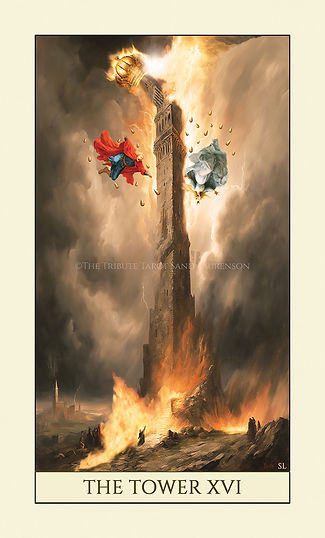
The Tower in my card stands stark against a dark sky, struck at its peak. Lightning tears into the crown. The golden diadem is hurled aside. Flames burst from stone. The structure is caught at the precise moment between arrogance and ruin — not after the fact, not softened by distance, but in the instant of rupture.
Figures fall: male and female, archetypal humanity, tumbling with equal helplessness. One is robed in red and blue — colours of authority and spirit — the other in white and blue, signifying faith, innocence, purity. Both are undone together, no station or virtue exempting them. Their bodies are caught mid-fall: arms flung outward, hair thrown wide by shock, identity torn loose from the role it clung to.
Golden drops fall around them — sparks from the rupture — both embers of destruction and seeds of revelation. Each drop is counted, deliberate, almost judicial. None are wasted. Even here, even in terror, the card insists on order: every collapse is exact.
At the base, fire burns outward. Witnesses stand in awe or terror. And that matters. The Tower isn’t private; it is seen. It is catastrophic, yes — but it is also theatre of truth: the public moment when the lie can no longer hold its shape. This is not a landscape of “bad luck.” It is a landscape of exposure. The air itself feels like judgement: a single, bright line of fact splitting the darkness.
esoteric correspondences
“In a sense, I'm the one who ruined me: I did it myself.”
― Haruki Murakami, 1Q84
The Tower corresponds to Mars: not “anger” in the sentimental sense, but force, impact, severance, confrontation — the energy that cuts through negotiation. Astrologically, it often leans toward Aries, the ram that charges and clears the way. This is martial truth: sudden, violent, decisive. The Tower does not persuade. It strikes.
Alchemically, the Tower belongs to calcinatio — the burning down of matter until only the irreducible remains. It is purification by fire: the ego’s ornament scorched away, the false alloy separated from the real metal. In this sense, the Tower is less about destruction than extraction: what survives the heat is what is true.
In the Kabbalistic stream, the Tower aligns with Peh (the mouth): speech that breaks spells. There is a particular brutality to Peh — it can bless, but it can also expose. The Tower is what happens when a truth is spoken (or realised) that can no longer be contained inside the old structure. The mouth opens, and the illusion collapses.
In my image, the golden crown cast down signifies false sovereignty: authority built on arrogance, splendour without substance. The lightning is archetypal revelation — not “divine fire” as comfort, but illumination that burns illusion away. Nothing about this card is random. Collapse is precise, deserved, inevitable — not because the universe is moral, but because reality is structural.
Even the counted drops (those golden sparks) speak to this: the fall is not chaos; it is consequence. The Tower’s “violence” is the violence of truth meeting a lie at full speed.

COSTUME & MOTIFS
“To be, or not to be: that is the question…” — William Shakespeare, Hamlet
The crown is blown away: sovereignty undone. Pride of rule, arrogance of command, splendour without foundation — all cast down in one motion. That crown is not merely a decoration; it is the whole claim of the Tower: I am above consequence. The bolt answers: no.
The falling figures are clothed, not naked. Their robes cling to their roles even as they plummet — and this detail shifts the meaning. The Tower is not only stripping flesh; it is stripping identity. Authority, faith, innocence, spirit — all fall alike. The garments become tragic because they reveal what the figures thought would save them: status, virtue, belief, position. The Tower spares no dignity because dignity is not the point; truth is.
The golden drops are counted — twenty-two — echoing the Hebrew alphabet: the full range of human speech and illusion. They rain down as sparks of destruction, but also as fragments of revelation. What was lofty becomes scattered across the earth. Splendour corrupted becomes fire — and fire does not flatter.
The lightning is the central motif. Unlike the Devil’s inverted torch — which parodies illumination — this bolt is not parody but revelation. It is not random fire but targeted strike: energy precise, exact, deserved or not. And because it is so exact, it reads as moral even when it is simply structural: truth hitting the lie at its weakest point. The Tower is not a moraliser; it is a fact.


archetype & psychology
“Crisis takes place when the old has not yet died and the new has not yet been born.” — Antonio Gramsci
Psychologically, the Tower is the archetype of collapse: the moment when psychic structures can no longer bear their weight, when denial has risen too high. The lightning is insight, revelation, breakthrough — and the breakdown it brings. This is not gradual change. It is the psyche saying: I cannot live this lie for another day.
The Tower’s fall is catastrophic for the ego because the ego depends on continuity. The persona — long constructed — is shattered. Illusions collapse. False identities dissolve. What remains is momentary, terrifying, emptiness, but also the chance for truth. The Tower is psyche’s ruthless honesty: what is false must burn.
The falling figures represent aspects of self undone: male and female, conscious and unconscious, authority and innocence — all cast down together. That “together” matters. The psyche does not dismantle one corner politely while preserving the rest. When the central lie falls, everything attached to it loses its foothold.
Archetypally, the Tower always strikes at necessity. It does not destroy for sport. It collapses only what cannot endure. Its destruction is crisis, but its gift is clarity. And clarity, while brutal, is often the beginning of freedom — the first time the psyche can breathe without the old structure pressing down on it.
This is why the Tower can be both terrifying and oddly clean. After it, there is less self-deception available. The mind may grieve the loss, but something deeper recognises the relief: the end of the exhausting performance.
upright Meaning
“Reality continues to ruin my life.”
Bill Watterson, The Complete Calvin and Hobbes
Upright, the Tower is sudden collapse, catastrophe, revelation. It marks endings that come without warning: structures destroyed by truth. It arrives when a situation has been held together by force of will, denial, or social permission — and then one fact enters the room and everything changes.
Relationships break apart, careers collapse, institutions fail, beliefs shatter. Yet the Tower is not merely loss; it is exposure. It insists that what has fallen was false, untenable, unsustainable. The fire is cleansing, not spiteful. The bolt is insight: the collapse is honesty.
In readings, upright the Tower demands surrender. Do not cling to what is gone. Accept collapse as necessary. Begin again — this time without lies. That may sound simple, but it is not. The Tower often requires the hard disciplines: admitting what you avoided, speaking what you swallowed, leaving what you kept “for appearances”.
Upright, the Tower can also be the moment of a long-delayed recognition: the exact second you see the pattern clearly — addiction, self-betrayal, a rotten bargain — and you can no longer pretend you do not. The cost is immediate, but the clarity is priceless.
And upright the Tower carries a hidden gift: catastrophe clears the ground. From the ashes, something true can be built — not quickly, not sentimentally, but cleanly. The Tower does not promise comfort. It promises a real foundation.

reversed meaning
“Never ruin an apology with an excuse.”
Benjamin Franklin
Reversed, the Tower is resistance to collapse. The structure shakes but still stands, the cracks patched, the flames smothered. Denial props up what must fall. This is the Tower as postponement: the refusal to let the necessary truth do its work.
This may show as a failing relationship prolonged by fear; a corrupt institution shielded by loyalty; a self clinging to illusion though cracks show everywhere. The reversal warns: delay does not prevent collapse. It makes the fall worse. The longer the lie is maintained, the more violent the eventual correction tends to be — because pressure accumulates.
Yet reversed the Tower can also mark aftermath. The worst has passed. The ruin is accepted. Rebuilding begins. In this sense, the reversal is survival: the Tower already fell, the ground already bare. What remains is damage control, adaptation, and the slow task of finding your footing without the old height.
Reversed, the Tower demands honesty in a different form: not the lightning-strike of revelation, but the steady refusal to varnish the ruins. Do not pretend what is broken can be saved. Accept collapse — or be dragged down with it.
The warning here is sharp: a maintained façade is not stability. If the Tower is already burning inside, it will show outside sooner than you think.
here and now
“In a time of deceit telling the truth is a revolutionary act.”
― George Orwell
In the modern world, the Tower often arrives through systems rather than weather. Institutions grow enormous, opaque, self-protecting — and then one leak, one image, one fact punctures the façade. Reputations built on curated narratives collapse in hours. The bolt is data, footage, receipts — the contemporary lightning that turns performance into ash.
We also live in an age of precarious scaffolding. Financial structures, digital identities, and social belonging can feel stable — until they aren’t. Jobs vanish, platforms shift, markets swing, rules change overnight. In such a world, the Tower is not rare; it is almost an atmosphere: the sense that the ground is less solid than it looked yesterday.
At the personal level, the Tower shows up as the moment a person’s private story cannot survive contact with reality. Not only “bad things happening,” but sudden clarity: the end of self-deception. The modern Tower is often an inbox, a diagnosis, a screenshot, a recorded sentence, an audit — not mythic thunder, but the clean violence of fact.
And yet our culture also fetishises collapse. Outrage becomes a sport. Cancellation becomes entertainment. The crowd gathers at the base of every burning tower, convinced it is watching justice. Sometimes it is. Often it is simply appetite — the old human hunger to see a crown tumble. The Tower warns against joining the crowd too quickly. It asks: Is this necessary truth, or just spectacle?
Here and now, the Tower is a demand for foundations. Not slogans. Not optics. Not “identity” as costume. The Tower reminds that whatever is built — in life, in work, in love — must be capable of surviving a lightning-strike of reality. If it cannot, then we are living in decoration. And decoration, eventually, burns.


shadow
“Facts do not cease to exist because they are ignored.”
― Aldous Huxley
The shadow of the Tower is not collapse — collapse is sometimes necessary. The shadow is the misuse of collapse: the appetite for destruction disguised as truth. It is the person who confuses cruelty with honesty, who sets fire to lives and calls it “integrity”. The Tower’s lightning becomes a weapon in the hands of the resentful.
Another shadow is addiction to crisis. Some psyches cannot tolerate steadiness; they provoke rupture because rupture makes them feel alive. They pull down what is good and workable because patience feels like death. They burn bridges, they shatter alliances, they sabotage love — and then they call the smoke “freedom”. That is the Tower as compulsion, not awakening.
There is also the darker moral shadow: the Tower as public humiliation. Exposure without dignity. Truth used as spectacle. This is the cultural delight in watching someone fall — the crowd at the base of the Tower, thrilled by flames, mistaking destruction for justice. In this distortion, the Tower becomes theatre rather than necessity.
Psychologically, the Tower’s shadow can show as nihilism after collapse: “If that was false, then everything is false.” The psyche, shocked by the fall, refuses the slow work of rebuilding and chooses emptiness as identity. It becomes proud of disillusionment. It wears cynicism like a crown — and that crown, too, will eventually be struck.
The Tower’s shadow is ultimately a warning about precision. The true Tower is exact: it collapses what cannot endure. The shadow Tower is indiscriminate: it destroys what could have been saved, simply because the psyche cannot bear the humility of repair.
conclusion
The Tower XVI is catastrophe, but also revelation. Its fire destroys pride, its bolt shatters lies, its fall clears the ground.
To draw this card is to face collapse — sudden, violent, unavoidable — but also to glimpse hope. The Tower levels what cannot stand, leaving bare ground on which something true may finally rise.
“A great hope fell - You heard no noise - The ruin was within.”
― Emily Dickinson