
creating this deck
“For us, there is only the trying, the rest is not our business.”
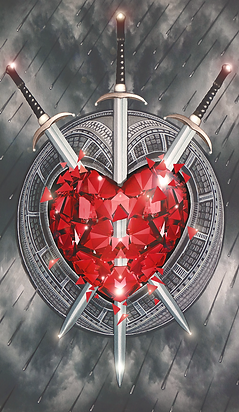
The artworks shown here are early studies and working experiments from the making of the Tribute Tarot — stages in the testing of material and method, not the final card images.

building structure
To make a tarot deck is to take an inherited structure and rebuild it by hand. Every choice — line, colour, proportion — becomes a negotiation between obedience and resistance. What began as a study in craft gradually became an exercise in endurance: years of drawing, revising, abandoning, and returning again.
The work was never simply illustration. It was an act of translation — from symbol to image, from tradition to present form. Familiar figures of the tarot were not redrawn for novelty, but re-examined to see what still held true. In that process, mistakes were unavoidable and often instructive. A misplaced line or uncertain tone became a reminder that control in art is always partial, always contested.
Every deck carries the history of its making. This one carries the marks of labour: late nights, revisions layered over earlier revisions, decisions corrected and reconsidered. Its surfaces are not perfectly smooth. They hold the sediment of time — the traces left by persistence rather than speed.
What emerged is less a finished object than a record of attention sustained over time. The Tribute Tarot was never intended as display, but as an attempt to build something that could hold its ground in a culture of haste — to test whether patience, proportion, and restraint still have weight.

the material and the myth
Creation begins in the tangible. Before symbol or story there is paper, pigment, graphite, and pressure — the friction between hand and surface. The Tribute Tarot did not begin with theory but with contact: the resistance of card, the hesitation of line, the slow negotiation between intention and material.
Yet the physical act of making was never separate from the symbolic one. The figures of tarot — The Fool, The Hermit, The Tower — are not inventions of fantasy but enduring images shaped by centuries of human reflection. To work with them is to encounter the continuity of human error, aspiration, fear, and renewal.
Materials themselves carry meaning. Graphite, ink, paper, and print are not embellishments but the vehicles through which thought becomes visible. They hold the tension between endurance and decay. When an image slips slightly in the press, when a line thickens or fades, the result is not merely technical but revealing: the distance between vision and its realisation.
To build a deck from such elements is to accept imperfection as evidence rather than flaw. The myth is not imposed on the card; it emerges through the process of making itself — a record of intention meeting resistance.

the discipline of seeing
To see clearly is work. It demands the same endurance as any craft, and the same resistance to self-deception. Making a deck at this scale was not an indulgence in inspiration but a sustained confrontation with attention. Every line became a test: was I seeing what was present, or what I expected to see?
The labour of drawing is psychological before it is physical. One must remain still long enough to recognise when precision becomes rigidity, or when discipline slips into avoidance. The tarot becomes a mirror of that balance: each card an act of observation made visible.
A misplaced gesture, an expression slightly wrong, a colour pushed too far — each reveals something of the maker’s state of mind. To work with archetypal images is to risk distortion if attention falters.
There is no mythology without scrutiny. A symbol only holds meaning if it withstands examination. The act of seeing therefore becomes a form of judgement — stripping away sentiment until what remains is proportion, structure, and presence.
In that sense the eye becomes the judge, and the hand its witness.

accident and correction
No artist escapes error. The question is not whether mistakes occur, but how they are carried forward. The early months of this project were a sequence of experiments: graphite studies, acrylic layers, diluted inks that echoed the uncertain textures of early printing. Nothing settled easily. Even the choice of card stock became part of the argument — should the original art gleam like porcelain, or breathe like parchment?
What emerged was a method shaped by both compromise and persistence. Each card carries traces of several techniques: graphite underdrawing, acrylic wash, digital refinement used sparingly to preserve detail, and the satin surface of the final print. The result is a language forged under consistent conditions rather than assembled from novelty.
The coherence of the deck came from returning repeatedly to its source. After many diversions, I returned to Pamela Colman Smith’s structure — her balance of clarity, narrative, and restraint. It proved difficult to improve upon without losing what made the original work endure.What remains is not a flawless system but a disciplined one: the meeting point between medieval symbolism, nineteenth-century engraving, and contemporary scrutiny.

tradition and inheritance
Every image begins inside another. No artist works in isolation; we labour in conversation with those who came before, whether acknowledged or not. The Tribute Tarot stands on ground prepared by others — the disciplined symbolism of Pamela Colman Smith, the visionary intensity of William Blake, and the monumental moral theatre of Gustave Doré. Their languages differ, but their intention was similar: to translate belief into image without sentimentality.
Inheritance carries responsibility. To work with archetypal forms is to inherit their long history of use and misuse. The artist becomes both interpreter and custodian. Change too much and the chain breaks; change too little and the work collapses into repetition. Each adjustment — a gesture altered, a composition rebalanced, a light redirected — must justify its place within centuries of precedent.
Researching earlier traditions made one fact clear: the most enduring images are those that refuse to flatter their time. Early woodcuts, illuminated manuscripts, and Renaissance emblems all belonged to their era, yet none were enslaved by fashion. Their authority lies in proportion rather than ornament.
Tradition, then, is not a museum but a dialogue. My own conversation was with the dead and the living alike — with Smith’s quiet precision, Blake’s defiance, Doré’s gravity, and the anonymous craftsmen who carved the first symbolic alphabets into wood and metal. To inherit their discipline is not to repeat their work, but to continue it.
What emerges is neither revival nor reinvention, but continuity: a line unbroken, though newly sharpened.

the artist as custodian
This deck marks a return rather than a conversion. For many years my practice moved through conceptual and abstract territories, shaped by questions more than certainties. Meaning often arrived slowly, through inference and time.
The tarot altered that direction. It required a different form of discipline: to work outward from the visible world rather than inward from the idea. It demanded respect for proportion, anatomy, and light — foundations that conceptual practice can sometimes ignore.
In returning to those foundations I rediscovered the ancient language of image as evidence. Drawing a mountain, a gesture, or a face is not an act of invention but of recognition. It is a dialogue with forms that already exist in the world.
This was not nostalgia, nor rejection of earlier work. It was a search for the ground beneath both — the place where intention and form meet through craft.

conclusion
The Tribute Tarot is one work among many, but it gathers several strands of my practice into a single frame. It holds the clarity of traditional craft alongside the questioning impulse of conceptual thought.
The project stands in quiet tension with some of my earlier beliefs about art and process. Yet it suggests that realism can still carry philosophical weight — that precision does not exclude depth, and that careful making can still hold meaning.
When I began, I had no ambition to make a statement. I only wanted to produce something I could stand beside without reservation. What emerged feels less like a declaration than a return — a rediscovery of where I began before theory threatened to outrun instinct.
Whether that return endures I cannot yet know. But the deck remains as evidence that meaning can still survive through technique, and that beauty — handled without sentiment — still has a place in art.
↩ Return to Architecture of the Deck
— where the structure behind the cards is revealed
↪ Continue to An Artist’s Tarot
— where the images themselves unfold