
the
wounded tarot
“Art is restoration: the idea is to repair the damages that are inflicted in life.”
Louise Bourgeois - Artist

the first proof & production
After receiving a proof that met the agreed specification — aligned borders, precise logo placement, and a smooth satin finish — I signed off in writing. At that point, the edition felt resolved. The work had found its form.
Two weeks later, the production run arrived altered.
The borders on the card backs had shifted beyond what I consider acceptable for a fine-art edition — not dramatically, but enough to disturb the balance. The lid image had been compressed at the crown, distorting the central emblem — the face of the deck itself. The surface of the box no longer held the quiet, even finish of the approved proof.
These are not incidental adjustments. In a work built on proportion and repetition, small deviations alter the whole. What should sit still begins to move. What should feel held begins to loosen.
The imagery itself remained intact — colour, weight, and structure held. But the discipline around it — the frame that steadies the image and gives it authority — had been compromised.

tolerance & decision
In the correspondence that followed, responsibility for the lid distortion and box finish was acknowledged. The border shift was described as “within tolerance.”
The options presented were simple: authorise destruction of the full batch and consider a future reprint, or accept the edition as it stood.
To destroy the decks would have been to erase not only the work, but the evidence of what had occurred — to remove the mark of the process and the labour already invested.
The edition was not conceptually flawed, nor was it unusable. What had shifted was not the work itself, but the way it met the world: its alignment, its surface, its face.
At that point, trust in the production process had ended. The work itself had not. The decision was therefore not a compromise, but a position: to retain the edition, and to name it.
The Wounded Edition is not a correction, but a decision — to retain the work as it was made, and to release it as it stands.
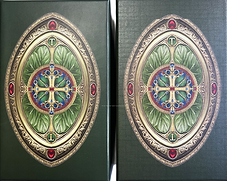
the choice
The printer’s position was clear: return the decks for destruction, entrust the project to them again at a future date, or accept the loss.
To destroy the decks would have removed the evidence of what had occurred and erased five years of completed work. The issue was not the art itself, but its reproduction — not concept, but execution.
I chose not to have them cut apart.
The work remains.

the reality of making
Art rarely fails in its making. It falters in the passage between creation and delivery — where precision depends on shared standards.
This project was built without sponsorship or institutional backing. Every hour, every cost, was carried in full. The work was not speculative; it was resolved.
When those standards shifted, the question was no longer technical. Printing, like any craft, relies on agreement. When that agreement breaks, clarity becomes necessary.
What is revealed here is not failure, but the point at which control gives way to process. The work leaves the hand and enters a system governed by others — where intention must rely on trust. When that trust fractures, the artist is faced not with correction, but with choice.

moving forward
The first edition of The Tribute Tarot now exists as the Wounded Edition, in 78 decks only. The imagery remains clear. The structure holds.
The deviation lies in alignment, in surface, in the distortion of the lid — visible, but not structural.
Each deck records a moment where intention and outcome diverged — not in the work itself, but in its translation.
These decks are not replacements. They are not seconds. They are the first state of the work, preserved rather than withdrawn.
The edition disperses now, as limited decks and — card by card — forming what becomes the Scattered Deck: a distributed body of the work that carries this history forward.

conclusion
The Wounded Edition is not an error set aside, nor a version corrected in hindsight. It is the work as it entered the world — altered in its making, but intact in its intention.
To destroy it would have been to remove both the object and the moment that shaped it. To preserve it is to acknowledge that the conditions of making are part of the work itself — not separate from it.
The decision, then, was not simply to keep the edition, but to change its condition.
Only 78 decks will be held as complete sets,, others will be opened, and — one card at a time they will be released. Each card moves outward, carrying the structure with it — not diminished, but redistributed.
This movement is not preservation alone, but continuation.
What is released here becomes the means by which the work can return — corrected, resolved, and carried forward into its next state.
The Wounded Edition does not conclude.
It continues in the 78 wounded decks and as The Scattered Deck— not as a fixed object, but as a living system, shaping eventually through dispersal as a Living Map of each cards landing in the world.

limited edition - 78 - 2025
The first edition, as produced — not as approved.
-
View the Living Map

