


the suit of cups
the element of emotion
“The cure for anything is salt water: sweat, tears, or the sea.” — Isak Dinesen
ELEMENT & ESSENCE
“The soul is like water: it comes from heaven, it rises to heaven, and down again to earth in an eternal cycle.” — Goethe
The Suit of Cups belongs to Water — the element of attachment, memory, and inner continuity. Water nourishes, but it also reshapes what it touches. It erodes slowly, accumulates quietly, and exerts pressure without spectacle.
In these cards, emotion is not sentiment but influence. Longing, devotion, grief, projection — these currents shape behaviour as decisively as law or ambition. Water moves beneath the surface of action. What appears gentle may be relentless; what appears passive may alter the landscape entirely.
Unlike Fire, which asserts, or Air, which divides, Water binds. It connects and entangles, restores and dissolves. Its force is gradual but cumulative. The discipline of this suit lies in containment — not repression, but form. Without boundary, water floods; without depth, it stagnates.

ARCHETYPES & THEMES
“In one drop of water are found all the secrets of the ocean.” — Kahlil Gibran
The archetype of the Cup is the relational temperament — attuned to nuance, responsive to atmosphere, sensitive to the unseen exchange between people. This disposition seeks connection, belonging, and meaning.
Water steadies through care, but it can also blur distinction. Compassion may clarify truth, or obscure it. Devotion may strengthen commitment, or tether one to illusion. The strength of this suit lies not in intensity of feeling, but in discernment within it.
Where Fire tests will and Air tests thought, Water tests sincerity. It asks whether attachment is mutual or projected, whether grief is honoured or prolonged, whether love is grounded or idealised. The work here is not to feel less, but to see clearly within feeling.

DECANS OF WATER
“There is a tide in the affairs of men, which, taken at the flood, leads on to fortune.” — Shakespeare
According to some, each Cup card belongs to a precise portion of the zodiac. A useful guide if you are interested in using a card as a querent significator based on birth date.
II of Cups: 0°–10° Cancer 21 June–1 July
III of Cups: 10°–20° Cancer 2–11 July
IV of Cups: 20°–30° Cancer 12–22 July
V of Cups: 0°–10° Scorpio 23 Oct–1 Nov
VI of Cups: 10°–20° Scorpio 2–11 Nov
VII of Cups: 20°–30° Scorpio 12–22 Nov
VIII of Cups: 0°–10° Pisces 19–28 Feb (29)
IX of Cups: 10°–20° Pisces 1–10 March
X of Cups: 20°–30° Pisces 11–20 March
Whether you abide by them or not, these decans remind us that water always carries a tide. Emotion gathers, crests, and ebbs. To master water is to know its timing.


myth and meaning
“Water is the driving force of all nature.” — Leonardo da Vinci
The Ace of Cups marks the beginning of emotional life, not as sentiment but as initiation. In myth, the cup is never neutral. The Holy Grail restores only those prepared to face themselves without disguise. The lovers’ shared cup seals devotion. In communion, the chalice binds community through sacrifice and remembrance. To drink is to enter covenant.
Yet the cup also carries danger. Folklore and history remember the poisoned chalice — the gift that destroys, the sweetness that conceals harm. Water heals and it dissolves; it baptises and it overwhelms.
What fills the cup determines its consequence: devotion or dependency, compassion or collapse. Feeling is not virtue in itself; it is potential. Honoured with maturity, it deepens into love and moral awareness. Indulged without boundary, it floods judgement and confuses intensity with truth.
Decan Dates (Astrological Note): The Ace is not bound to a single decan. It is the root of water itself — Cancer, Scorpio, and Pisces held in potential.

ace of cups
the well of emotion
“Love is the water of life.” — Rumi.
UPRIGHT
“There is a crack in everything, that’s how the light gets in.” — Leonard Cohen
Upright, the Ace of Cups signals the arrival of genuine emotional or spiritual substance — something offered rather than pursued. This is not desire chasing fulfilment, but receptivity: the moment when feeling, compassion, or connection presents itself unforced.
Psychologically, this speaks to emotional openness that is neither naïve nor indulgent. It marks a capacity to receive without collapsing boundaries — to allow feeling without being consumed by it. The two hands holding the Cup reinforce this: it is held with care and responsibility.
In relationships, this can indicate the beginning of authentic intimacy — not infatuation, but mutual presence. In life, it marks a moment of renewal where feeling restores rather than overwhelms. The Cup may overflow, — but into awareness, not chaos.

REVERSED
“We never know the worth of water till the well is dry.” — Thomas Fuller
Reversed, the Ace of Cups points to blockage — not the absence of feeling, but resistance to receiving it. Emotion is withheld out of fear, pride, or self-protection.
This may manifest as emotional numbness, guardedness, or an insistence on self-sufficiency that refuses help or intimacy.
Psychologically, this is often rooted in
disappointment or betrayal — a decision, conscious or not, that feeling is too costly.
Alternatively, reversal can indicate emotional excess without grounding. The Cup still overflows, but without containment it floods judgement. Feeling becomes self-referential, performative, or manipulative — intensity mistaken for depth.

scene & symbols
For the moment I know this: there are sick people and they need curing.”
― Albert Camus, The Plague
The chalice in my card is ornate and deliberate: cobalt blue, edged with gold filigree, luminous against an open, ethereal sky. This is not a humble vessel. It signals value, reverence, and gravity. What it holds matters. Emotion here is precious, not casual.
Unlike the Pamela Colman Smith Ace, where a single hand reaches from the clouds to claim the cup, this chalice is held by two human hands. The difference is essential. My is entrusted, the hands offer but also cradle. It must be balanced, not possessed.
The Cup overflows — not in neat streams but in excess. This is intentional. Feeling here is not calibrated or managed; it exceeds measure. The twenty-two yods descending from the Cup suggest feeling breaking into thought — emotion articulated into inner language. What is received here is not vague sensation but experience rendered intelligible, the psyche beginning to name what it feels.
Below, red lotus blossoms open on dark water. Their roots lie in mud, yet their petals remain unstained. This is not metaphorical purity but biological fact — the lotus’s self-cleaning surface. Symbolically, it speaks to resilience rather than innocence: the capacity to rise from difficulty without being defined by it.
The background remains open and luminous, offering space rather than enclosure. Emotion here is not trapped or walled in. There is room to feel without suffocation, to experience without collapse. The scene insists that depth need not mean drowning — provided the vessel is respected.
The card does not romanticise emotion; it dignifies it. Feeling is shown as powerful, vulnerable, and demanding care. The Cup is beautiful — but it is heavy. It must be held with both hands.
shadow
“Here comes the flood.” — Peter Gabriel
The shadow of the Ace of Cups is emotional absolutism — the belief that feeling itself is truth, beyond judgement or consequence. Here, the Cup overflows not with grace but with excess: sentiment replaces discernment, vulnerability becomes currency, and emotion demands exemption from responsibility.
Archetypally, this is the peril of the open vessel. Compassion becomes indulgence; forgiveness becomes denial; love becomes refusal to see clearly. The Cup, no longer held steadily, spills into confusion. Feeling insists on primacy over structure, and the self drowns in its own interior weather.
In religious terms, the shadow inverts the Eucharistic image. Grace is no longer received humbly but presumed automatically. The sacred is sentimentalised; transcendence is reduced to mood. When the dove is assumed rather than awaited, reverence collapses into entitlement.
Psychologically, this shadow manifests as emotional dependency, porous boundaries, or identity built around sensitivity itself. Pain becomes proof of depth; tears become evidence of virtue. The self clings to feeling because without it there is emptiness — and so emotion is amplified, curated, or unconsciously weaponised.
At its darkest, the Ace of Cups shadow is emotional manipulation disguised as care: “If you loved me, you would feel as I feel.” Here, the Cup is no longer a gift but a demand — and what should nourish instead consumes.


here & now
“Sentimentality is the emotional promiscuity of those who have no real feeling.” — Norman Mailer
In the present moment, the Ace of Cups confronts a culture saturated with feeling yet starved of depth. Emotion is everywhere — broadcast, incentivised, algorithmically rewarded — while genuine intimacy becomes increasingly rare. We are urged to “feel everything,” but given few structures for holding what we feel.
Public life now trades heavily in emotional display. Outrage, grief, compassion, and confession circulate faster than understanding. In this climate, the Cup is perpetually tipped toward the camera. What matters is not whether feeling is integrated, but whether it is visible. Emotional exposure becomes performance.
The language of care is especially vulnerable to distortion. Compassion is invoked to silence discernment; empathy is demanded without limits. To question, to pause, or to refuse is framed as cruelty. In this way, the Cup is weaponised: feeling replaces judgement, and moral clarity is drowned beneath affect.
Social media intensifies this pattern. Personal pain is rewarded with attention, while restraint appears cold or inauthentic. The result is emotional exhaustion — a constant overflow with no vessel strong enough to contain it. Many withdraw not because they feel nothing, but because they feel too much, too often, without meaning.
Yet the card also offers correction. The Ace of Cups does not call for emotional withdrawal, but for stewardship. Feeling must be received, not exploited; shared, not monetised; honoured, not endlessly displayed. In a culture of emotional noise, the work is not to feel louder, but to feel more truthfully.
conclusion
The Ace of Cups is emotion at its source — abundant, demanding, transformative.
Overflow may cleanse or it may drown.
↑ Back to Index
ii cups
the pact of union
"Courage my Love"

MYTH & MEANING
“I have decided to stick to love...
Hate is too great a burden to bear.” ― Martin Luther King Jr
The Two of Cups is the archetype of encounter, union, and covenant. Where the Ace was overflowing potential, the Two is commitment: the first act of reciprocity. It embodies not only romantic attachment but also the deeper archetypes of friendship, alliance, and reconciliation.
In Greek philosophy, Plato described love as a form of divine madness — a force that unsettles reason and compels souls toward one another. This passion may exalt, but it also destabilises, showing that love is as much ordeal as blessing. Aristotle, by contrast, insisted that the highest form of of love was friendship, the mutual recognition of another’s good. The Two of Cups embodies both streams — the ecstatic pull of eros and the steadying mirror of philia.
This card also reminds us that covenant is never weightless. Vows bind as much as they uplift. Union requires choice and work; it is not mere reflection in the eyes of another but an active, enduring recognition.
Decan: June 21– June 30. First decan of Cancer, ruled by Venus.

upright
“Words are easy, like the wind; faithful friends are hard to find.”
― William Shakespeare
Upright, the Two of Cups speaks of recognition rather than romance. It is the moment two figures meet not to merge, but to acknowledge one another as equal and distinct. This is not intoxication, nor projection, but consent: I see you, and you see me. What is formed here is a covenant — voluntary, mutual, and sustained by balance rather than desire alone.
In relationships, this card describes intimacy grounded in parity. Each party retains sovereignty; neither consumes the other. Love here is not hunger but exchange. It grows through attentiveness, respect, and the willingness to meet again and again in good faith.
In work and collaboration, the Two of Cups signifies partnership built on shared values rather than convenience. Agreements hold because both sides honour their word. Power is not extracted but distributed; neither dominates nor dissolves. Alliances flourish when each voice is heard and neither is sacrificed for momentum.
Psychologically, the upright Two marks reconciliation within the self. Divided aspects — reason and instinct, feeling and judgment — are brought into dialogue. This is inner coherence, not self-indulgence. The card affirms that wholeness arises not from erasing difference, but from holding it without hostility.

reversed
“Love is so short, forgetting is so long.”
― Pablo Neruda
Reversed, the Two of Cups reveals imbalance within connection. Recognition falters; reciprocity thins. One may give more than the other, or both may cling to the form of union while its substance quietly drains away. What once felt mutual becomes transactional, uncertain, or strained.
In relationships, reversal often signals misalignment rather than absence of feeling. Affection may persist, but trust erodes. Care turns conditional; communication grows cautious or defensive. Bonds fray not from lack of emotion, but from the failure to meet each other honestly.
In work or partnership, this reversal points to agreements that no longer reflect reality. The pact remains on paper, but not in practice. One party carries disproportionate weight; the other withdraws, avoids, or exploits. Cooperation collapses when parity is lost.
On a psychological level, the reversed Two of Cups reflects inner division. Parts of the self refuse dialogue; contradiction hardens into stalemate.
One impulse dominates while another is silenced. This internal fracture often mirrors outer relational breakdowns.

scene & symbols
“Don’t walk in front of me… I may not follow
Don’t walk behind me… I may not lead
Walk beside me… just be my friend”
― Albert Camus
In my card, two figures stand facing one another, each holding a gold chalice. Their hands are steady, their gazes level, and their postures convey mutual acknowledgement and respect.
The female figure wears a white gown embroidered with gold brocade, dignity tempered with radiance. From beneath her hem a single red shoe peeks, a reminder of vitality and passion within purity. Around her head is a garland of ivy — evergreen, signifying constancy and endurance.
The male figure wears garments in ochres, greens, yellows, reds, and oranges — earthy yet passionate. His yellow toned boots describe thought behind emotion and recall the medieval knight, chivalric and steadfast. Around his head is a garland too, but woven with red blooms, a subtle allusion to passion, blood and sacrifice.
The sky above is a clear blue, expansive and serene. Beneath their feet, the ground is fertile green, strewn with yellow-toned flowers — reminders that in true relationship the mind is as vital as the heart. This is no barren stage but a living earth, fertile with growth and ideas alike.
Above them rises the caduceus: twin serpents entwined around a staff, crowned with the red lion’s head. The serpents evoke wisdom and healing, the lion passion and courage. Together they mark the bond as both challenge and strength, demanding discernment and bravery.
shadow
“Love is an irresistible desire to be irresistibly desired.”
― Robert Frost
The shadow of the Two of Cups is archetypal distortion: Plato described love as a divine madness — a force capable of lifting the soul, but equally able to unseat reason. In shadow, this madness dominates. Love hardens into obsession; devotion into possession; recognition into self-projection. To see only oneself reflected in another’s eyes is not union but delusion, a narrowing masquerading as intimacy.
In this card’s shadow, covenant is betrayed not through absence of feeling, but through its excess. Love becomes control, friendship becomes rivalry, trust curdles into suspicion. What was meant to endure now wounds. Bonds fray not because passion dies, but because it refuses restraint.
Eros without philia — passion without friendship — is unstable. Without steadiness, love collapses inward upon itself. Myth reminds us of tragic pairs such as Tristan and Isolde, Romeo and Juliet, whose devotion consumed rather than sustained them. The darker truth of the archetype is uncompromising: that which uplifts can equally destroy.
There is also the archetype of betrayal as the false friend — the intimate who turns. Betrayal cuts deepest when it comes from those closest, because only they possess the power to wound the heart’s core. Myth and history alike remind us that betrayal is both distant and near; it is often carried out by those within the circle.


here & now
"An insincere and evil friend is more to be feared than a wild beast;
a wild beast may wound your body, but an evil friend will wound your mind.”
― Buddha
In the present moment, the Two of Cups confronts a culture that confuses connection with proximity and agreement with intimacy. Contact is constant, but recognition is rare. We speak more than ever, yet listen less; we announce alignment while avoiding the slower work of understanding. Bonds are formed quickly and dissolved just as fast, often without anyone having truly been met.
Technology accelerates this erosion. Relationships are curated, branded, and filtered, encouraging projection rather than encounter. Others become mirrors for identity rather than separate beings with their own weight and resistance. The result is connection that feels intense but proves fragile under pressure. When difficulty arises, there is no covenant to hold it.
There is also a quieter modern distortion: the fear of asymmetry. We expect perfect balance at all times, forgetting that real relationships ebb and strain. When reciprocity falters briefly, bonds are abandoned instead of repaired. The demand for constant equilibrium prevents endurance from forming.
Genuine connection requires risk, patience, and the willingness to remain present when recognition wavers. Covenant is not sustained by likeness alone, but by honour — the choice to continue meeting the other as other, even when reflection fails.
conclusion
The Two of Cups is covenant embodied: a pact, a promise, a mirror held between equals.
Union here is not fantasy but labour: to sustain equality, and to resist the temptation of possession.
↑ Back to Index
myth and meaning
“Let us learn to show our friendship for a man when he is alive and not after he is dead.” ― F. Scott Fitzgerald
The Three of Cups extends the promise of the Two into fellowship, celebration, and community. Where two made covenant, three makes circle. This card represents not merely relationship but the social fabric that sustains life.
Classical myth often cast three women in symbolic roles: the Three Graces, who embodied charm, beauty, and creativity, forever linked in a dance of reciprocity; the Fates, weaving and cutting the threads of life. The number three is archetypal — it represents the smallest unit in which society can exist.
Ancient writers distinguished between friendship born of pleasure, or virtue. The Three of Cups belongs to pleasure and virtue both: the joy of gathering, of sharing the cup, of marking abundance together. At its heart, this card recognises the double nature of celebration. It can lift the spirit and strengthen bonds, but it can also blur truth, conceal discord, or mask envy.
Decan: July 1 – July 10. Second decan of Cancer, ruled by Mercury. This decan signals communication, celebration, and shared ritual.

UPRIGHT
“To like many people spontaneously and without effort is perhaps the greatest of all sources of personal happiness.”
― Bertrand Russell
Upright, the Three of Cups speaks of shared joy — not private fulfilment, but celebration that exists only because it is witnessed and reciprocated. This is the card of fellowship, of gathering after hardship, of raising a cup not to escape reality but to affirm survival, friendship, and continuity.
In work and creative life, it marks collaboration that is genuinely mutual. Success is not hoarded or leveraged for dominance, but acknowledged collectively. Each participant strengthens the whole, and recognition circulates rather than congeals at the top. The card favours environments where morale matters, where trust is built through shared effort and honest appreciation.
In relationships, the Three widens the lens beyond romance. It honours the circle that sustains intimacy — friends, kin, chosen family — and reminds us that love withers in isolation. Joy multiplies when it is shared, and endurance becomes possible when others are allowed to witness both triumph and fatigue.
Psychologically, this card represents integration: the alignment of inner life with outer belonging. It suggests emotional health expressed outwardly, the cup is raised because one is not alone.

REVERSED
“Good friends are hard to come by.. I need more money.” ― Bill Watterson
Reversed, the Three of Cups warns that celebration has tipped into excess. Pleasure becomes compulsive, connection becomes performative, and fellowship thins into noise. What once restored now distracts; what once united now fragments.
In work, this reversal can indicate cliques, favouritism, or a culture of surface camaraderie masking rivalry. Team spirit becomes a costume worn for advantage. Praise circulates selectively, and exclusion is disguised as humour or tradition.
In relationships, the reversed Three points to interference, gossip, or the erosion of trust through third parties. Bonds are strained not by absence of feeling, but by too many voices, too much comparison, or loyalty divided by attention-seeking dynamics. What should bless the union complicates it.
For the self, the card cautions against escapism. Pleasure pursued without restraint erodes resilience; constant stimulation replaces genuine replenishment. Joy that is never examined curdles, leaving fatigue in its wake.
The reversal asks not for abstinence, but for honesty: when does celebration cease to nourish and begin to anesthetise?

scene & symbols
“Let us be grateful to people who make us happy;
they are the charming gardeners who make our souls blossom.” — Marcel Proust
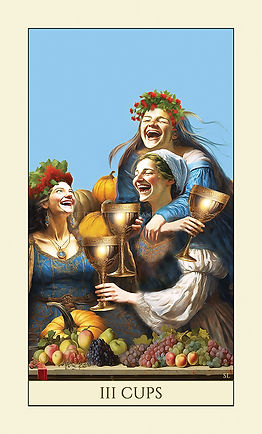
In my card, three women lift their cups in unison, forming a circle of recognition and joy. Each is crowned with garlands of red flowers, symbols of passion and life-force, yet each distinct in colour and dress, affirming individuality within unity.
They are on fertile ground. Pumpkins and fruit are all around them, signifying abundance, harvest, and sustenance. The ground is not barren celebration but rooted in the cycles of labour and reward. Yellow-toned flowers bloom around them, carrying the note of intellect as well as pleasure — reminding us that friendship is not only emotional but also thoughtful.
Their raised chalices are gold, radiant with light, and the sky behind is blue and open. The scene is celebratory but also balanced, contained within the circle of three. Unlike Pamela Colman Smith’s card, where the figures raise their cups in an open dance, mine stress acknowledgement and reverence: they are not merely drinking but toasting to bonds that endure. The imagery speaks of harvest and culmination: what was begun in covenant (Two) now blossoms into celebration (Three).
shadow
“False friends are like our shadow, keeping close to us while we walk in the sunshine,
but leaving us when we cross into the shade.” — Christian Nevell Bovee
The shadow of the Three of Cups is intoxication — not only of wine or pleasure, but of belonging itself. Fellowship becomes indulgence, loyalty becomes performance, and joy turns into a currency to be spent rather than a bond to be honoured. What begins as shared warmth can curdle into rivalry, envy, or quiet betrayal.
Archetypally, the triad carries both blessing and danger. The Three Graces dance in harmony, yet the Three Furies arise where bonds are violated. Myth insists that celebration invites shadow as surely as light. Where voices are raised together, discord may enter unnoticed — especially when pleasure dulls discernment.
In this shadow register, friendship decays into flattery. The circle tightens, becoming exclusive rather than welcoming. Inclusion is granted conditionally; dissent is punished socially rather than spoken aloud. Gossip replaces truth, and loyalty is measured by silence rather than integrity. What once embraced now encloses.
The wound cuts deepest when betrayal comes from within the circle. Trust, once broken by a friend, cannot be repaired by nostalgia or ritual. Toasts ring hollow where truth is absent. The cup is still raised, but it no longer blesses — it numbs.
At its darkest, this shadow reveals pleasure as escape. Celebration becomes avoidance; communion becomes dependency. The card warns that joy without grounding is as destructive as sorrow without hope. Fellowship that refuses honesty ultimately devours itself.


here & now
“Don't believe your friends when they ask you to be honest with them.
All they really want is to be maintained in the good opinion they have of themselves.”
― Albert Camus
The Three of Cups in our age reflects how friendship has been redefined and diluted. Digital life equates a “like” with loyalty and a “follower” with a friend. Communities are measured in numbers, but substance often falls away. The circle expands outward but rarely deepens.
For the young, this is acute. Friendships form instantly through apps and feeds, yet they are fragile, easily broken by silence or disagreement. Online, the definition of “friend” has stretched so far that it risks meaninglessness. Connection is abundant but often shallow, creating a generation surrounded yet lonely.
For those in middle years, friendship is often sacrificed for work, family, or mobility. Communities are scattered by jobs and relocations. Celebrations are postponed or reduced to obligation. Here, the loss is quieter but no less sharp: the thinning of trusted circles that once sustained resilience.
For the old, the cost is stark. Friends die, families scatter, and isolation grows. Celebration seems impossible when no one remains to raise the cup. The disappearance of communities — the village hall, the church fête, the local pub — leaves elders cut off from ritual and fellowship. The absence of friendship here is not inconvenience but grief, a wound that cuts to the root of human need.
The Here & Now of the Three of Cups asks us to look unflinchingly at fellowship today. Visibility has replaced presence; performance has replaced participation. The card insists that joy requires witnesses who remain when pleasure ends — and that true friendship must be cultivated deliberately, protected from excess, and anchored in truth.
conclusion
The Three of Cups celebrates fellowship, joy, and shared abundance. Celebration without substance is hollow. true friendship demands loyalty, endurance, and truth beneath the mask of festivity.
↑ Back to Index
iii cups
the celebration
"In prosperity our friends know us; in adversity we know our friends." John Churton Collins
iv cups
the unclaimed gift
“Gratitude is not only the greatest of virtues, but the parent of all others.” — Cicero

MYTH & MEANING
“The opposite of love is not hate, it’s indifference.” — Elie Wiesel
The Four of Cups embodies the archetype of the unclaimed gift: the blessing extended, the opportunity offered, but the receiver hesitating — or refusing — to take it.
In myth, ingratitude was punished as gravely as betrayal. Kings lost kingdoms not only through arrogance but through failure to honour what was given. Narcissus, gazing endlessly at his reflection, wasted the gifts of life. Tantalus, surrounded by water and fruit, could not drink or eat. These tales remind us that apathy can destroy as surely as greed.
Yet hesitation is not always ingratitude. In some traditions, the gift refused was not scorned but weighed carefully. Heroes paused before answering the call, not out of disdain but out of fear, caution, or the scars of earlier defeats. The Four of Cups holds this spectrum: laziness, timidity, caution, even wisdom in waiting.
Decan: July 11 – July 20. Third decan of Cancer, ruled by the Moon. A time of reflection and caution.

UPRIGHT
“Silent gratitude isn’t much use to anyone.”
— Gertrude Stein
Upright, the Four of Cups marks a moment of withdrawal in which abundance has lost its flavour. The three cups already received represent achievements, comforts, or relationships that once nourished but now feel inert. The fourth cup — extended yet unseen — is not a promise of more, but a demand for attention.
Psychologically, this is the danger point between contemplation and refusal. Reflection can deepen perception, but here it risks calcifying into superiority — the belief that nothing presented is worthy, that one’s discernment excuses inertia. The figure mistakes restraint for wisdom, distance for depth.
In work and vocation, the Four often appears when success has become hollow. Goals once chased have been attained, yet satisfaction fails to follow. The card warns against confusing dissatisfaction with insight. What feels like discernment may be exhaustion, boredom, or fear of recommitment.
In relationships, upright Four of Cups signals emotional withdrawal disguised as neutrality. Affection may still exist, but gratitude has withered into habit. What is refused here is not love, but presence.
Ultimately, the upright Four asks for honest reckoning: to recognise the offered cup is not to accept it blindly, but to admit that life still addresses us — whether or not we choose to answer.

REVERSED
“A man who lacks gratitude is only half alive.”
— Elbert Hubbard
Reversed, the Four of Cups intensifies the same tension, but shifts it toward rupture. Either apathy deepens into rejection, or gives way to sudden awakening. What has been ignored demands response — gently or violently. In its darker form, gratitude curdles into resentment; discernment becomes disdain.
Opportunities are dismissed reflexively, relationships erode through neglect, and the self takes pride in non-participation. The refusal becomes identity.
Yet reversal can also mark a breaking point. The spell of indifference cracks. A neglected bond threatens to vanish and the cost of disengagement becomes undeniable. What returns is not naïve enthusiasm, but sober recognition — a reckoning with what has been squandered.
In work, this reversal may signal either continued stagnation or abrupt re-engagement. The reopening is often uncomfortable: the realisation that waiting was not wisdom, and that renewal now requires effort rather than inspiration.
In relationships, reversed Four of Cups may expose emotional negligence — the moment when distance is no longer neutral but damaging. Alternatively, it can herald the return of gratitude, the conscious choice to value what remains before it is lost.

scene & symbols
“The greatest danger to our future is apathy.” Jane Goodall
In my card, a young man sits beneath a supporting tree, a figure withdrawn into thought. He wears a red tunic, a colour of life and action, though here it is dormant — vitality turned inward. His blue leggings suggest reflection, the realm of thought, while a glint of armour across his body points to caution and defence. He is not naïve: he knows battle, and perhaps carries scars.
Three golden cups rest before him, trophies of what has been achieved. These may be pleasures earned through effort, or blessings already received. They stand as proof that he has acted before, that he can create and claim. Yet above him another chalice is offered — luminous, almost ethereal. Yet his hand cups his chin, pondering or ignoring, as though weighing risk and worth.
The tree rises straight and firm, supporting his withdrawal rather than distorting it. Its roots tether him to the ground, suggesting both security and attachment. The sky is pale, watchful, waiting for his decision. The chalice is not an illusion but a genuine possibility. Whether ignored or simply deferred, its presence demands response.
shadow
“Do not spoil what you have by desiring what you have not;
remember that what you now have was once among the things you only hoped for.”
― Epicurus
The shadow of the Four of Cups is apathy hardened into vice. It is laziness masquerading as refinement, disdain disguised as discernment. Here, the refusal of the cup is no longer thoughtful but contemptuous — a rejection of connection elevated into principle.
Archetypally, this is the sin of ingratitude: the belief that what is offered is beneath one’s imagined standard. The shadow figure does not lack gifts; he despises them. He rejects not because he has nothing, but because nothing satisfies his entitlement. The common feast is scorned in favour of an abstract ideal that never arrives.
Myth and history are filled with this failure. Blessings ignored become wounds; abundance refused turns corrosive. The unreceived gift does not vanish — it curdles into bitterness, poisoning both giver and receiver. What was meant to bind becomes a source of resentment.
Psychologically, this shadow drains vitality. It is not contemplation but corrosion: the slow erosion of engagement until colour drains from experience itself. Withdrawal is confused with strength; isolation mistaken for autonomy. Gratitude dies first, followed by joy.
At its deepest level, the Four’s shadow warns that to refuse gratitude is to refuse life. The cup is not merely an object, but a relationship. When the gesture of offering is denied, the bond itself is severed — and the self becomes increasingly alone, convinced of superiority while quietly starving.


here & now
“Dead people receive more flowers than the living ones
because regret is stronger than gratitude.” ― Anonymous
The Four of Cups speaks with sharp relevance in the present age. Many live surrounded by comfort, choice, and opportunity — yet dissatisfaction has become habitual. Abundance can breed boredom; privilege can dull perception. The unclaimed cup is no longer rare — it is structural. But the offer remains: what is overlooked is not withdrawn.
For the young, abundance often arrives without context. Comfort becomes normal, opportunity expected, and gratitude replaced by entitlement. The culture teaches desire without endurance. What is freely given is easily dismissed. Yet awareness can be learned. The very ease that dulls perception can, when recognised, become the ground for maturity rather than apathy.
In midlife, the Four manifests as burnout and disengagement. Exhaustion masquerades as discernment; apathy as wisdom. Offers are overlooked not out of pride, but depletion. Yet the danger remains the same: neglect hardens into cynicism. And still, renewal does not require drama — only attention. The cup need not be spectacular to be real.
For the old, the wound cuts deep. Contributions go unrecognised, wisdom dismissed, continuity broken. The cup remains extended, and sometimes no one seems willing to notice it. Ingratitude here becomes grief — not personal failure, but cultural amnesia. Yet inheritance is not erased so easily. What is sown returns, even if belatedly, through those who choose to listen.
Politically and culturally, the card describes societies that squander inheritance. Institutions stagnate not for lack of resources, but for lack of will. Progress stalls not because opportunity is absent, but because attention has collapsed. And yet attention can be reclaimed. Apathy is learned — and so is responsibility.
The Four of Cups in the Here & Now does not flatter, but neither is it fatalistic. It reminds us that apathy is not neutral — it is corrosive. Gratitude is not ornament, but necessity. The cup is still being offered. The question is whether we are willing to look up.
conclusion
The Four of Cups is the card of the unclaimed gift — the moment when apathy, caution, or pride can reject what life offers.
It warns that without gratitude, connection itself collapses.
Yet it also affirms that the gift remains. Even in apathy, the chalice is still extended.
↑ Back to Index
v cups
the bridge of loss
"The end is where we start from.” — T. S. Eliot

MYTH & MEANING
“Even in our sleep, pain which cannot forget falls drop by drop upon the heart.” — Aeschylus
The Five of Cups is the archetype of grief. It marks the moment when loss overwhelms, when the gaze falls only on what has been spilled, not on what remains. Five disrupts the stability of Four: here is rupture, change that cannot be undone.
In myth, mourning rituals were central. The Greeks dressed in black, poured libations to the dead, and honoured grief as sacred. The Israelites tore their garments in lament. Even the gods were not immune: Demeter wandered in sorrow when Persephone was taken, her grief plunging the world into winter. These myths teach that mourning is not weakness but part of the cycle of life.
Mourning is real and necessary, but so too is the courage to notice what still stands — the two unspilled chalices, the bridge across the waters, the sanctuary in the distance.
Decan: October 23 – November 1. First decan of Scorpio, ruled by Mars. Loss is sharp and penetrating here, but Mars drives the will to transform pain into endurance.

UPRIGHT
“Grief is itself a medicine.” — William Cowper
Upright, the Five of Cups speaks plainly of loss, regret, and mourning. Something has ended, failed, or been taken away, and the sorrow it brings must be acknowledged. This card does not rush consolation.
In work, this may indicate the collapse of a project, a missed opportunity, or the aftermath of professional disappointment. Energy has been invested and not returned. Yet even here, the two upright cups remind us that not everything has been lost — skills remain, alliances endure, and recovery is possible once attention shifts.
In relationships, the card often marks bereavement, separation, betrayal, or emotional rupture. The heart turns toward what has gone, sometimes unable to see what remains. This is grief that asks to be felt fully, without denial, before movement is possible.
For the self, upright Five of Cups shows the danger of becoming defined by sorrow. Yet the card quietly offers another truth: grief acknowledged can become the ground of resilience.

REVERSED
“Tears are the silent language of grief.”
— Voltaire
Reversed, the Five of Cups marks a turning point. Either grief is being avoided — masked by distraction, bravado, or denial — or the mourner begins, slowly, to turn their head. The two remaining cups come into view.
In work, this may show recovery after collapse: a project rebuilt, a lesson absorbed, or the courage to begin again. Equally, it can warn against chasing sunk costs, refusing to accept what has ended and pouring energy into what cannot be saved.
In relationships, reversal can signal the first stirrings of healing after heartbreak. But it also carries a caution: bitterness left unexamined can harden, poisoning future bonds before they begin.
For the self, the reversed card marks a fragile threshold. Either grief is integrated, or it calcifies. Reversal does not erase sorrow — it asks whether one will remain turned toward the spilled cups, or step towards the bridge.

scene & symbols
“Every man has his secret sorrows which the world knows not.” — Henry Wadsworth Longfellow
In my card, the mourner stands with her back to us, cloaked in black, her posture upright but withdrawn. This is not collapse, but containment. Grief here is held, not performed. The long white braid falling down her back suggests memory, lineage, and continuity — sorrow carried through time rather than erased by it.
At her feet lie three overturned cups, their contents spilled into the earth. The liquid reads as wine, blood, or emotional substance — celebration inverted, vitality wasted, feeling poured where it can no longer be gathered. These cups mark what has already happened: losses that cannot be undone, words that cannot be retrieved, trust already broken.
To her right stand two upright golden cups, intact and luminous. They are deliberately placed behind her line of sight. These cups symbolise what remains: relationships not lost, inner resources still present, possibilities that endure quietly while attention is fixed on regret. Their gold suggests value unchanged by circumstance.
Beyond her stretches a river, carrying time forward, separating past from future. A stone bridge spans it — not dramatic, but functional — a symbol of passage available when one chooses to turn. In the distance rises a castle, a place of shelter, community, and re-entry into life. Renewal exists, but it is not forced; it waits.
The sky is muted, greyed but not black. Sorrow clouds vision without extinguishing light entirely. The landscape remains green. Life continues even in mourning. The symbols together insist on the card’s central truth: grief is real, but it is not the whole story.
shadow
“As I walked out the door toward the gate that would lead to my freedom,
I knew if I didn't leave my bitterness and hatred behind, I'd still be in prison.”
― Nelson Mandela
The shadow of the Five of Cups is grief distorted into self-pity. It is the “why me?” that refuses responsibility, the sulk that turns loss into a stage for entitlement. Archetypally, this is mourning collapsed into indulgence — sorrow not honoured but clung to as excuse.
In this shadow, the three fallen cups are blamed on fate, on others, on anyone but the self. The possibility that they were knocked over by one’s own hand is denied. Loss becomes identity; victimhood becomes a role too comfortable to leave.
The danger here is not grief itself — but the refusal to move beyond it. The bridge stands, the two cups remain, but they are ignored because despair has become more attractive than endurance.
Shadow also includes nostalgia turned corrosive — the refusal to accept change, clinging to times past as if they could be restored. Mourning becomes not only for real loss but for an imagined “better age” that blinds one to the present. This is as dangerous as despair, for it paralyses as surely as grief.
Here too lies the bitterness of “too little, too late.” The two cups still upright are judged insufficient, dismissed as consolation. The mind circles around the spilt cups: wasted effort, misplaced trust, energy poured into the wrong people or causes. Shadow insists that what remains is inadequate, and so turns away from hope toward resentment.


here & now
“It's only after we've lost everything that we're free to do anything.”
― Chuck Palahniuk, Fight Club
In our own time, the Five of Cups speaks not of apathy but of collective loss. We are living through endings — of certainties, of institutions, of ways of life once assumed stable. The spilled cups are visible everywhere: trust fractured, relationships broken, systems faltering. Grief is no longer private; it is ambient.
Among the young, this appears as disillusionment. Promises once taken for granted — prosperity, stability, continuity — feel withdrawn. The path ahead seems narrower than the one behind. Loss here is not always dramatic; it is the quiet recognition that inheritance has thinned. Yet grief at this stage can become clarifying. It strips illusion and forces discernment about what truly matters.
In midlife, the card reflects the reckoning with what did not endure — careers altered, marriages ended, ambitions unmet. The question shifts from “Why did this happen?” to “What remains?” The two standing cups are not triumph; they are sufficiency. To turn toward them requires humility, but it also restores agency.
For older generations, the Five speaks of compounded grief — friends gone, roles diminished, landscapes changed beyond recognition. Nostalgia deepens the wound. Yet memory is not only ache; it is continuity. What survives does so through those willing to carry it forward rather than guard it in bitterness.
Politically and culturally, the card mirrors societies standing amid their own spilt inheritance. Decline is lamented; blame is traded. But the figure in the card does not live forever in mourning. The bridge still stands. The river still flows. The journey is not erased by loss — it is redirected.
The Here & Now of the Five of Cups does not deny sorrow. It honours it. But it insists on movement. To grieve fully is not to remain bent over what has fallen, but to recognise what still stands and to cross toward it. Renewal does not replace what was lost — it begins with what endures.
conclusion
The Five of Cups is solemn, a card of grief and regret. But it is not final. It acknowledges that loss is real, that mourning is necessary, but also that despair is not the only path. Two cups remain, the bridge still stands, the castle still waits.
The task is to lift the head, to see what endures, and to walk toward it.
↑ Back to Index
vi cups
sweetness & shadow
“The childhood shows the man, as morning shows the day.” — John Milton

MYTH & MEANING
“There is always one moment in childhood when the door opens and lets the future in.” — Graham Greene
The Six of Cups carries the archetype of innocence and memory. Six restores balance after the rupture of Five, through gift, affection, and the bonds of kinship. It is the moment when loss yields to consolation, when memory provides continuity rather than despair.
In myth, children are often bearers of hope. Childhood carries not only fragility but latent promise. Yet myths also remind us that innocence can be betrayed. Persephone was plucked from her childhood meadow into Hades’ realm. The slaughter of the Innocents in Christian tradition haunts history with the vulnerability of the young. The Six holds this tension: the tenderness of giving and the danger of exploitation.
Nostalgia threads through this card as well. Memory can nourish, but it can also distort. To cling too tightly to a past that has gone risks paralysing the present.
Decan: November 2 – November 11. Second decan of Scorpio, ruled by the Sun. The past burns brightly here, illuminating both memory and the risk of being blinded by it.

UPRIGHT
“Children see magic because they look for it."
— Christopher Moore
Upright, the Six of Cups signifies generosity rooted in memory, kinship, and continuity. It is the card of offering without transaction — the gesture made not to gain advantage, but to affirm connection. At its best, this is reconciliation: the restoration of trust, the quiet return of goodwill after distance or injury.
In work, the Six upright may indicate support freely given — mentorship, recognition, or the revival of a project once abandoned but not forgotten. It can mark collaboration based on shared history rather than competition, where experience is passed down rather than hoarded.
In relationships, the Six speaks to loyalty, family bonds, and the comfort of long-standing ties. It may show reunion after estrangement, or the endurance of friendships forged early and sustained through time. This is affection that remembers — not naïvely, but with tenderness that has survived difficulty.
For the self, upright Six asks for an honest relationship with memory. It encourages remembering origins without becoming trapped by them — recognising how the past has shaped identity, while allowing the present to mature beyond it. Childhood is not idealised here, but honoured as foundation rather than destination.
Upright, the Six insists that generosity is an ethical act. To give cleanly — without manipulation, nostalgia, or control — is to affirm dignity in both giver and receiver. This card reminds us that the truest gifts do not bind; they release.
REVERSED
“The past is never dead. It’s not even past.”
— William Faulkner
Reversed, the Six of Cups warns of distortion. Memory becomes a trap rather than a root; nostalgia hardens into refusal. The past is clung to not because it nourishes, but because the present feels threatening. What once offered comfort now limits growth.
In work, reversal may show fixation on “how things used to be,” resisting necessary change. It can also indicate immaturity — indulgence where discipline is required, sentiment where seriousness is needed. Projects are treated as heirlooms rather than living structures, protected from criticism even as they decay.
In relationships, the reversed Six exposes manipulation hidden in generosity. Gifts may come with unspoken expectations; affection may conceal control. Innocence is exploited, not protected. Alternatively, it can signal an inability to outgrow old relational roles — sibling dynamics replayed endlessly, childhood hierarchies preserved long past their usefulness.
For the self, reversal warns against over-sentimentality. Memory replaces action; longing replaces responsibility. One lives in recollection rather than engagement, using the past as shelter from difficult truths. Here, the refusal to mature masquerades as loyalty to what once was.
Yet reversal is not inherently destructive. It demands honesty. The question it asks is simple and uncomfortable: is memory serving growth, or suffocating it? The Six reversed does not forbid remembrance — it insists that remembrance must evolve, or it will rot.

scene & symbols
“Memory is the treasury and guardian of all things.” — Cicero
In my card, a child offers a golden cup overflowing with white blooms to another, a gesture of innocence and tenderness. Both figures stand within a setting of safety and familiarity. Their clothing is simple, unpretentious, marked by warmth rather than grandeur. The cups themselves bloom with life, symbols of abundance offered freely.
Yet not all is fixed. A man in blue, staff in hand, walks away from the scene. He may be protector or passer-by, but his departure suggests transition: innocence cannot remain untouched forever. His presence connects this card to life’s journeys, the inevitability of leaving childhood behind.
The sky is pale, the air still. Around them lies a community that seems stable, but the emphasis remains on the children’s exchange. It is filial affection rather than romantic love, the gift that affirms continuity.
Compared with Pamela Colman Smith’s version, where some speculated the smaller figure might be a dwarf, mine emphasises the clarity of children in a moment of genuine giving. Ambiguity is reduced, but depth is not lost. The walking figure reminds us that innocence is always shadowed by departure.
shadow
“A truth that's told with bad intent
Beats all the lies you can invent.”
― William Blake, Auguries of Innocence
The shadow of the Six of Cups is innocence betrayed — not merely lost, but used. Archetypally, it is the corruption of gift into leverage, memory into control. What should be freely given becomes conditional; what should be protected becomes exposed. This shadow has always haunted human history: children exploited, siblings set against one another, affection rationed or weaponised. It is the antithesis of generosity — taking disguised as giving.
Fairy tales understood this long before psychology named it. Gifts are rarely what they seem. Snow White accepts the apple, Pandora lifts the lid, the Trojan Horse is welcomed inside the walls. Little Red Riding Hood mistakes familiarity for safety. Such stories endure because they warn that innocence without discernment invites harm. The child who cannot yet mistrust becomes prey to those who know exactly how to mimic care.
Shadow here also includes nostalgia turned corrosive. The rose-tinted longing for a past that never truly existed blinds one to present reality. Memory becomes delusion — a refusal to accept that time has moved on, that people have changed, that old dynamics cannot simply be restored. This is not grief, as in the Five, but self-deception: retreat into an imagined Eden where responsibility can be avoided.
There is also a distinctly Swords-like cruelty in this card’s shadow: sibling rivalry, favouritism, the quiet accounting of who received more love, more protection, more permission. Old wounds sharpen with age. What was once competition for attention becomes lifelong resentment. The gift remembered is not the one received, but the one denied — and memory becomes a blade.
At its darkest, the Six warns of the exploitation of trust itself. Predation hides behind kindness; manipulation dresses as care. Without vigilance, the gift of innocence is inverted into its opposite. The Six insists that purity alone is not virtue — it must be guarded by awareness, or it will be consumed.


here & now
“Nostalgia is a seductive liar.” — George Ball
In our own time, the Six of Cups reflects a culture saturated in curated nostalgia. Childhood is repackaged as marketing, innocence commodified for sentiment and profit. Memory is flattened into brand, engagement replaced by consumption. We are invited to feel rather than to remember — and feeling becomes a substitute for responsibility.
Images and stories are staged to evoke “simpler times,” often as an escape from present complexity. The result is sentimentality without substance: emotion detached from truth. Here, memory soothes rather than challenges, pacifies rather than matures. The danger is not remembrance itself, but its misuse — comfort in place of growth.
For the young, the inversion is sharper. Childhood is no longer shielded; adult imagery and behaviours arrive early. Many emulate what they see in elders — not always the best of it — rushing toward adulthood without the grounding of earned experience. In some environments, taking replaces receiving: respect, status, or goods are seized rather than offered. Generosity collapses into entitlement. The Six is turned inside out.
For adults, unresolved childhood dynamics resurface in quieter but no less dangerous ways. Sibling rivalry persists beneath politeness; old roles are replayed at family tables and workplaces alike. Favouritism, comparison, and inherited resentments distort relationships long after the original context has vanished. Memory here becomes a script rather than a resource.
Culturally, the Six warns against mistaking the recovery of the past for progress. Communities long for rituals dissolved, villages vanished, certainties lost — yet nostalgia alone cannot rebuild what was never protected. Without honest reckoning, memory becomes stagnation.
The Here & Now of the Six of Cups calls for gratitude without illusion: memory honoured, not idolised; innocence protected, not exploited; gifts given freely, without debt or disguise. The task is not to return to childhood, but to carry forward what was best in it — without allowing it to blind, divide, or wound.
conclusion
The Six of Cups is tender, but not naïve. It affirms memory and affection, the bonds of kinship and the gift given without demand. But it also warns: innocence is vulnerable, nostalgia can distort, and the past cannot be embalmed.
↑ Back to Index
vii cups
the temptation of choice
“Things are in the saddle, and ride mankind.” — Emerson

MYTH & MEANING
A grotto of greed, a delusion of desire, a mirage of miracles.
The Seven of Cups is a chamber of temptation, a moment where choice itself becomes peril. The card is a catalogue of human longing: wealth, glory, power, lust, safety, beauty, even transcendence.
Pamela Colman Smith showed seven cups floating in cloud — a dreamer staring at their promise. In my version, the dreamer has entered the cave itself. A cloaked figure stands with their back to us, engulfed by treasures and trophies that blur the line between aspiration and delusion.
Myth has always told of those undone by their wishes. Pandora opened the jar, releasing woes upon the world. Midas wished for gold, and starved when even food turned to metal. Faust traded his soul for knowledge and power.
The Seven of Cups reminds us that longing without discernment courts ruin. Every choice has a cost, and every glittering cup may conceal poison.
Decan: November 13 – November 22 (inclusive) 20°–30° Scorpio, ruled by Venus. Desire is magnetic but perilous here — an all‑consuming passion that can bless or consume.

UPRIGHT
“He who desires is always poor.” — Claudian
Upright, the Seven of Cups is desire unanchored. Possibility multiplies faster than judgement can keep pace. The cups shimmer with promise, but promise is not proof, and abundance without hierarchy quickly becomes confusion. This is not the card of choice fulfilled, but of choice demanded.
In work, the Seven appears when options proliferate: projects, collaborations, directions, each calling for attention. Some glitter but lack substance; others appear dull yet contain real growth. The danger is dispersion — energy scattered across too many visions, none brought fully into form. Upright, the card asks for discernment, not enthusiasm: what can be carried through, and what merely excites the imagination?
In relationships, it warns against falling in love with images rather than people. Attraction drifts toward fantasy, potential, or projection. Desire becomes aesthetic rather than relational. One may pursue endless options to avoid the vulnerability of choosing — because to choose one is to relinquish the rest.
For the self, this card exposes the inner marketplace of wants. Not all desires are equal, and not all deserve feeding. Imagination is not the enemy here. Undisciplined imagination is. Upright, the Seven of Cups calls for the courage to rank desires, to let some illusions dissolve, and to accept the cost of clarity.

REVERSED
“Desire is a contract you make with yourself to be unhappy until you get what you want.” — Naval Ravikant
Reversed, the Seven of Cups is the collapse of illusion. The mist thins. Consequences surface. Some cups are revealed as empty, others poisoned, others never meant for you at all. What looked like freedom now shows its price.
In work, reversal exposes wasted cycles: schemes begun without structure, promises made without plan, energy spent chasing visions that could never sustain themselves. This is the reckoning moment — not of shame, but of discipline. What remains viable once fantasy is stripped away?
In relationships, reversal marks the end of projection. Triangles dissolve. Secrets surface. Idealised narratives can no longer survive contact with reality. This can feel brutal, but it is clarifying. You cannot build a life with a mirage. The reversed Seven insists on truth over intoxication.
For the self, this is the end of avoidance. The real desire stands exposed — along with the sacrifices it requires. Freedom returns not through having everything, but through choosing one thing fully and bearing its weight.
Reversed, the Seven of Cups does not punish dreaming. It demands that dreams submit to reality. Only then can desire become direction rather than distraction.

scene & symbols
"If you can dream—and not make dreams your master." Rudyard Kipling - If
In my card, the dreamer does not gaze at clouds as in the Pamela Colman Smith image; instead they have stepped into a grotto, swallowed by a chamber of glitter and shadow. Candles, chandeliers, shelves heavy with glass and metal crowd the air. The cloaked figure, anonymous and faceless, is turned away, already half lost inside. This is not a daydream at a distance but a full immersion, where fantasy presses close on every side.
Each cup offers a different temptation. The castle gleams with safety and grandeur, yet walls are also prisons. Jewels sparkle with wealth, but hint at debt, extraction, and greed. The laurel wreath offers victory, but the skull beneath reveals how all rots. The dragon glimmers with the thrill of danger, but its breath is destruction. The veiled figure promises perfection but hides projection: the unattainable ideal. The serpent coils with a double meaning — wisdom and healing if met honestly, betrayal and ruin if not. The shining head suggests enlightenment, but may be glamour, intoxication with one’s own image.
The colours of this card are heavy, saturated jewel like and burning golds. The room feels thick with heat and closeness. This is not a sky of passing dreams but a vault of seduction, an atmosphere where desire suffocates as much as it dazzles. The scene insists: you are not looking at options from afar; you are surrounded, touched, tempted. Choice here is not casual but perilous.
shadow
“Envy is the ulcer of the soul.” — Socrates
The shadow of the Seven of Cups is not desire alone, but dispersion. Appetite without centre. The cloaked figure stands before treasures, relics, sacred vessels — and yet cannot choose. The danger is not that nothing is offered, but that everything is.
Desire becomes compulsive, no longer joyful but restless — wanting for its own sake, severed from consequence. Archetypally, this is the sorcerer’s temptation: power without discipline, vision without integration. Choice is avoided because choice requires loss. To select one cup is to relinquish six.
In this shadow, people become possibilities rather than commitments. Promises shimmer but never solidify. Belonging becomes performance; intimacy becomes consumption. Envy hides beneath admiration. Comparison replaces devotion.
At its deepest, this shadow fractures identity. The self dissolves into mirrors — curated, sampled, displayed. Nothing is rooted. Cups are hoarded, admired, catalogued — but never drunk. The result is not abundance, but hollowness: an appetite that expands as it feeds.
The Seven warns that imagination without courage becomes illusion. Without the will to choose, freedom decays into paralysis.

here & now
“Distracted from distraction by distraction.” — T. S. Eliot
We live inside the Seven of Cups. Modern life offers infinite aisles — identities to sample, beliefs to adopt, lives to emulate. Algorithms refine temptation into precision. Everything glitters. It feels like autonomy. It is agitation.
Social media turns longing into spectacle. Dating culture markets endless alternatives. Consumer life promises reinvention without sacrifice. But each unchosen path lingers as possibility, and possibility becomes anxiety. The cups multiply faster than wisdom.
The cost is quiet but profound. Attention fragments. Loyalty thins. Depth gives way to display. Families absorb absence; partners compete with screens; communities dissolve into audiences. Desire inflamed, responsibility deferred — we call it freedom while stability erodes.
Yet the card does not condemn imagination. It demands discernment.
The figure in the image stands cloaked, not enthralled. The vessels are luminous, but she does not kneel. This is the turning point: the Seven is not about having many options — it is about having the strength to refuse most of them.
The ethical task of our time is not to eliminate desire, but to discipline it. To choose one cup. To drink fully. To accept the loss that comes with commitment.
Imagination becomes power only when anchored. Depth begins the moment comparison ends.
conclusion
The Seven of Cups is the cave of desire, dazzling and dangerous. It is the test of discernment: not every glittering cup is meant to be drunk from. To stand before them all is to be asked — what do you truly want and what are you prepared to lose to get it?
↑ Back to Index
viii cups
the road less travelled
"Two roads diverged in a wood, and I, I took the one less traveled by,
And that has made all the difference.” ― Robert Frost

MYTH & MEANING
“You must change your life.” — Rainer Maria Rilke
The Eight of Cups is the solemn moment of departure, where the familiar securities of life — the home kept, the table laid, bonds tended with care, work performed faithfully, promises kept — have ceased to nourish. These cups are not chalices of wealth but vessels of lived experience: family ties, loyalties, duties, comforts, the “ordinary winnings” of the human estate. They stand upright and unbroken. The lesson is harsher because nothing catastrophic has shattered them. The break comes from within.
It honours not youthful rebellion but mature acceptance: the recognition that what once gave life now takes more than it returns. This step demands enormous strength when it is taken not only by the free young man of epic, but by those to whom wandering is often 'forbidden': the mother, the grandmother, the widow. Yet here the archetype insists: to walk is not to betray, but to remain true when the cups no longer yield.
This card rules the first decan of Pisces (February 19 – February 28). Under the influence of Saturn in Pisces, discipline pressing against longing — the departure from comfort toward a truth that lies beyond.

upright
“If you can force your heart and nerve and sinew
To serve your turn long after they are gone…”
— Rudyard Kipling
Upright, the Eight of Cups shows departure chosen freely, though never lightly. It is the recognition that to remain is to betray the self. The cups represent all that was faithfully built — home, love, kinship, roles, careers, bonds — but the balance has grown unequal: so much poured in, too little returned. The figure chooses not to collapse into resentment, but to walk away with dignity.
In work, this card may mean leaving a long-held position, respected yet hollow, to seek something more authentic. In relationships, it can signal the quiet decision to end a bond no longer alive, not out of cruelty, but honesty. For the self, it is the discarding of identities that have hardened into costumes, roles that imprison more than they steady.
This card insists that alignment is greater than comfort. The Eight honours those who endure long, who have given much, yet choose to step away when they see the balance is broken. This is not rashness but resilience. Kipling’s line reminds us that courage often begins when the body and spirit are tired, and yet the soul demands one more step.

reversed
“Midway upon the journey of our life
I found myself within a forest dark,
For the straightforward pathway had been lost.” — Dante Alighieri
Reversed, the Eight warns against hesitation, drift, or departure without depth. It can mean clinging to the familiar long after its warmth has gone, choosing comfort over truth. Equally, it may signify flight without reflection, leaving again and again in restless dissatisfaction, unable to ask the deeper “why.”
In work, reversal may appear as endless job-hopping, or waiting year after year for the “right moment” to change.
In relationships, it may show as cycles of leaving and returning, or the restless search for an ideal partner who never exists. For the self, it exposes the false start: the bags packed and unpacked, the words spoken but not lived.
Reversal is the card of circles without exit. It shows what happens when fear of the unknown outweighs fidelity to the truth, or when restlessness replaces discernment.
The Eight reversed is the forest edge, walked round and round without the step into its heart.

scene & symbols
“If you can meet with Triumph and Disaster
And treat those two impostors just the same…” — Rudyard Kipling
In my card, the traveller wears a cloak of red, the colour of blood remembered and resolve renewed. It is not anger but decision: I have given; I will not bleed myself dry. A staff rests in the traveller’s hand, a mark of readiness, the tool of pilgrims, a sign that this is no flight but a journey prepared for.
The river flows beside him, winding through a narrow valley. It represents the current of truth: it runs one way only, forward, with no return. The mountains rise stark in the distance, symbols of trials that must be faced. They cannot be skirted or dissolved; they are immutable, awaiting ascent. Above, a golden eclipse marks the sky, a liminal moment when clarity is half-veiled, half-revealed, an ending that prepares a new beginning.
The eight cups stand upright, intact, aligned. They are not shattered, not overturned. They remain whole, yet they no longer nourish. That is the harder lesson: the departure is not forced by catastrophe but chosen by clarity. Triumph and Disaster stand as impostors side by side; the figure accepts both, and walks on.
shadow
“We shall not cease from exploration,
And the end of all our exploring
Will be to arrive where we started
And know the place for the first time.” — T. S. Eliot
The shadow of the Eight of Cups is the refusal to act when departure is required. It wears disguises: patience, loyalty, sacrifice. Yet beneath them lies fear, apathy, or the dread of scandal. It is the voice that says, Stay, because leaving would shame you. It is the silence that settles into households where love has died but duty props up appearances.
Here the archetype twists. The Eight is supposed to walk; the shadow lingers. It is the man who grows numb at his own table, excusing inaction as fidelity. It is the woman who stays because her absence would unsettle the story told about her. It is the parent who maintains the family script though it strangles them.
Culturally, this shadow thrives wherever stagnation is sanctified. In politics, it is the leader who refuses to step aside, clinging to office while decay spreads. In religion, it is the institution that commands obedience long after its spirit has dried. In the family, it is the pressure of what will people think, that keeps generations circling the same patterns. The Eight’s shadow is inertia weaponised, apathy made holy.
The myths warn of this too. The Grimm tales tell of enchanted banquets that lull guests into endless sleep, of castles that hold wanderers captive by glamour. These are images of resignation disguised as contentment. The shadow whispers: better a numb feast than the pain of the road. But the truth is starker: stagnation rots, and silence corrodes more deeply than risk.


here & now
“If you can fill the unforgiving minute -With sixty seconds’ worth of distance run,”
— Rudyard Kipling
In our time, the Eight of Cups speaks to countless quiet departures, rarely celebrated but deeply significant. Across Europe and beyond, people step away from roles that no longer sustain them: the midlife woman who leaves a marriage, the nurse who resigns from a collapsing system, the grandfather who downsizes not for wealth but for dignity, the worker who walks away from job security that devours health and soul. These are not grand gestures but survival with integrity.
The Zeitgeist is shifting. The safe paths — careers, pensions, national promises, even familial roles — no longer keep their end of the bargain. Many have poured decades into these vessels, only to find them empty. The Eight recognises this imbalance: so much put in, so little given back. Its message for today is blunt: it takes courage to stop investing in broken systems, to leave before bitterness becomes permanent.
It also speaks to migration — those leaving countries not in pursuit of riches but of dignity, safety, or the hope of being heard. They are often branded irresponsible or selfish, especially when women take the lead. Yet the Eight honours such acts as necessary when home itself becomes unyielding. It is an exodus card: walking away not from hunger of the body, but from hunger of the spirit.
In the digital realm, the Eight manifests as the quiet exodus from platforms that no longer nourish. Once they promised community; now they overwhelm with noise, hostility, or emptiness. The eclipse above becomes the doom-scroll, a sky filled with false abundance. Many are stepping away, logging off, choosing solitude or smaller circles. This too is a form of courage: to reject the endless banquet of distraction and seek something more real.
And yet, the Eight is not a card of despair. It is the card of purposeful leaving. It reminds us that walking away does not mean defeat. It means arriving, in time, at a life aligned with truth. To fill the unforgiving minute today may mean breaking silence, leaving late, starting over without approval. It may mean refusing the guilt placed on those who depart. The Eight insists: to leave for meaning is to honour life, even if society calls it failure.
conclusion
The Eight of Cups is acceptance, not resentment. It honours the courage of those who walk away when the familiar has ceased to nourish — mothers as well as sons, widows as well as wanderers, the ordinary as much as the celebrated.
It is the decision to risk new cups, even late, even alone.
↑ Back to Index
ix cups
the banquet of contentment
“All men seek happiness. this is without exception.” — Blaise Pascal

MYTH & MEANING
“The greatest wealth is to live content with little.” — Plato
The Nine of Cups occupies a dangerous and beautiful threshold. Mythically, it is the banquet after the ordeal — Odysseus home at last, the feast following the hunt, the king returned to his hall. It is not the struggle, nor the vision, but the pause where one says: this is enough.
This card carries the archetype of sufficiency — not excess, but arrival. It is the psychic state where longing relaxes its grip and the self feels momentarily whole. Psychologically, this is integration: the Eight’s renunciation has yielded peace, not emptiness. The nervous system settles. Joy becomes possible without urgency.
But the Nine also holds a moral edge. Satisfaction can quietly curdle into complacency. Gratitude can become entitlement. The mythic danger here is stasis — mistaking comfort for completion, pleasure for purpose.
Decan Dates (Astrological Note):
Second decan of Pisces (10°–20°). Jupiter in Pisces - expansion through feeling, generosity of spirit, and the risk of excess disguised as fulfilment.

UPRIGHT
“Happiness is not an ideal of reason, but of imagination.” — Immanuel Kant
Upright, the Nine of Cups is satisfaction after endurance. This is not luck, nor indulgence handed down without cost, but arrival earned through labour, restraint, and survival. The room is warm because storms have been weathered; the table is laid because hunger has been known. This card honours sufficiency — not excess — and recognises the quiet dignity of having enough.
In work, it marks completion that holds. A project brought to term, a contract honoured, a reputation earned rather than performed. It speaks of pride that does not need advertisement: the craftsman standing back from the finished thing, the team that knows what it has built without needing applause. There is pleasure here, but it is grounded in responsibility and follow-through.
In relationships, the Nine suggests emotional security — not intoxication, but ease. It is the ability to rest into connection without fear of collapse or abandonment. Love here is not dramatic; it is steady, reciprocal, and mature. This card often appears when intimacy has survived strain and no longer needs to prove itself.
For the self, the Nine marks integration. Desire and reality are no longer at war. One can acknowledge pleasure without shame and contentment without complacency. This is the card of earned peace — the moment when striving pauses and gratitude is possible without illusion.
Yet the Nine does not bless indulgence without measure. It remembers the Eight — the long walk, the discipline, the burdens laid down one by one. Its joy is ethical: upright, the Nine says: you may rest — but remember how you arrived.

REVERSED
" Religion is what keeps the poor from murdering the rich.”
― Napoleon Bonaparte
Reversed, the Nine of Cups exposes the fragility of satisfaction built on display rather than substance. Here joy curdles into smugness, pleasure into performance, and abundance into insulation from reality. What looks fulfilled may be hollow; what appears confident may be brittle.
In work, reversal often signals coasting — reliance on past achievement, reputation mistaken for invincibility. The banquet is still on the table, but the kitchen is neglected. Innovation stalls, humility erodes, and warning signs are ignored. This is success that has stopped listening.
In relationships, reversed Nine can point to comfort without care. Love assumed rather than tended. Bonds maintained for appearances, status, or habit rather than intimacy. The danger here is subtle: not cruelty, but neglect — the quiet erosion that comes when gratitude is replaced by entitlement.
For the self, reversal often reveals hollow plenty. One may possess what was once desired and yet feel dissatisfied, restless, or empty. Pleasure no longer nourishes; it distracts. This is the shadow of “having it all” and discovering that it is insufficient to hold meaning.
The reversed Nine asks an uncomfortable question: is your contentment authentic, or rehearsed? Have you mistaken being seen for being fulfilled? It is not a condemnation, but a warning. Reversal calls for humility and repair. To return from spectacle to sincerity. To remember that gratitude is not a feeling but a practice.

scene & symbols
“A short cut to riches is to subtract from our desires.”― Francesco Petrarch
In my card, the banquet is richly staged. A woman sits enthroned, robed in gold and cream, framed by blue and gold drapery. She wears a scarlet turban with a plume, its echo reaching across the deck — the plume of the Fool, the mark of Death, the crown of the Sun. Her expression is calm, self-assured, yet not unkind.
The nine cups are arranged behind her, gleaming like trophies, aligned on a blue cloth. They are not scattered as temptations but ordered as achievements, visible proof of what has been endured and gathered. The gold of the throne, carved with cherubs and fruit, speaks of delight and abundance. The blue drapery folds like water, reminding us that emotion and spirit underpin the display of power.
Unlike Pamela Colman Smith’s figure, squat and guarded, arms folded in possessive pride, my figure is regal, feminine, and open-handed. The difference matters. This is not smugness but sovereignty, a queen at her feast, blessing those who enter her hall.
shadow
“The world says: "You have needs -- satisfy them. You have as much right as the rich and the mighty. Don't hesitate to satisfy your needs; indeed, expand your needs and demand more." This is the worldly doctrine of today. And they believe that this is freedom. ”
― Fyodor Dostoyevsky, The Brothers Karamazov
The shadow of the Nine of Cups is smugness — satisfaction worn as superiority. It is the presumption that abundance means worth, and that having more makes one more worthy. Wealth here may be inherited, earned, stolen, or bestowed; the shadow is not the source itself, but the attitude it fosters. Entitlement, when untempered by gratitude, curdles into disdain for those with less.
This card warns of the hollowness of riches without humility. A feast can turn sour when it becomes a display, when generosity is absent and possessions are hoarded rather than shared. The smile of the Nine may hide envy, greed, or self-satisfaction at another’s expense.
In its darkest light, the Nine shows the rot beneath the banquet table — the arrogance of assuming permanence in what fortune has given. Shadow here also reveals how fragile joy becomes when it is tied only to circumstance. If the cups are overturned — if wealth is lost, status diminished, applause withdrawn — what remains? Without gratitude, the banquet dissolves into bitterness. This card reminds us that smugness is not strength but weakness in disguise.
History is littered with shadows of this kind: elites feasting while peasants starve; courts where banquets are staged while kingdoms rot. The Nine in shadow reminds us that sufficiency without humility becomes fragile. It becomes brittle self-satisfaction, the smile that conceals fear of collapse.
There is also the shadow of excess: Wine that once symbolised becomes addiction; luxury that once delighted becomes demand. The card warns that joy becomes its own prison if it is not renewed by truth. The banquet without honesty is an echo chamber of appetite.


here & now
“We buy things we don’t need with money we don’t have to impress people we don’t like.”
— Dave Ramsey
In our time, the Nine of Cups is most visible in the culture of display. Social media has turned life into a permanent banquet hall: curated tables, polished smiles, endless images of ease and abundance. Sufficiency is advertised everywhere — yet anxiety grows. Comparison corrodes contentment, and the feast becomes theatre.
Influencers sit at this table most visibly, surrounded by products, travel, wealth, curated bodies. But the banquet is often false. What is consumed is debt-financed, borrowed, staged. The Nine warns that performance of abundance hides fragility: exhaustion from constant curation, self-worth tethered to applause, intimacy replaced by audience.
At the same time, this card speaks to a genuine human need. In an age of scarcity, political unrest, and instability, people seek refuge in small feasts: a meal with friends, a warm room, a moment of peace. The Nine does not mock this — it blesses it and insists that joy must be grounded in truth, not spectacle.
Familially, the Nine raises difficult questions. What does “success” look like in the household? Is contentment modelled as gratitude, or as consumption? Are children taught sufficiency — or endless appetite? The card warns that when joy is commodified, it becomes another burden passed down.
The Zeitgeist shadow is clear: happiness is sold as product, fulfilment as image. The Nine of Cups calls us back to something older and harder — the discipline of enough. To recognise when the table is laid, when hunger has been met, and when striving can stop. Not forever — but honestly.
Here & Now, the Nine asks not what more can you have? but what is already sufficient.
conclusion
The Nine of Cups is the banquet of sufficiency. It blesses gratitude, endurance, and joy earned through trial, but it also warns against arrogance, indulgence, and display. It asks us to sit at the table with humility.
↑ Back to Index
x cups
the summit of emotion
“Happiness is not a state to arrive at, but a manner of travelling.” — Margaret Lee Runbeck

MYTH & MEANING
“The family is one of nature’s masterpieces.” - George Santayana
The Ten of Cups has long been called the card of harmony and fulfilment. Yet in its deeper sense it is not sentiment but covenant — joy that is shared, witnessed, and anchored in relationship. Harmony is not assumed; it is earned.
The children dancing in the foreground remind us that fulfilment is generational. It extends beyond the couple, beyond the moment, into continuity. This card is not only emotional satisfaction but the expansion of love into household, land, and legacy. It is belonging rooted in place.
Like all Tens, it marks completion and threshold. The summit has been reached — but summits do not last. What is celebrated must now be sustained.
Decan Dates (Astrological Note):
Third decan of Pisces (20°–30°). Mars in Pisces — active devotion, love expressed through protection, and the courage required to preserve shared joy.

upright
“Happiness is real only when shared.”
— Christopher McCandless
Upright, the Ten of Cups is joy, covenant, and belonging. It shows family or community gathered under the rainbow — harmony not as fantasy but as survival, the reward of enduring storms.
In relationships, it signals reconciliation, marriage, or harmony restored after trial. It blesses unions that have endured hardship, pointing not to perfection but to bonds alive and resilient. For families, it represents joy in children, delight in kinship, or the creation of chosen families that sustain where blood ties may fail.
In work, the Ten upright can mark collective achievement: a team’s triumph celebrated together, a project whose benefits ripple outward, a culture where cooperation outweighs competition. It is legacy at its most generous — success that blesses others.
For the self, it marks integration. After the departure of the Eight and the sufficiency of the Nine, the Ten brings a sense of wholeness. It is the moment when inner fragments are reconciled, when harmony is felt not only in circumstance but in the soul.

reversed
“Happy families are all alike; every unhappy family is unhappy in its own way.” — Leo Tolstoy
Reversed, the Ten reveals fracture, illusion, or joy performed rather than lived. The rainbow may still shine, but beneath it bitterness stirs.
In relationships, this may show unions preserved for appearance, a smiling exterior masking emptiness. The holiday dinner becomes a stage where silence and resentment do the speaking. Inheritance disputes, divorces prolonged by pride, and children caught in parental wars all belong here.
In community or work, reversal points to divisions under a veneer of unity. A project is presented as collaborative while envy festers; the rainbow becomes a logo, a façade.
For the self, the reversed Ten can mean estrangement or exile: the pain of being cut off from kinship, whether by choice or rejection. It may also represent the collapse of inner harmony, when integration falters and discord reasserts itself. The reversed Ten does not condemn unhappiness; it exposes falsehood.

scene & symbols
“You'll never find a rainbow if you're looking down” ― Charlie Chaplin
In my card, a couple stands arms raised in joy, children dancing gleefully behind them. Above them arches a radiant rainbow, ten crystal cups gleaming as vessels of covenant. The scene is pastoral and abundant: flowing water, autumnal trees, a red-roofed house anchoring the horizon. This is not abstract promise but embodied joy, rooted in season and soil.
The couple’s robes and the children’s clothes mirror one another in colour. This echo binds the generations — adults and children reflecting one another, suggesting continuity, shared identity, and legacy. Yet it also poses a question: is this mirroring a blessing or a burden? Do the children inherit joy, or do they inherit the expectation of joy? The symmetry is both beautiful and ambiguous.
The rainbow is crystalline, each cup distinct. The detail heightens its intensity: this is a promise clearly seen, a vision of joy so sharp it almost seems fragile, breakable, ephemeral.
shadow
“Every man thinks his own geese swans.” — English proverb
The shadow of the Ten lies in complacency and illusion. To see the rainbow as eternal is to mistake its nature. Families fracture, communities divide, children grow and leave, and what was once radiant becomes memory. Shadow arises when the pursuit of perfect happiness becomes tyranny — when families mask their fractures, or when joy is demanded rather than nurtured.
There is also the shadow of presumption: believing happiness, wealth, or stability to be a right rather than a gift. Inherited ease, prosperity taken for granted, or a smug assumption of superiority over those who struggle — these turn joy into arrogance. Worse still is the exclusionary shadow, when the joy of “us” is built on the exclusion of “them,” leaving outsiders in shadow while the rainbow shines only for the few.
Often this happiness is achieved at a cost unseen. A family may thrive not through fairness but through deceit — by taking what rightfully belonged to another, by exploiting legal advantage, or by seizing more than their share of inheritance.
Children in one house may grow in laughter and ease while others, equally innocent, are left in poverty. Greed dressed as prosperity ensures that “they” will be happy, but only by prolonging the hardship of others. This is the brittle underside of the Ten: joy hoarded at another’s expense is not joy at all, but a mask for injustice.
Another danger lies in sentimentality: the temptation to idealise the past or project a fantasy of “perfect family life” that never truly existed. When memory or imagination becomes more powerful than reality, present bonds are strained against an impossible ideal. This can stifle growth, leaving individuals unable to honour the truth of their own experiences, or resentful of the expectations placed upon them. The rainbow then becomes not a blessing but a burden — an emblem of what can never be lived up to.


here & now
“Happiness in intelligent people is the rarest thing I know.”
― Ernest Hemingway
In our time, the Ten of Cups resonates with both longing and fragility. Families and communities are celebrated in images, yet often strained in practice. The digital world has filled with curated rainbows of happiness — smiling children, glowing homes, perfect moments displayed for admiration. Yet behind the image may lie stress, loneliness, or fracture.
For many, economic pressures and political divides have put unprecedented strain on family bonds. Houses that once gathered generations stand empty, or become battlegrounds of values. The “dream” of happiness is still chased, but increasingly it is commodified: the perfect holiday, the perfect home, the perfect post. And always the question remains: whose happiness is displayed, and who is left outside the frame?
We cannot ignore that prosperity itself is unevenly shared. Some families arrive at ease through sacrifice of others — by systems that reward greed, by inheritances unfairly divided, or by laws that privilege one community while leaving another to struggle. To those inside, the rainbow shines brightly; to those excluded, it is a bitter sight. The Ten of Cups therefore asks us to consider not only the bonds we celebrate, but also the structures and intent that deny them to others.
At the same time, alternative forms of belonging are flourishing — chosen families, communities of care. The Ten of Cups, read in this context, speaks not only to domestic happiness but to the human need for connection in whatever form it can be found. The rainbow arches over all who seek it, not just the conventional household.
Thus the Ten’s wisdom today is twofold: to beware the lure of perfection sold to us as commodity, and to recognise that joy remains possible in fleeting, ordinary, imperfect moments.
conclusion
The Ten of Cups crowns the suit with fulfilment — joy shared, bonds honoured, gratitude offered. Yet it also warns of change: the Wheel turns, and even rainbows fade. Its wisdom lies in cherishing what is, not grasping for what must pass.
↑ Back to Index
page of cups
the cup of wonder
“The true sign of intelligence is not knowledge but imagination.” — Albert Einstein

MYTH & MEANING
“The child is father of the man.” — William Wordsworth
Mythically, the Page corresponds to the young initiate, the messenger who does not yet carry doctrine or authority, only sensitivity. This figure appears across stories as the child who hears what others ignore, the dreamer whose intuition precedes reason. The Page does not act; she receives. Her gift is openness — and that gift is also her risk.
Psychologically, this card represents emotional permeability. Boundaries are thin, impressions travel inward easily, and experience is absorbed rather than filtered. This allows for empathy, imagination, and creative receptivity, but it also leaves the Page exposed to confusion, projection, and overwhelm.
What arises here has not yet been tested by consequence or contradiction. Emotion is sincere, but sincerity is not the same as wisdom. The Page trusts what is felt because there is not yet a framework to question it. What begins here must either be nurtured into maturity or corrected before it hardens into fantasy. Without grounding, the Page risks mistaking intensity for truth, imagination for reality.
Decan Dates (Astrological Note):
First decan of Pisces 10 - 20 degrees (March 1 – March 10). Saturn in Pisces.The Page does not act; she receives. Openness is her strength, and her vulnerability.

UPRIGHT
“Blessed are the hearts that can bend; they shall never be broken.” — Albert Camus
Upright, the Page of Cups marks the first emergence of feeling into awareness. This may arrive as affection, curiosity, empathy, or a creative impulse not yet shaped by intention. It is not declaration or commitment, but the quiet moment when the heart responds before the mind intervenes.
In relationships, the Page speaks of openness without strategy. There may be a tentative offering of emotion — a message sent, an apology made, a vulnerability revealed without knowing how it will be received. The tone is sincere rather than confident. This is emotional honesty at its earliest stage, unarmoured and untested.
In work or creative life, the Page represents inspiration before discipline. An idea stirs, a sensitivity sharpens, a desire to make or express something surfaces without yet knowing its form. Progress here depends not on intensity but on care: what is felt must be tended patiently if it is to grow into something viable.
For the inner life, the Page invites attention to subtle emotional signals. Dreams, moods, fleeting intuitions, and quiet longings carry meaning, but not instruction. The task is not to act immediately, but to listen without distortion — to allow feeling to exist without inflating it into certainty.
Upright, the Page of Cups encourages emotional receptivity with humility. It blesses beginnings, provided they are approached gently and without demand. What arises here is real — but still becoming.

REVERSED
“We are never deceived; we deceive ourselves.”
— Goethe
Reversed, the Page of Cups reveals what happens when sensitivity loses balance. Emotion may still be present, but it turns inward, becomes distorted, or is expressed without grounding. Feeling overwhelms discernment, or else is suppressed until it leaks out in indirect ways.
In relationships, this can appear as emotional immaturity: expectations unspoken, affections imagined rather than shared, or disappointment born from assumptions rather than reality. The reversed Page may mistake intensity for intimacy, or retreat into fantasy when vulnerability feels unsafe.
In creative or professional contexts, reversal often signals unrealised potential. Inspiration arises but is not carried through. Ideas remain half-formed, protected from failure by never being tested. There may be much talk of feeling or vision, but little structure to support it.
For the self, the reversed Page points to emotional confusion — moods mistaken for truth, intuition overridden by insecurity, or sensitivity used as a justification for avoidance. The danger is not feeling too much, but failing to translate feeling into understanding.
Reversed, the Page of Cups cautions against indulgence without responsibility. It asks for emotional literacy — the ability to differentiate between what is felt, what is imagined, and what is real. Without this, tenderness becomes instability, and openness turns into retreat.

scene & symbols
“The beginning is always today.” — Mary Shelley
The Page stands at the shoreline, the narrow band where land yields to sea. This is a place of pause rather than passage — a threshold rather than a destination.The horizon remains calm and open, suggesting emotional possibility without turbulence or drama. She holds a single golden cup close to her chest. It is not raised, displayed, or offered outward. The cup is contained, intimate, almost guarded. From it rises a blue fish — this is the intrusion of something unanticipated from depth into awareness.
Her posture is inward and reflective. The eyes are lowered, absorbed not in the world but in what has appeared before her. This is not performance or display; it is private encounter. The Page is listening rather than declaring. Nothing in the stance suggests certainty. The moment is one of reception, not mastery.
Her clothing reinforces this state. Soft blues and muted rose tones speak to receptivity, tenderness, and emotional permeability. At her feet, lotus flowers bloom. The lotus, traditionally associated with emergence from murk into clarity, reinforces the card’s central tension: innocence arising from complexity, not ignorance.
Her wide-brimmed hat, adorned with a lotus and curling feather, frames the head — the seat of perception. The feather, a recurring motif across the deck, suggests thought, movement, and breath: ideas in motion rather than conclusions fixed. Together, hat, flower, and feather suggest a mind open to impression, but still sheltered.
The shift to the feminine is not decorative; it changes the register of the card. This is not boyish curiosity but early emotional awareness — intuitive, serious, and untested. She is poised at the beginning of experience, not dazzled by it. The symbolism insists that what is beginning here is delicate and must be handled with care.
shadow
“The young man who has not wept is a savage, and the old man who will not laugh is a fool.” — George Santayana
The shadow of the Page of Cups is not cruelty, but unprotected tenderness. It is sensitivity without structure, openness without discernment. Here, feeling is trusted simply because it is felt, and vulnerability is mistaken for virtue rather than recognised as a state that requires care and boundary.
Archetypally, this is innocence exposed too early. The Page in shadow represents the moment when emotional receptivity meets a world that does not mirror it. Wonder becomes ridicule, sincerity is met with exploitation, and intuition is dismissed as naïveté. What should have been guided is instead left undefended.
Psychologically, this shadow appears as emotional dependency or fragility. The individual may seek validation through feeling itself — believing that being sensitive makes one morally right, or emotionally superior, while avoiding the harder work of discernment, resilience, and responsibility. Hurt is experienced deeply, but not integrated.
There is also a danger of sentimentality: the refusal to confront reality when it threatens an inner ideal. In this form, imagination becomes escape rather than insight. Fantasy replaces relationship, longing replaces action, and disappointment is blamed on the world rather than examined within the self.
At its darkest, the Page of Cups shadow exposes how innocence can be used — by others or by oneself — as a mask. Performative softness, emotional manipulation, and passive guilt all belong here. What appears gentle may conceal avoidance, and what appears pure may hide distortion.


here & now
“Imagination is the only weapon in the war against reality.” — Lewis Carroll
In the present moment, the Page of Cups reflects a culture that prizes emotional expression but struggles with emotional responsibility. Sensitivity is encouraged, even celebrated, yet rarely taught how to mature. Feeling is foregrounded; judgement is quietly sidelined. The result is a world rich in emotional language but poor in emotional containment.
Public life increasingly rewards vulnerability when it is visible, curated, and deemed as non-threatening. Confession becomes performance; softness becomes social capital. In this climate, the Page’s openness is easily exploited — not always by others, but by systems that monetise attention, outrage, and affect. Feeling is drawn out, amplified, and left unsupported.
There is also a broader cultural reluctance to grow beyond emotional adolescence. Discomfort is framed as harm, disagreement as invalidation. The expectation that the world should accommodate sensitivity rather than challenge it leaves many unprepared for friction, disappointment, or contradiction. The Page’s fragility, once a stage, risks becoming a permanent stance.
Familially, this shows up in blurred boundaries between protection and overprotection. Children are shielded from difficulty rather than guided through it; adults remain hesitant to claim authority for fear of causing emotional distress. The result is often confusion rather than safety — feelings acknowledged but not shaped.
Yet the Page of Cups does not condemn softness. It asks for its education. Sensitivity must be accompanied by structure, reflection, and limits if it is to survive contact with reality. In the Here & Now, the task is not to feel less, but to learn how to hold feeling without demanding exemption from consequence.
conclusion
The Page of Cups represents the first stirrings of feeling, offered without armour.
She reminds us that tenderness, once recognised, asks for patience and guidance rather than haste or dismissal.
↑ Back to Index
knight of cups
the pilgrim of desire
“Tell me what you love and I will tell you who you are.” — St Augustine

MYTH & MEANING
“Love alters not with his brief hours and weeks, but bears it out even to the edge of doom.” — Shakespeare
The Knight of Cups is the rider who carries emotion as his charge and imagination as his weapon. He does not fight for territory or wealth, but for vision, dream, and the promise of love. This Knight proceeds with grace and allure, cup in hand as offering.
In European tradition, he is Parsifal on his Grail quest, or the fairy-tale prince who brings not conquest but invitation. He is noble but also vulnerable: passion and idealism make him luminous, but also expose him to folly.
Cervantes’ Don Quixote embodies his shadow side — tilting at windmills in the name of honour, trapped in delusion even as he believes himself heroic. The archetype therefore contains both the radiant lover and the absurd dreamer.
The Knight belongs to the second decan of Aquarius and the first of Pisces (February 9–March 10). He straddles air and water, intellect and dream, clarity and surrender.

UPRIGHT
“Love does not consist of gazing at each other, but in looking outward together in the same direction.” — Antoine de Saint-Exupéry
Upright, the Knight of Cups represents inspiration made active. This is not sentiment alone, but the decision to move in service of an ideal — artistic, ethical, or emotional. His motion is deliberate: he rides because something within demands expression, not because applause is guaranteed.
In relationships, he signifies genuine courtship rather than conquest. This Knight approaches with intention, restraint, and imagination, offering devotion rather than demand. Yet his gift is not certainty. He brings possibility, poetry, and meaning — not outcomes. Upright, he asks whether love is being pursued with integrity, or merely enjoyed as an experience.
In work and vocation, the Knight marks a phase where values begin to guide action. Progress may be slower, but it is principled. He reminds us that beauty, when acted upon responsibly, can be a form of discipline.
For the self, the upright Knight of Cups is a call to listen carefully to what moves the heart — and then to act without exaggeration. He asks not what do you desire, but what are you willing to serve. Inspiration becomes meaningful only when it is carried with humility.

REVERSED
“There are many who go down into the depths of the sea and bring up nothing but salt.” — English proverb
Reversed, the Knight of Cups loses his grounding. Inspiration becomes indulgence; ideals are proclaimed but not embodied. The quest continues, but its purpose blurs. Promises are made easily and kept poorly, emotion flows without responsibility, and sincerity slips into performance.
In relationships, this can manifest as emotional inconsistency — charm without follow-through, intensity without endurance. The reversed Knight may confuse longing for love, or mistake fantasy for intimacy. What appears romantic may conceal avoidance, immaturity, or a reluctance to confront reality.
In work, reversal warns against chasing vision without structure. Projects begin with enthusiasm and dissolve into drift. Creative identity may replace creative labour; ideals are spoken of rather than tested. The Knight dreams of the destination but refuses the discipline of the road.
For the self, the reversed Knight of Cups points to inner confusion — desire projected outward while inner truth is avoided. It asks whether the journey is still honest, or whether the role of “seeker” has become a disguise. When ideals are no longer examined, they lose their authority.

scene & symbols
“The road to excess leads to the palace of wisdom.” — William Blake
The Knight rides a white horse, symbol of purity, vision, and momentum guided by intuition rather than force. The steed steps tentatively but carries quiet strength, embodying both grace and restraint. The pace is measured — he advances, but not in haste.
The Knight’s armour is ornate yet softened with golden embroidery and flowing scarf, showing the blend of strength and beauty that defines him. Blue plumes on his helm and greaves echo the element of water, linking him to emotion and imagination. His cup is held steady, not lifted in triumph but offered with reverence, as though the quest itself is sacred.
The wings on his helmet and boots are echoes of Hermes — messenger of the gods — suggesting that his mission is communication of ideals and longings. The breastplate is patterned with fish, linking him to the Page of Cups, reminding us that the dreamer’s innocence matures into quest.
The landscape is lush and mountainous, with rivers threading valleys, lotus flowers blooming at his horse’s feet. The lotus recalls the Page of Cups — innocence now transfigured into chivalric devotion. The mountains suggest challenges ahead, the high paths of aspiration. His gaze is inward, contemplative, suggesting that the true quest is not conquest but inner pilgrimage.
shadow
“We are what we pretend to be,
so we must be careful about what we pretend to be.”
— Kurt Vonnegut
The shadow of the Knight of Cups is not cruelty, but evasion. It is the danger of mistaking feeling for truth, and sincerity for responsibility. In shadow, emotion becomes a shield against accountability: one means well, therefore one need not answer for outcomes.
Archetypally, this is the eternal suitor who never arrives, the pilgrim who loves the journey more than the vow. Desire is continually renewed, but commitment is deferred. The Knight remains in motion not because the quest is noble, but because arrival would require sacrifice — the narrowing of possibility into choice.
In relationships, the shadow appears where poetry is offered instead of commitment and depth is promised but not sustained. Feelings may be intense, even genuine, yet poorly stewarded. The harm is subtle: disappointment accumulates quietly, trust erodes without open conflict, and others are left holding the weight of unfinished gestures.
For the self, the shadow warns against self-deception dressed as idealism. When inner vision is not tested against reality, it turns inward and stagnates. The Knight becomes trapped between longing and action, neither fully dreaming nor fully living — devoted to the idea of meaning, but afraid of its cost.


here & now
“The great enemy of truth is very often not the lie, but the myth.” — John F. Kennedy
In the present moment, the Knight of Cups speaks directly to a culture saturated with feeling but starved of follow-through. We live in an age where intention is broadcast instantly, while responsibility is endlessly postponed. Emotion circulates freely; commitment does not.
Socially, this appears in the elevation of identity over conduct — where expressing values replaces living them, and sentiment becomes a substitute for action. Causes are loved aesthetically, relationships are curated symbolically, and ideals are displayed rather than carried. The Knight rides proudly, but the cup is rarely set down.
In creative and professional life, this card surfaces wherever inspiration is plentiful but structure is resisted. Many are drawn to meaning, fewer to mastery. The result is exhaustion masked as sensitivity, and drift mistaken for depth. The Knight asks whether passion is being used as fuel — or as an excuse.
Yet the card is not condemning. It offers a corrective: emotion is not the problem, nor imagination the flaw. What is required now is containment. The courage to choose one path, to honour one promise, to let vision mature into responsibility. In this way, the Knight of Cups becomes not a dreamer of better worlds, but a participant in their making.
conclusion
The Knight of Cups is the Page grown older, but not always grown wiser.
He asks us to distinguish between dream and delusion, vision and vanity, promise and reality.
↑ Back to Index
queen of cups
the well beneath
"Found I had a thirst that I could not quell, lookin' for the water from a deeper well"
- Emmylou Harris

MYTH & MEANING
“I observe and remain silent.”
― Queen Elizabeth I
The Queen of Cups is the archetype of the sovereign of the heart: bearing, holding, transmitting. Her chalice is ornate, covered, like a reliquary. It tells us that what she carries is consecrated, too sacred to spill casually.
Where the Page stares with wonder at the fish in her cup, and the Knight carries his chalice forward, the Queen sits still, enthroned at the very edge of sea and land, her gown part of the ripples of the water.
The landscape reinforces her dominion: deep water lies around her, land stretching to the side, a pale blue sky above. She rules not through force but through stillness — the authority of one who listens, who contains, who does not flinch before the tides of feeling.
In myth, she is Aphrodite rising from the sea, or the fairy-tale queen who keeps counsel in silence, knowing more than she speaks. She is also linked to the Fisher King’s grail — not the quester but the keeper, holding what others seek.
She rules the second and third decan of Gemini and the first of Cancer (June 11 – July 11). She bridges air and water: thought woven with feeling, intellect softened into intuition.

UPRIGHT
“The deep sea hides many pearls.” — Proverb
Upright, the Queen of Cups represents emotional intelligence exercised with restraint. She is not defined by feeling, but by her capacity to hold feeling without being ruled by it. Her strength lies in attunement: noticing what others miss, recognising emotional patterns, and responding rather than reacting.
In relationships, she signifies care that is steady rather than dramatic. This is not passion performed, but loyalty expressed through consistency, listening, and emotional availability. She offers trust carefully, and once given, honours it.
In work and vocation, the Queen points to roles that require discernment rather than force: she understands that listening is a skill, not a personality trait. Her insight comes from observation and experience, not projection.
For the self, this card marks a mature relationship with one’s inner life. Intuition is trusted, but tested. Feelings are acknowledged without being indulged. Upright, the Queen of Cups reflects emotional depth integrated into daily life — not withdrawn from it.

REVERSED
*“It’s an entire world of just 64 squares… If I get hurt I only have myself to blame.”
— Walter Tevis, The Queen’s Gambit
Reversed, the Queen of Cups signals emotional imbalance — not absence of feeling, but poor boundaries around it. Empathy becomes over-identification; care becomes self-erasure. Where the upright Queen holds emotion, the reversed Queen is submerged by it.
In relationships, this may show as emotional manipulation masked as concern, or devotion that quietly demands return. Care is given in excess, then resented. Alternatively, the Queen may withdraw entirely, using silence as protection or control. The danger here is confusion between intimacy and emotional dependence.
In work, reversal warns of burnout and misdirected responsibility. The one who cannot stop giving, the one who absorbs others’ pain, the one who loses creative clarity through emotional overload.
For the self, the reversed Queen reflects emotional neglect — either one’s own needs are ignored, or feelings are indulged without discipline. This can lead to numbness, fantasy, or quiet bitterness. The task is not to feel less, but to contain more wisely.

scene & symbols
"Women are never so strong as after their defeat."
— Alexandre Dumas (Queen Margot)
In my card, nothing is decoration: every detail is deliberate. The Queen sits in profile, side-on — not turned outward but listening, attentive to what lies beyond her gaze. This posture suggests privacy, inwardness, the act of attending to mystery rather than display.
Behind her stretches a deep dark blue sea, vast and unknowable, symbol of the unconscious and the depths of emotion. To her right lies a strip of land, a stabilising counterbalance to the water: reality, groundedness, the practical alongside the intuitive.
Her crown is set with specific jewels — blue-green stones like sapphires and emeralds. Blue for depth and truth, green for healing and compassion. Her authority is inscribed in colour, not ornament. Behind her an arch curves like a scallop shell, temple architecture framing her as both monarch and archetype.
The chalice she holds is gilded, winged, and closed, part reliquary and part grail: consecrated, sealed, never poured without reverence. The shells and cherubs carved on her throne speak of birth and protection, guardianship of the fragile. At her feet lie coloured stones, treasures dredged from the deep and placed where they may be put to use.
shadow
"The evil queen was stupid to play Snow White's game. There's an age where a woman has to move on to another kind of power. Money, for example. Or a gun.”
― Chuck Palahniuk, Fight Club
The shadow of the Queen of Cups is not merely wounded empathy, but emotional dominion. When her compassion is betrayed, ignored, or exploited, the waters she governs can turn tidal. Care becomes control. Sensitivity becomes surveillance. Love becomes leverage.
Archetypally, she is the sorceress of feeling. She senses what others conceal; she knows where longing hides. In shadow, this knowledge is no longer offered in service — it is wielded. She gives not to free, but to bind. Devotion becomes obligation. Gratitude becomes debt.
There is also the quieter distortion: martyrdom. She sacrifices endlessly, then bleeds the room with unspoken expectation. “After all I have done…” becomes the silent refrain. Resentment gathers beneath stillness. The sea appears calm; the undertow is merciless.
When disappointment corrodes tenderness, she does not always rage — she withdraws. Silence replaces warmth. Intimacy becomes conditional. Secrets once safeguarded become instruments. The cup that once healed now drowns.
And culture has always known how to misname this power. When her emotional intelligence unsettles order, she is recast — witch, hysteric, crone, exile. The King’s severity may be called strength; the Queen’s depth is called excess. Authority in her is scrutinised; emotion in her is feared.
Thus another shadow forms: the silenced Queen. Reduced, replaced, her story dismissed. She is sent figuratively to the tower — not for cruelty, but for intensity. Society adapts more easily to the diminished woman than to the emotionally sovereign one.
The deepest danger, however, is not exile but inversion. The kindest heart, when betrayed, can become corrosive. Water soothes — but it can also flood, erode, and drown.


here & now
“You take your life in your hands every time you stand up for the truth.”
— Clarissa Pinkola Estés
Today, the Queen of Cups walks a perilous path. Compassion and sovereignty are still demanded of her — but when she speaks with moral clarity, she is often resisted. History shows a recurring pattern: women who combine empathy with authority unsettle established order. They are praised while nurturing, criticised when discerning, feared when resolute.
Public “queens” — are rarely judged only for error. They are judged for tone, for boundary, for refusing to soften truth. Compassion becomes liability when it refuses to flatter. Sovereignty becomes scandal when it refuses permission.
The fate of queens who step outside the approved script is ancient: denouncement, exile, caricature. The tower is not always stone; it can be silence, mockery, or withdrawal of legitimacy. Unlike kings, whose authority is often preserved through wealth or structure, queens must constantly re-earn their moral ground.
And yet there is another distortion: the queen who retreats into symbolism. Crown without courage. Presence without responsibility. To withhold her voice is also betrayal — not of others, but of her own depth.
The Queen of Cups in our time exposes a question that outlives politics: can empathy remain powerful without becoming submissive? Can sovereignty remain compassionate without becoming defensive?
Her challenge is not to conform — nor to react — but to hold the centre of her waters, without apology.
conclusion
The Queen of Cups stands at the tide’s edge — compassionate, perceptive, sovereign.
Tenderness is her strength; integrity her boundary. She does not seek approval — she holds depth.
↑ Back to Index
king of cups
the throne of the deep
“They were glad and proud and humble to be men in a world where men were valuable.”
― John Steinbeck, The Acts of King Arthur

MYTH & MEANING
“Uneasy lies the head that wears a crown.” — William Shakespeare, Henry V
The King of Cups is the sovereign of feeling, authority poised upon shifting tides. His sceptre proclaims command, his chalice compassion, yet his realm is water — never still, never fully controlled. His archetype is that of the ruler who governs not by force alone but by wisdom, restraint, and empathy.
In myth and literature, he appears as the wise king: Solomon dispensing judgements with compassion, Arthur presiding at the Round Table where might was tempered by justice, the father who mediates with care rather than command. He is the archetype of rule when power is exercised not in conquest but in balance.
Yet sovereignty is rarely serene. Shakespeare’s Lear shows the monarch undone when he misreads love, collapsing as his kingdom collapses around him. The Fisher King is wounded, his realm barren until the hidden truth is named.
Decan notes: The King of Cups carries the weight of late Libra and Scorpio (October 23–November 22).

UPRIGHT
“The strength of a man’s virtue should not be measured by his special exertions, but by his habitual acts.” — Blaise Pascal
Upright, the King of Cups represents emotional authority exercised through restraint. He governs feeling rather than being governed by it. His power lies not in expression but in containment: the ability to hold intensity without collapse, to respond rather than react, to remain present under pressure.
In relationships, he is the partner or parent whose steadiness creates safety. He listens without absorbing, supports without rescuing, and sets boundaries without cruelty. His love is not demonstrative but reliable. Where others escalate emotion, he lowers the temperature. Where others demand reassurance, he offers consistency.
In work and leadership, he appears as the mediator, judge, or senior figure capable of holding conflict without polarising it. He weighs competing voices and decides with measured judgement rather than popularity or impulse. His authority comes from credibility earned over time, not charisma or force.
Psychologically, the upright King marks emotional maturity: feeling deeply while remaining sovereign. His lesson is discipline of the inner life — the mastery of mood, impulse, and projection.

reversed
““The best swordsman does not fear the second best. He fears the worst since there’s no telling what that idiot is going to do.”
― Mark Twain
Reversed, the King of Cups reveals emotional authority distorted by avoidance. Feelings are neither expressed nor integrated; they are managed, suppressed, or redirected. What appears calm becomes evasive, and composure becomes control.
In relationships, this can show as emotional unavailability disguised as steadiness. The partner who “never loses control” but never truly shows up. Affection becomes conditional, guidance non-committal, presence unreliable. Care is offered abstractly rather than personally.
In work or leadership, the reversed King avoids decisive responsibility. He placates rather than leads, endlessly mediating without resolving. What is presented as balance is often fear of judgement. Trust erodes when authority refuses to act.
For the self, reversal points to repression that corrodes inwardly. Unfelt emotions return as mood swings, passive aggression, dependency, or quiet collapse.
The King who refuses to face his inner waters finds himself ruled by them. The throne remains, but mastery is lost.

scene & symbols
“What is a throne but a chair covered in velvet?” — Napoleon Bonaparte
In my card, the King sits upon a carved stone throne rising directly from the sea. There is no dry land beneath him. This is not accidental: his authority is founded on instability, on emotional currents that never fully settle. Unlike kings who rule from fortified ground, this King governs from within flux. His mastery is not domination of feeling, but endurance within it.
He holds both sceptre and chalice, the twin instruments of command and care. The sceptre is upright and deliberate, signalling decision, law, and the burden of judgement. The chalice is cradled rather than raised, held close to the body, suggesting emotional responsibility rather than display. His robes are layered and intentional. Red asserts sovereignty and will; green speaks to healing, stability, and continuity; blue carries emotional depth and introspection; gold confirms legitimacy and inherited power.
These colours are not decorative but psychological: they show a man who must continuously integrate competing demands. His crown, patterned with waves, confirms him not as ruler over water, but as ruler within it — sovereign of a realm that moves, resists, and threatens to overwhelm. His gaze is distracted, not weak but vigilant — the look of someone who cannot afford naïveté. This is a King who watches the horizon, aware that stability is temporary. His posture carries tension: calm maintained, unrest concealed.
Around him the sea is active. Ships with red sails move across the horizon, symbols of trade, fate, and consequence beyond his direct control. A fish breaks the surface near the throne — intuition intruding, emotion refusing full repression. Even his boot, visible beneath the robe, matters: green and grounded, yet patterned like snakeskin. It suggests adaptability, but also slippage — the risk that what appears steady may still shed its skin when threatened.
shadow
“Life is a stage where the worst actor plays the king while the best actor the beggar.”
― Arthur Schopenhauer
The shadow of the King of Cups is not cruelty, but evasion — the misuse of calm as refuge. He mistakes composure for courage, restraint for wisdom. He prides himself on reasonableness while quietly avoiding the cost of decisive action.
Archetypally, he is the ruler who governs the tides yet fears the storm. Emotion is not denied, but managed — contained, filtered, presented in acceptable measure. What appears balanced is often guarded. The cup is held steady, but rarely emptied.
In family life, this shadow appears as the parent who provides stability without intimacy. Present, yet unreachable. Conflict is smoothed rather than resolved. Children learn that strong feeling must be moderated to preserve peace. Silence becomes the currency of harmony.
Psychologically, his distortion is repression rather than excess. Emotion is stored, curated, postponed — until it re-emerges as melancholy, quiet withdrawal, or sudden collapse. Stillness becomes inertia. What looks like maturity may conceal fear: fear of blame, exposure, or inadequacy.
In relationships, he listens but does not risk. He understands without committing. Empathy becomes substitute for accountability. By refusing emotional turbulence, he creates the very distance he claims to prevent.
At his most dangerous, the King of Cups confuses containment with integrity. Water held too tightly stagnates. Calm without truth becomes control. Care without courage becomes abandonment.


here & now
“They had been inheritors and subjects of cruelty and outrage so long that nothing could have startled them but a kindness.”
― Mark Twain, A Connecticut Yankee in King Arthur's Court
In any age, the throne of the King of Cups appears wherever authority is performed through reassurance rather than resolve. The language of care is spoken fluently; the cost of decision is quietly deferred. The King promises steadiness, yet hesitates when steadiness demands risk.
Power often cloaks itself in emotional intelligence. To listen, to mediate, to soothe — these are virtues. But when harmony becomes the highest good, justice is postponed. What is framed as neutrality may be avoidance. The cup is polished, visible, exemplary — yet rarely poured out.
Systems governed in this manner do not explode; they erode. Accountability diffuses into committees and statements. Conviction softens into tone. By attempting to comfort every side, authority binds itself to none.
On a personal scale, this pattern repeats. We smooth conflict to preserve approval. We choose calm over confrontation. We speak of unity while sidestepping necessary rupture. The result is not peace, but suspended truth.
The King of Cups in the Here & Now asks a difficult question: is composure serving courage — or shielding us from it? Compassion that refuses action becomes sentiment. Balance without honesty becomes decay. True sovereignty in water is not the absence of waves, but the willingness to navigate them.
conclusion
The King of Cups does not escape the tide — he stands within it.
The journey through water has taught him that feeling without truth dissolves, and power without vulnerability corrodes.
↑ Back to Index
The Cups conclude here: not in softness, but in earned steadiness.
Now, emotion ceases to shelter us; the tide recedes, exposing what feeling alone could not resolve.
The Swords begin where emotion stops being an excuse, and truth is no longer negotiable.